Results by title
4 books match the query 'LeVine, Mark'
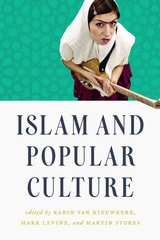
Islam and Popular Culture
Edited by Karin van Nieuwkerk, Mark LeVine, and Martin Stokes
University of Texas Press, 2016
Popular culture serves as a fresh and revealing window on contemporary developments in the Muslim world because it is a site where many important and controversial issues are explored and debated. Aesthetic expression has become intertwined with politics and religion due to the uprisings of the “Arab Spring,” while, at the same time, Islamist authorities are showing increasingly accommodating and populist attitudes toward popular culture. Not simply a “westernizing” or “secularizing” force, as some have asserted, popular culture now plays a growing role in defining what it means to be Muslim.
With well-structured chapters that explain key concepts clearly, Islam and Popular Culture addresses new trends and developments that merge popular arts and Islam. Its eighteen case studies by eminent scholars cover a wide range of topics, such as lifestyle, dress, revolutionary street theater, graffiti, popular music, poetry, television drama, visual culture, and dance throughout the Muslim world from Indonesia, Africa, and the Middle East to Europe. The first comprehensive overview of this important subject, Islam and Popular Culture offers essential new ways of understanding the diverse religious discourses and pious ethics expressed in popular art productions, the cultural politics of states and movements, and the global flows of popular culture in the Muslim world.
Palestine, Israel, and the Politics of Popular Culture
Rebecca L. Stein and Ted Swedenburg, eds.
Duke University Press, 2005
The volume is interdisciplinary, including the work of anthropologists, historians, sociologists, political scientists, ethnomusicologists, and Americanist and literary studies scholars. Contributors examine popular music of the Palestinian resistance, ethno-racial “passing” in Israeli cinema, Arab-Jewish rock, Euro-Israeli tourism to the Arab Middle East, Internet communities in the Palestinian diaspora, café culture in early-twentieth-century Jerusalem, and more. Together, they suggest new ways of conceptualizing Palestinian and Israeli political culture.
Contributors. Livia Alexander, Carol Bardenstein, Elliott Colla, Amy Horowitz, Laleh Khalili, Mary Layoun, Mark LeVine, Joseph Massad, Melani McAlister, Ilan Pappé, Rebecca L. Stein, Ted Swedenburg, Salim Tamari

Sound Fury
PoemsMark Levine
University of Iowa Press, 2022

Travels of Marco
Mark Levine
Four Way Books, 2016