Results by title
4 books match the query 'League of Nations'

A Violent Peace
Media, Truth, and Power at the League of NationsCarolyn N. Biltoft
University of Chicago Press, 2021
An exploration of instability in information systems, the allure of fascism, and the contradictions at the heart of a global modernity, A Violent Peace paints a rich portrait of the emergence of the age of information—and all its attendant problems.
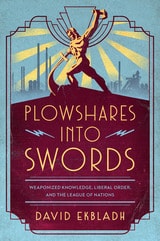
Plowshares into Swords
Weaponized Knowledge, Liberal Order, and the League of NationsDavid Ekbladh
University of Chicago Press, 2022
In Plowshares into Swords, David Ekbladh recaptures the power of knowledge and information developed between World War I and World War II by an international society of institutions and individuals committed to liberal international order and given focus by the League of Nations in Geneva. That information and analysis revolutionized critical debates in a world in crisis. In doing so, Ekbladh transforms conventional understandings of the United States’ postwar hegemony, showing that important elements of it were profoundly influenced by ideas that emerged from international exchanges. The League’s work was one part of a larger transnational movement that included the United States and which saw the emergence of concepts like national income, gross domestic product, and other attempts to define and improve the standards of living, as well as new approaches to old questions about the role of government. Forged as tools for peace these ideas were beaten into weapons as World War II threatened. Ekbladh recounts how, though the US had never been a member of the organization, vital parts of the League were rescued after the fall of France in 1940 and given asylum at the Institute for Advanced Study in Princeton. However, this presence in the US is just one reason its already well-regarded economic analyses and example were readily mobilized by influential American and international figures for an Allied “war of ideas,” plans for a postwar world, and even blueprints for the new United Nations. How did this body of information become so valuable? As Ekbladh makes clear, the answer is that information and analysis themselves became crucial currencies in global affairs: to sustain a modern, liberal global order, a steady stream of information about economics, politics, and society was, and remains, indispensable.
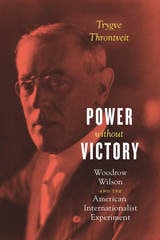
Power without Victory
Woodrow Wilson and the American Internationalist ExperimentTrygve Throntveit
University of Chicago Press, 2017
In Power without Victory, Trygve Throntveit argues that there is more to the story of Wilson than these sad truths. Throntveit makes the case that Wilson was not a “Wilsonian,” as that term has come to be understood, but a principled pragmatist in the tradition of William James. He did not seek to stamp American-style democracy on other peoples, but to enable the gradual development of a genuinely global system of governance that would maintain justice and facilitate peaceful change—a goal that, contrary to historical tradition, the American people embraced. In this brilliant intellectual, cultural, and political history, Throntveit gives us a new vision of Wilson, as well as a model of how to think about the complex relationship between the world of ideas and the worlds of policy and diplomacy.

The Collected Works of William Howard Taft, Volume VII
Taft Papers on League of NationsFrank X. Gerrity
Ohio University Press, 2003
Eager to turn the congressional election of 1918 into a confirmation of his foreign policy, President Woodrow Wilson was criticized for abandoning the spirit of the popular slogan “Politics adjourned!”
His predecessor, William Howard Taft, found Wilson difficult to deal with and took issue with his version of the League of Nations, which Taft felt was inferior to the model proposed by the League to Enforce Peace. Rather than join the massive Republican opposition to the Treaty of Versailles, however, Taft instead supported Wilson’s controversial decision to travel to Paris as the head of the American peace delegation, and he defended the critical tenth article in the covenant, which detractors saw as a surrender of American sovereignty. He also counseled Wilson to insert a clause concerning the Monroe Doctrine that would pacify the Senate’s group of “reservationists,” whose votes were essential to approval of the treaty.
Volume VII in The Collected Works of William Howard Taft consists of the Taft Papers on League of Nations originally published in 1920. This is a collection ofTaft’s speeches, newspaper articles, and complementary documents that reflect his consistent support for a league of nations and, eventually, for the Covenant of the League of Nations emanating from the Paris Peace Conference.
Although the failure of the treaty and its League of Nations can probably be laid at the feet of an obstinate Wilson and a wily Henry Cabot Lodge, William Howard Taft can be credited with rising above partisanship to emerge as the League’s most consistent supporter.
As in the rest of the Collected Works, Taft Papers on League of Nations provides a window on the machinations surrounding some of the most significant decisions of the era.