Results by title
10 books match the query 'Learning, Psychology of'
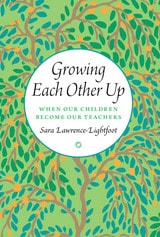
Growing Each Other Up
When Our Children Become Our TeachersSara Lawrence-Lightfoot
University of Chicago Press, 2016
With Growing Each Other Up, Macarthur Prize–winning sociologist and educator Sara Lawrence-Lightfoot offers an intimately detailed, emotionally powerful account of that experience. Building her book on a series of in-depth interviews with parents around the country, she offers a counterpoint to the usual parental development literature that mostly concerns the adjustment of parents to their babies’ rhythms and the ways parents weather the storms of their teenage progeny. The focus here is on the lessons emerging adult children, ages 15 to 35, teach their parents. How are our perspectives as parents shaped by our children? What lessons do we take from them and incorporate into our worldviews? Just how much do we learn—often despite our own emotionally fraught resistance—from what they have seen of life that we, perhaps, never experienced? From these parent portraits emerges the shape of an education composed by young adult children—an education built on witness, growing, intimacy, and acceptance.
Growing Each Other Up is rich in the voices of actual parents telling their own stories of raising children and their children raising them; watching that fundamental connection shift over time. Parents and children of all ages will recognize themselves in these evocative and moving accounts and look at their own growing up in a revelatory new light.
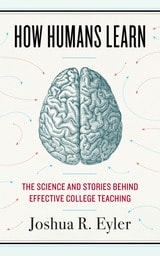
How Humans Learn
The Science and Stories behind Effective College TeachingJoshua R. Eyler
West Virginia University Press, 2018
Even on good days, teaching is a challenging profession. One way to make the job of college instructors easier, however, is to know more about the ways students learn. How Humans Learn aims to do just that by peering behind the curtain and surveying research in fields as diverse as developmental psychology, anthropology, and cognitive neuroscience for insight into the science behind learning.
The result is a story that ranges from investigations of the evolutionary record to studies of infants discovering the world for the first time, and from a look into how our brains respond to fear to a reckoning with the importance of gestures and language. Joshua R. Eyler identifies five broad themes running through recent scientific inquiry—curiosity, sociality, emotion, authenticity, and failure—devoting a chapter to each and providing practical takeaways for busy teachers. He also interviews and observes college instructors across the country, placing theoretical insight in dialogue with classroom experience.

Informed Learning
Christine Bruce
Assoc of College & Research Libraries, 2011
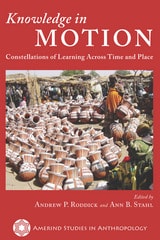
Knowledge in Motion
Constellations of Learning Across Time and PlaceEdited by Andrew P. Roddick and Ann B. Stahl
University of Arizona Press, 2019
In the last twenty-five years, scholars from a number of disciplines have explored “situated learning,” specifically investigating how learning relates to social reproduction and daily life. In Knowledge in Motion, contributors focus on learning through time and at a variety of scales, particularly as they relate to power and politics, with implications for emergent communities and constellations of practice.
This volume brings together archaeologists, historians, and cultural anthropologists to examine communities engaged in a range of learning practices around the globe, from Africa to the Americas. Contributors draw on the growing interdisciplinary scholarship on situated learning to explore those processes in relation to power and broader forces that shape knowledge during times of turbulent change.
Enriching the diversity of regions and disciplines, Knowledge in Motion focuses on how learning, knowledge transmission, and the emergent qualities of communities and constellations of practice are shaped by changing spheres of interaction or other unstable events and influences. The contributions forge productive theories and methodologies for exploring situated learning and its broad-ranging outcomes.
Notes on the Heart
Affective Issues in the Writing ClassroomSusan H. McLeod
Southern Illinois University Press, 1997
It has long been recognized that affect (that is, the noncognitive aspect of mental activity) plays a large role in writing and in learning to write. According to Susan H. McLeod, however, the model that has been most used for empirical research on the writing process is based on cognitive psychology and does not take into account affective phenomena. Nor does the social constructionist view of the writing process acknowledge the affective realm except in a very general way. To understand the complete picture, McLeod insists, we need to explore how cognitive, affective, and social elements interact as people write.
In this book, McLeod follows a group of students through a semester of writing assignments, tracking the students’ progress and examining the affective elements relevant to their writing. To facilitate future discussion of these phenomena, McLeod also provides suggested definitions for terms in the affective domain.
In a very real sense, this book is the result of a collaboration of three Susans: Susan McLeod, who researched and wrote the book; Sue Hallett, an instructor in Washington State University’s composition program whose classes McLeod observed and who helped provide much of the data; and Susan Parker, a graduate student who observed Hallett’s class and who ran a tutorial connected to that class. To provide a narrative structure, McLeod and her two collaborators have constructed a simulated semester, conflating the year and a half of the study into one semester and creating a class that is a composite drawn from seven classrooms over three semesters.
Although philosophers have had much to say about the affective domain, Notes on the Heart is based for the most part on research from the social sciences. Discussions of pedagogy, while meant to have practical value, are suggestive rather than prescriptive. The goal is to help teachers see their practice in new way.
Teachers will be particularly interested in McLeod’s discussion of teacher affect/effect. This section examines both the issue of the "Pygmalion effect" (students becoming better because the teacher believes they are) and perhaps the more common opposite, the "golem effect" (students becoming less capable because their teachers view them that way).

Reflective Teaching, Effective Learning
Instructional Literacy for Library EducatorsChar Booth
American Library Association, 2011
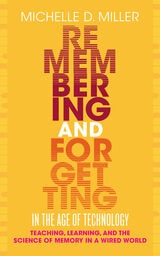
Remembering and Forgetting in the Age of Technology
Teaching, Learning, and the Science of Memory in a Wired WorldMichelle D Miller
West Virginia University Press, 2022
Human minds are made of memories, and today those memories have competition. Biological memory capacities are being supplanted, or at least supplemented, by digital ones, as we rely on recording—phone cameras, digital video, speech-to-text—to capture information we’ll need in the future and then rely on those stored recordings to know what happened in the past. Search engines have taken over not only traditional reference materials but also the knowledge base that used to be encoded in our own brains. Google remembers, so we don’t have to. And when we don’t have to, we no longer can. Or can we?
Remembering and Forgetting in the Age of Technology offers concise, nontechnical explanations of major principles of memory and attention—concepts that all teachers should know and that can inform how technology is used in their classes. Teachers will come away with a new appreciation of the importance of memory for learning, useful ideas for handling and discussing technology with their students, and an understanding of how memory is changing in our technology-saturated world.
State Learning and International Change
Andrew Farkas
University of Michigan Press, 1998
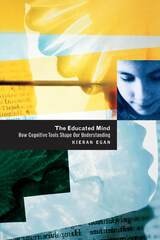
The Educated Mind
How Cognitive Tools Shape Our UnderstandingKieran Egan
University of Chicago Press, 1997
"A carefully argued and readable book. . . . Egan proposes a radical change of approach for the whole process of education. . . . There is much in this book to interest and excite those who discuss, research or deliver education."—Ann Fullick, New Scientist
"A compelling vision for today's uncertain educational system."—Library Journal
"Almost anyone involved at any level or in any part of the education system will find this a fascinating book to read."—Dr. Richard Fox, British Journal of Educational Psychology
"A fascinating and provocative study of cultural and linguistic history, and of how various kinds of understanding that can be distinguished in that history are recapitulated in the developing minds of children."—Jonty Driver, New York Times Book Review
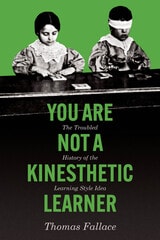
You Are Not a Kinesthetic Learner
The Troubled History of the Learning Style IdeaThomas Fallace
University of Chicago Press, 2025
The widely embraced notion that we all process information in one of three distinct modes—visual, auditory, or kinesthetic—has informed educational practices for decades. In recent years, however, numerous studies have questioned the effectiveness of aligning instruction with the alleged learning styles of individual students. So, why is it still commonplace in the literature on beneficial teaching at all levels of education?
In You Are Not a Kinesthetic Learner: The Troubled History of a Dangerous Idea, historian Thomas Fallace traces the origins, evolution, and history of the learning style idea, demonstrating its relationship to a legacy of unequal education for children of color. Fallace argues that the research supporting the learning style idea was problematic from its inception in the 1910s and that it was used to label and justify a diminished curriculum for many Black and Latine students, whose cultural differences were perceived as weaknesses. In recent years, numerous empirical studies have not found the approach to be effective. This fascinating history clearly shows the danger of sorting and labeling students with permanent style identities and makes a strong case for removing learning styles as the basis for any educators’ instructional toolkit.
The first book-length history of learning styles, You Are Not a Kinesthetic Learner encourages us all to consider the research, be open to future developments and updates, and question even our most intuitive assumptions.