Results by title
4 books match the query 'Lectures and lecturing'
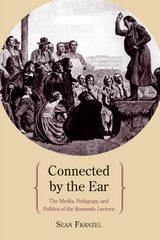
Connected by the Ear
The Media, Pedagogy, and Politics of the Romantic LectureSean Franzel
Northwestern University Press, 2013
In this innovative new study, Sean Franzel charts the concurrent emergence of German Romantic pedagogy, the modern research university, and modern visions of the politically engaged scholar. At the heart of the pedagogy of Immanuel Kant, Johann Gottlieb Fichte, K. P. Moritz, A. W. Schlegel, Adam Müller, and others was the lecture, with its ability to attract listeners and to model an ideal discursive community, reflecting an era of revolution, reform, and literary, philosophical, and scientific innovation.
Along with exploring the striking preoccupation of Romantic thinkers with the lecture and with its reverberations in print, Franzel argues that accounts of scholarly speech from this period have had a lasting impact on how the pedagogy, institutions, and medial manifestations of modern scholarship continue to be understood.
"Sean Franzel’s archaeology illuminates both the bourgeois public sphere and discourse network 1800 by showing the romantic lecture to be the key cultural form in a pivotal moment of German intellectual history, a history long obsessed with the mediation of oral discourse and written text."—John Durham Peters, author of Speaking into the Air
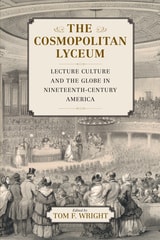
The Cosmopolitan Lyceum
Lecture Culture and the Globe in Nineteenth-Century AmericaTom F. Wright
University of Massachusetts Press, 2013
From the 1830s to the 1900s, a circuit of lecture halls known as the “lyceum movement” flourished across the United States. At its peak, up to a million people a week regularly attended talks in local venues, captivated by the words of visiting orators who spoke on an extensive range of topics. The movement was a major intellectual and cultural force of this nation-building period, forming the creative environment of writers and public figures such as Frederic Douglass, Ralph Waldo Emerson, Anna Dickinson, and Mark Twain.
The phenomenon of the lyceum has commonly been characterized as inward looking and nationalistic. Yet as this collection of essays reveals, nineteenth-century audiences were fascinated by information from around the globe, and lecturers frequently spoke to their fellow Americans of their connection to the world beyond the nation and helped them understand “exotic” ways of life. Never simple in its engagement with cosmopolitan ideas, the lyceum provided a powerful public encounter with international currents and crosscurrents, foreshadowing the problems and paradoxes that continue to resonate in our globalized world.
This book offers a major reassessment of this important cultural phenomenon, bringing together diverse scholars from history, rhetoric, and literary studies. The twelve essays use a range of approaches, cover a wide chronological timespan, and discuss a variety of performers both famous and obscure. In addition to the volume editor, contributors include Robert Arbour, Thomas Augst, Susan Branson, Virginia Garnett, Peter Gibian, Sara Lampert, Angela Ray, Evan Roberts, Paul Stob, Mary Zboray, and Ronald Zboray.
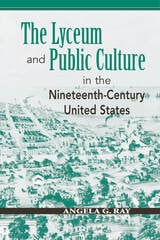
The Lyceum and Public Culture in the Nineteenth-Century United States
Angela G. Ray
Michigan State University Press, 2005
Angela Ray provides a refreshing new look at the lyceum lecture system as it developed in the United States from the 1820s to the 1880s. She argues that the lyceum contributed to the creation of an American "public" at a time when the country experienced a rapid change in land area, increasing immigration, and a revolution in transportation, communication technology, and social roles.
The history of the lyceum in the nineteenth century illustrates a process of expansion, diffusion, and eventual commercialization. In the late 1820s, a politically and economically dominant culture—the white Protestant northeastern middle class—institutionalized the practice of public debating and public lecturing for education and moral uplift. In the 1820s and 1830s, the lyceum was characterized by organized groups in cities and towns, particularly in the Northeast and the Old Northwest (now the Midwest). These groups were established to promote debate, to create a setting for study, and to provide a forum for members’ lecturing. By the 1840s and 1850s, however, most lyceums concentrated on the sponsorship of public lectures, presented for institutional profit as well as public instruction and entertainment. Eventually, lyceum lectures became a commercial enterprise and desirable platform for celebrities who wished to expand their incomes from lecturing.
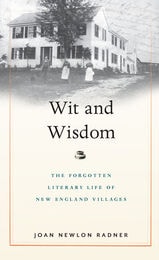
Wit and Wisdom
The Forgotten Literary Life of New England VillagesJoan Newlon Radner
University of Massachusetts Press, 2023
The lyceum movement gained momentum in the decades preceding the Civil War, presenting members with the opportunity to participate in literary life and engage with the issues of the day. While urban lyceums played host to a who’s who of nineteenth-century intellectual life, literary societies also cropped up in thousands of villages across the nation, acting as influential sites of learning, creativity, and community engagement. In rural New England, ordinary men and women, farmers and intelligentsia, selectmen and schoolchildren came together to write and perform poetry and witty parodies and debate a wide range of topics, from women’s rights and temperance to slavery, migration, and more.
Wit and Wisdom takes readers inside this long-forgotten tradition, providing new access to the vibrant voices, surprising talents, and understated humor on display on many a cold winter’s night. Having uncovered dozens of handwritten newspapers produced by village lyceums across Maine, New Hampshire, Vermont, and Massachusetts, Joan Newlon Radner proves that these close-knit groups offered a vital expression of the beliefs, ambitions, and resilience of rural New Englanders.