Results by title
2 books match the query 'Leeds'
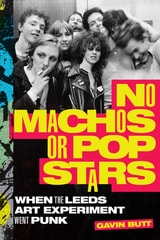
No Machos or Pop Stars
When the Leeds Art Experiment Went PunkGavin Butt
Duke University Press, 2022
After punk’s arrival in 1976, many art students in the northern English city of Leeds traded their paintbrushes for guitars and synthesizers. In bands ranging from Gang of Four, Soft Cell, and Delta 5 to the Mekons, Scritti Politti, and Fad Gadget, these artists-turned-musicians challenged the limits of what was deemed possible in rock and pop music. Taking avant-garde ideas to the record-buying public, they created Situationist antirock and art punk, penned deconstructed pop ditties about Jacques Derrida, and took the aesthetics of collage and shock to dark, brooding electro-dance music. In No Machos or Pop Stars Gavin Butt tells the fascinating story of the post-punk scene in Leeds, showing how England’s state-funded education policy brought together art students from different social classes to create a fertile ground for musical experimentation. Drawing on extensive interviews with band members, their associates, and teachers, Butt details the groups who wanted to dismantle both art world and music industry hierarchies by making it possible to dance to their art. Their stories reveal the subversive influence of art school in a regional music scene of lasting international significance.
[more]

Popular Music in Leeds
Histories, Heritage, People and PlacesEdited by Brett Lashua, Karl Spracklen, and Kitty Ross
Intellect Books, 2023
A groundbreaking study of music and musical history in Leeds.
This is the first scholarly volume to focus on popular music in Leeds. It delves into the rich musical history of Leeds and its long tradition of vibrant venues, nightclubs, dance halls, pubs, and other sites of musical entertainment. The contributors use the popular music of Leeds to exemplify and inform understandings of broader cultural and urban changes, the social and historical significance of music as mass media; music and migration; music, racialization, and social equity; and industrial decline, deindustrialization, neoliberalism, and the rise of the twenty-four-hour city. Charting moments of stark musical politicization and de-politicization, while also tracing arguments about heritagizing popular music within discussions about music’s place in museums and in the urban economy, this book contributes to debates about why music matters, has mattered, and continues to matter in Leeds and beyond.
This is the first scholarly volume to focus on popular music in Leeds. It delves into the rich musical history of Leeds and its long tradition of vibrant venues, nightclubs, dance halls, pubs, and other sites of musical entertainment. The contributors use the popular music of Leeds to exemplify and inform understandings of broader cultural and urban changes, the social and historical significance of music as mass media; music and migration; music, racialization, and social equity; and industrial decline, deindustrialization, neoliberalism, and the rise of the twenty-four-hour city. Charting moments of stark musical politicization and de-politicization, while also tracing arguments about heritagizing popular music within discussions about music’s place in museums and in the urban economy, this book contributes to debates about why music matters, has mattered, and continues to matter in Leeds and beyond.
[more]