Results by title
8 books match the query 'Legal'

A Naked Singularity
A NovelSergio De La Pava
University of Chicago Press, 2012
The mind-bending, brilliant, often hilarious PEN Award-winning classic novel of justice, the law, and the brutal gap between the two.
A Naked Singularity tells the story of Casi, a child of Colombian immigrants who lives in Brooklyn and works in Manhattan as a public defender--one who, tellingly has never lost a trial. Never. In the book, we watch what happens when his sense of justice and even his sense of self begin to crack--and how his world then slowly devolves. It’s a huge, ambitious novel clearly in the vein of DeLillo, Foster Wallace, Pynchon, and even Melville, and it's told in a distinct, frequently hilarious voice, with a striking human empathy at its center. Its panoramic reach takes readers through crime and courts, immigrant families and urban blight, media savagery and media satire, scatology and boxing, and even a breathless heist worthy of any crime novel. If InfiniteJest stuck a pin in the map of mid-90s culture and drew our trajectory from there, A Naked Singularity does the same for the feeling of surfeit, brokenness, and exhaustion that permeates our civic and cultural life today. In the opening sentence of William Gaddis’s A Frolic of His Own, a character sneers, "Justice? You get justice in the next world. In this world, you get the law." A Naked Singularity reveals the extent of that gap, and lands firmly on the side of those who are forever getting the law.
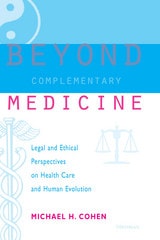
Beyond Complementary Medicine
Legal and Ethical Perspectives on Health Care and Human EvolutionMichael H. Cohen
University of Michigan Press, 2000
Integration of divergent philosophies, paradigms, and practices requires responsible investigation, informed judgment, and open-minded yet critical study and analysis of various systems of healing. Michael H. Cohen offers providers and policymakers vitally important information by addressing questions such as credentialing, malpractice, informed consent, and liability for referrals. He describes both practical strategies for minimizing liability, as well as the necessary future evolution of the legal and regulatory structure.
Cohen also probes uncharted ethical and bioethical issues in complementary medicine and integrative health care. He further explores the connection between law, medicine, and spirituality and the role of this connection in human evolution. The book's range mirrors the integrative process itself, a process of grappling with, and meaningfully assimilating, disparate traditions and unfamiliar ways of thinking about the significance of health, body, and being.
Beyond Complementary Medicine is required reading for anyone involved in health care, including executives, insurers, managed care organizations, attorneys, ethicists, and lawmakers; physicians integrating complementary and alternative therapies; complementary and alternative medicine practitioners; medical schools, law schools, and educational institutions offering programs in health care, public health, and complementary therapies; companies manufacturing herbs and dietary supplements; and most of all, patients and their families.
Michael H. Cohen is President of the Institute for Integrative and Energy Medicine, a nonprofit organization in health care policy, ethics, and legal and regulatory affairs, and an attorney with an international practice in integrative health care.
Chilling Effect
A Lucinda Hayes MysteryMarianne Wesson
University Press of Colorado, 2004
When attorney Lucinda Hayes reluctantly agrees to represent the mother of a brutally slain child, she must convince the court that the makers of a pornographic film are liable for the murder. As the case unfolds, Lucinda calls upon all her personal strength and legal talent, facing down her own ghosts as well as the powerful entertainment industry's star lawyers.
In Chilling Effect, Wesson affirms the power of free speech to inspire the best and the worst human behavior and explores the tension between freedom and accountability
Color of Law
A NovelDavid Milofsky
University Press of Colorado, 2000
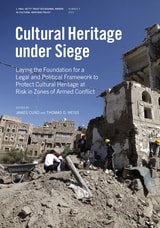
Cultural Heritage Under Siege
Laying the Foundation for a Legal and Political Framework to Protect Cultural Heritage at Risk in Zones of Armed ConflictJames Cuno
J. Paul Getty Trust, The, 2020
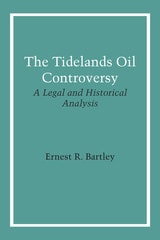
The Tidelands Oil Controversy
A Legal and Historical AnalysisBy Ernest R. Bartley
University of Texas Press, 1953
This study is not written from the narrow perspective of “Who gets the oil?” It is a thoughtful probing of an issue—the ownership and control of the submerged soils of the marginal sea—the outcome of which may go far to determine the division of powers between states and nation under the American federal system.
American constitutional law, international law, theory of federalism, American politics, the machinations of pressure groups, use of propaganda techniques, and issues of social and economic policy—all these features of American government and many more are inherent in the controversy.
In 1947, in a precedent-making decision, the Supreme Court enunciated the principle that the federal government, not the states, has “paramount rights in and power over” the marginal seas which border the coastal states, and has “full dominion over the resources under that water area, including oil.”
For more than 150 years the littoral states had exercised uncontested jurisdiction and ownership over the marginal-sea area, subject only to the powers specifically granted to the national government by the Constitution. The states had regulated the fisheries within the three-mile limit, applying state laws to vessels licensed under federal statutes. Long before oil possibilities were thought of, they had granted or leased areas in the marginal seas to private persons and corporations for purposes of land reclamation and harbor development, dredging for sand and gravel, development of oyster beds, and similar projects. These property rights can far exceed in value the wealth to be derived from petroleum.
A just settlement of the issue, says the author, calls for restoration to the states of control of the marginal sea out to their historical boundaries—three miles in most cases; three leagues, or ten and one-half miles, in the case of Texas and the west coast of Florida.
This study is based upon thorough investigation of all literature on the subject and personal interviews and correspondence with leaders on both sides of the controversy.

The Wife of Martin Guerre
Janet Lewis
Ohio University Press, 2013
In this new edition of Janet Lewis’s classic short novel, The Wife of Martin Guerre, Swallow Press executive editor Kevin Haworth writes that Lewis’s story is “a short novel of astonishing depth and resonance, a sharply drawn historical tale that asks contemporary questions about identity and belonging, about men and women, and about an individual’s capacity to act within an inflexible system.” Originally published in 1941, The Wife of Martin Guerre has earned the respect and admiration of critics and readers for over sixty years.
Based on a notorious trial in sixteenth-century France, this story of Bertrande de Rols is the first of three novels making up Lewis’s Cases of Circumstantial Evidence suite (the other two are The Trial of Sören Qvist and The Ghost of Monsieur Scarron).
Swallow Press is delighted and honored to offer readers beautiful new editions of all three Cases of Circumstantial Evidence novels, each featuring a new introduction by Kevin Haworth.
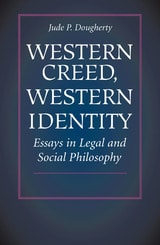
Western Creed, Western Identity
Essays in Legal and Social PhilosophyJude P. Dougherty
Catholic University of America Press, 2000