Results by title
4 books match the query 'Legal Services'
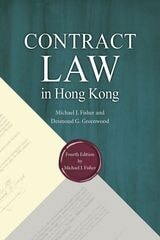
Contract Law in Hong Kong
Michael J. Fisher and Desmond G. Greenwood
Hong Kong University Press, 2024
A new edition of the textbook for Hong Kong contract law students.
This fourth edition of Contract Law in Hong Kong is the most comprehensive contemporary textbook on Hong Kong contract law written primarily for law students. The sixteen chapters of the book cover all basic contract concepts in a reader-friendly style and make ample use of case illustrations, including over 200 new cases since the third edition. The book deals with the core areas of contract law. The new legislative rules, such as the Contract Ordinance regarding the rights of third parties, have also been covered.
The first two chapters introduce the major themes and explain the multiple sources of law in Hong Kong. The subsequent thirteen chapters cover the formation of a valid contract, its contents, "vitiating" elements, the consequences of illegality, the termination of contracts, and remedies for breach of contract. The book concludes with an explanation of the doctrine of privity and the legislative reform of the operation of privity in Hong Kong. Particular attention is given to what makes Hong Kong law different from other common law jurisdictions, and to the continuing significance of English case law in Hong Kong.
[more]

International Handbook on Clinical Tax Education
Edited by Amy Lawton
University of London Press, 2023
A handbook for establishing tax clinics.
Tax clinics, a government-funded initiative to help people who may not be able to afford professional advice and representation with their tax affairs, have existed in the United States since the early 1990s. Now they are being established throughout the world, particularly in Australia, the UK, and Ireland. This practical handbook explores the benefits that a clinical tax education can have and equips readers with the tools needed to start a clinical tax project. It investigates the ways in which tax clinics can both educate and remedy tax positions for local communities in supporting those without access to the tax profession to understand their tax liabilities. It also explores the higher education setting, in which community tax projects rely on students for their success, offering them the benefits of an alternative learning environment in tax and experience in the tax profession while studying. Beyond identifying the practical benefits, this handbook uses learning from tax clinics to uncover the burdens and impacts of tax policy on more marginalized taxpayers, and how policymakers can tailor tax systems to overcome them.
Tax clinics, a government-funded initiative to help people who may not be able to afford professional advice and representation with their tax affairs, have existed in the United States since the early 1990s. Now they are being established throughout the world, particularly in Australia, the UK, and Ireland. This practical handbook explores the benefits that a clinical tax education can have and equips readers with the tools needed to start a clinical tax project. It investigates the ways in which tax clinics can both educate and remedy tax positions for local communities in supporting those without access to the tax profession to understand their tax liabilities. It also explores the higher education setting, in which community tax projects rely on students for their success, offering them the benefits of an alternative learning environment in tax and experience in the tax profession while studying. Beyond identifying the practical benefits, this handbook uses learning from tax clinics to uncover the burdens and impacts of tax policy on more marginalized taxpayers, and how policymakers can tailor tax systems to overcome them.
[more]
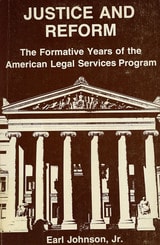
Justice and Reform
The Formative Years of the OEO Legal Services ProgramEarl Johnson
Russell Sage Foundation, 1974
Justice and Reform is the first study of the origins, philosophy, creation, management, and impact of the Office of Economic Opportunity Legal Services Program. As such, it clearly and concisely describes the Program's role both as an instrument of equal justice and as a strategy for overcoming poverty. Timely, important, and unique, it tells the story behind the OEO Legal Services Program—an endeavor that has been called both the most successful element of the war on poverty and the most stimulating development to occur in the American legal profession during the Twentieth Century. The early chapters in the book reveal the nature and motivations of the two groups which joined to create the Program: the conservative, American Bar Association sponsored 89-year-old legal aid movement and the Ford Foundation-financed neighborhood lawyer experiments that started in 1962 under the direction of young activist lawyers. Why they merged and how they merged forms the background for a description of how the partners persuaded the OEO bureaucracy to start a legal services program and convinced over 200 communities (including most large cities) to set up a federally funded legal assistance agency. Legal Services Program established policy, how it settled upon "law reform" as the priority function of the Program, how it preserved the integrity of its policies within OEO, and how it caused its grantees to engage in law reform. Chapter 8 evaluates, for the first time, the economic, political, and social impact of the Program as of 1972. The final chapter speculates on the future of government-subsidized legal assistance in the United States from the perspective of the OEO program's twin goals of equal justice and social reform.
[more]
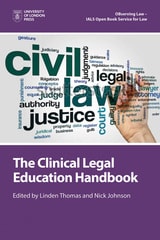
The Clinical Legal Education Handbook
Edited by Linden Thomas and Nicholas Johnson
University of London Press, 2020
The Clinical Legal Education Handbook is a practical resource and guide for those engaged in the design and delivery of clinical legal education programs at university law schools. The Handbook offers direction on how to establish and run student law clinics, sets out guidance on both the pedagogical and regulatory considerations involved in the delivery of clinical programs, and introduces the existing body of research and scholarship on Clinical Legal Education (CLE).
CLE has become an increasingly popular method of legal education in recent years. By the end of 2013 at least 70% of all law schools in the United Kingdom were delivering some type of CLE, and 25% of these offered credit-bearing CLE programs. It is almost certain that this number will increase in the years to come with the advent of the forthcoming Solicitors’ Qualifying Examination, which will allow time spent volunteering in a student law clinic to count as “qualifying work experience.” However, despite the popularity of CLE, there is currently very little information available about the best practices for setting up and delivering these programs.
The Handbook seeks to remedy this gap, offering an invaluable resource to staff involved in running law clinics, both as a practical guide to establishing and running their programs and as a teaching resource and recommended text on clinical programs. It will also act as a resource for clinical legal education researchers who wish to engage in regulatory, pedagogic, and legal service delivery research in this area.
[more]