Results by title

7 books match the query 'Legal assistance to the poor'
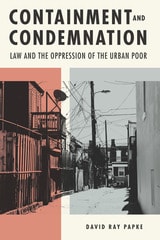
cover of Containment and Condemnation: Law and the Oppression of the Urban Poor

Containment and Condemnation

Law and the Oppression of the Urban Poor

David Ray Papke

Michigan State University Press, 2019
The populations of American cities have always included poor people, but the predicament of the urban poor has worsened over time. Their social capital, that is, the connections and organizations that traditionally enabled them to form communities, has shredded. Economically comfortable Americans have come to increasingly care less about the plight of the urban poor and to think of them in terms of “us and them.” Considered lazy paupers in the early nineteenth century, the urban poor came to be seen as a violent criminal “underclass” by the end of the twentieth. Living primarily in the nation’s deindustrialized inner cities and making up nearly 15 percent of the population, today’s urban poor are oppressed people living in the midst of American affluence. This book examines how law works for, against, and with regard to the urban poor, with “law” being understood broadly to include not only laws but also legal proceedings and institutions. Law is too complicated and variable to be seen as simply a club used to beat down the urban poor, but it does work largely in negative ways for them. An essential text for both law students and those drawn to areas of social justice, Containment and Condemnation shows how law helps create, expand, and perpetuate contemporary urban poverty.
[more]
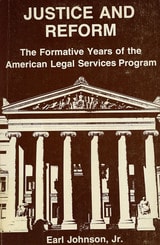
cover of Justice and Reform: The Formative Years of the OEO Legal Services Program

Justice and Reform

The Formative Years of the OEO Legal Services Program

Earl Johnson

Russell Sage Foundation, 1974

Justice and Reform is the first study of the origins, philosophy, creation, management, and impact of the Office of Economic Opportunity Legal Services Program. As such, it clearly and concisely describes the Program's role both as an instrument of equal justice and as a strategy for overcoming poverty. Timely, important, and unique, it tells the story behind the OEO Legal Services Program—an endeavor that has been called both the most successful element of the war on poverty and the most stimulating development to occur in the American legal profession during the Twentieth Century. The early chapters in the book reveal the nature and motivations of the two groups which joined to create the Program: the conservative, American Bar Association sponsored 89-year-old legal aid movement and the Ford Foundation-financed neighborhood lawyer experiments that started in 1962 under the direction of young activist lawyers. Why they merged and how they merged forms the background for a description of how the partners persuaded the OEO bureaucracy to start a legal services program and convinced over 200 communities (including most large cities) to set up a federally funded legal assistance agency. Legal Services Program established policy, how it settled upon "law reform" as the priority function of the Program, how it preserved the integrity of its policies within OEO, and how it caused its grantees to engage in law reform. Chapter 8 evaluates, for the first time, the economic, political, and social impact of the Program as of 1972. The final chapter speculates on the future of government-subsidized legal assistance in the United States from the perspective of the OEO program's twin goals of equal justice and social reform.
[more]
cover of Poor People's Lawyers in Transition

Poor People's Lawyers in Transition

Katz, Jack

Rutgers University Press, 1982
Jack Katz has written the first case study of legal assistance lawyers—commonly known as poverty lawyers—and their agencies. Focusing on legal services for the poor over the last 100 years in Chicago, the city with the most experienced large staff of poverty reform lawyers in the nation, Katz examines what organizational and personal experiences make these lawyers either passive or entrepreneurial in their drive for equal justice for the poor. This historical and participant-observation study traces the social foundations of the aspiration for equal justice. In the 1880s, when lawyers were first hired by organizations specifically to assist the poor, the legal status of poverty was virtually non-existent. Today the legal status of the poor is defined affirmatively in scores of statues, in masses of highly differentiated administrative regulations, and in a rich case law of judicial decisions made in the last 20 years. During the rise and fall of the Progressive era, throughout the Depression and the New Deal, in the midst of the explosive public activism of the Sixties, and even after the internment of the War on Poverty, legal assistance lawyers have worked progressively toward the legalization of poverty. Recently, a disturbing irony has appeared in this progress. Legal assistance lawyers, especially the most aggressive and professionally creative, have proven less successful in eliminating poverty than in reorganizing the poor into a formal social category. This category is systematically, comprehensively, and predictably defined by law, and administratively maintained by the state in segregation from the working and middle classes.
[more]
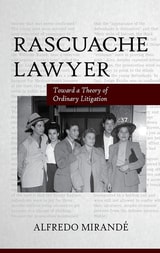
cover of Rascuache Lawyer: Toward a Theory of Ordinary Litigation

Rascuache Lawyer

Toward a Theory of Ordinary Litigation

Alfredo Mirandé

University of Arizona Press, 2011

Alfredo Mirandé, a sociology professor, Stanford Law graduate, and part-time pro bono attorney, represents clients who are rascuache—a Spanish word for “poor” or even “wretched”—and on the margins of society. For Mirandé, however, rascuache means to be “down but not out,” an underdog who is still holding its ground. Rascuache Lawyer offers a unique perspective on providing legal services to poor, usually minority, folks who are often just one short step from jail. Not only a passionate argument for rascuache lawyering, it is also a thoughtful, practical attempt to apply and test critical race theory—particularly Latino critical race theory—in day-to-day legal practice.

Every chapter presents an actual case from Mirandé’s experience (only the names and places have been changed). His clients have been charged with everything from carrying a concealed weapon, indecent exposure, and trespassing to attempted murder, domestic violence, and child abuse. Among them are recent Mexican immigrants, drug addicts, gang members, and the homeless. All of them are destitute, and many are victims of racial profiling. Some “pay” Mirandé with bartered services such as painting, home repairs, or mechanical work on his car. And Mirandé doesn’t always win their cases. But, as he recounts, he certainly works tirelessly to pursue all legal remedies.

Each case is presented as a letter to a fascinating (fictional) “Super Chicana” named Fermina Gabriel, who we are told is an accomplished lawyer, author, and singer. This narrative device allows the author to present his cases as if he were recounting them to a friend, drawing in the reader as a friend as well.

Bookending the individual cases, Mirandé’s introductions and conclusions offer a compelling vision of progressive legal practice grounded in rascuache lawyering.
[more]
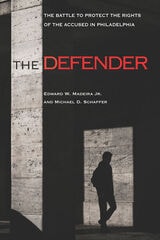
cover of The Defender: The Battle to Protect the Rights of the Accused in Philadelphia

The Defender

The Battle to Protect the Rights of the Accused in Philadelphia

Edward W. Madeira Jr. and Michael D. Schaffer

Temple University Press, 2020

Long before the Supreme Court ruled that impoverished defendants in criminal cases have a right to free counsel, Philadelphia’s public defenders were working to ensure fair trials for all. In 1934, when penniless defendants were routinely railroaded through the courts without ever seeing a lawyer, Philadelphia attorney Francis Fisher Kane helped create the Voluntary Defender Association, supported by charity and free from political interference, to represent poor people accused of crime. 

When the Supreme Court’s 1963 decision Gideonv. Wainwright mandated free counsel for indigent defendants, the Defender (as it is now known) became more essential than ever, representing at least 70 percent of those caught in the machinery of justice in the city. Its groundbreaking work in juvenile advocacy, homicide representation, death-row habeas corpus petitions, parole issues, and alternative sentencing has earned a national reputation.

In The Defender, Edward Madeira, past president of the Defender’s Board of Directors, and former Philadelphia Inquirer journalist Michael Schaffer chart the 80-plus-year history of the organization as it grew from two lawyers in 1934 to a staff of nearly 500 in 2015.

This is a compelling story about securing justice for those who need it most.
[more]
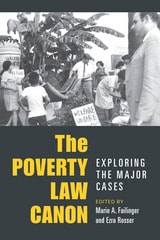
cover of The Poverty Law Canon: Exploring the Major Cases

The Poverty Law Canon

Exploring the Major Cases

Marie A. Failinger and Ezra Rosser, Editors

University of Michigan Press, 2016

The Poverty Law Canon takes readers into the lives of the clients and lawyers who brought critical poverty law cases in the United States. These cases involved attempts to establish the right to basic necessities, as well as efforts to ensure dignified treatment of welfare recipients and to halt administrative attacks on federal program benefit levels. They also confronted government efforts to constrict access to justice, due process, and rights to counsel in child support and consumer cases, social welfare programs, and public housing. By exploring the personal narratives that gave rise to these lawsuits as well as the behind-the-scenes dynamics of the Supreme Court, the text locates these cases within the social dynamics that shaped the course of litigation.
 
Noted legal scholars explain the legal precedent created by each case and set the case within its historical and political context in a way that will assist students and advocates in poverty-related disciplines in their understanding of the implications of these cases for contemporary public policy decisions in poverty programs. Whether the focus is on the clients, on the lawyers, or on the justices, the stories in The Poverty Law Canon illuminate the central legal themes in federal poverty law of the late 20th century and the role that racial and economic stereotyping plays in shaping American law.
 
[more]
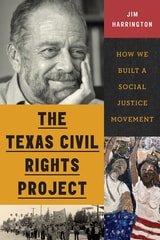
cover of The Texas Civil Rights Project: How We Built a Social Justice Movement

The Texas Civil Rights Project

How We Built a Social Justice Movement

Jim Harrington

University of Texas Press, 2025

Texas civil rights icon Jim Harrington recounts his lifelong fight for equality, winning major reforms for farmworkers and disabled Texans and helping build a movement for social justice.

Jim Harrington arrived in South Texas in 1973, ready to file class action lawsuits and “save the world.” Over the following fifty years, he built one of Texas’s key civil rights organizations and played an essential role in many of its greatest victories.

Harrington takes readers on his journey from a Midwest seminary to a United Farm Workers office in the Rio Grande Valley and on to founding the Texas Civil Rights Project. He fought for the rights of a wide range of Texans, bringing justice to victims of police brutality, injured farmworkers, silenced students, and people with disabilities excluded from full participation in society, building a movement for social justice, and a family, along the way. These major gains were tempered by heartbreaking losses, and Harrington recounts the difficult work of persevering in the face of injustice.

Framed by a foreword from Judge Lora Livingston and an afterword by Congressman Greg Casar, The Texas Civil Rights Project is at once a history of the struggle for equality over the last fifty years, a celebration of the individuals and grassroots organizations who fought hard to improve the lives of others, and a memoir of a singular force who pushed the Texas justice system to live up to its ideals.

[more]