Results by title
320 books match the query 'Legal status, laws, etc' and 38 start with a

A Body of One's Own
A Trans History of ArgentinaPatricio Simonetto
University of Texas Press, 2024
2026 Silver Medal for the Best LGBTQ+ Themed Book, Conference on Latin American History (CLAH)
2026 Honorable Mention, Book Award, Social History Society
2025 Best Book in Social Sciences Award, Southern Cone Section, Latin American Studies Association
2024 Sylvia Rivera Award in Transgender Studies, The Center for LGBTQ Studies at the Graduate Center, CUNY
A history of Argentina that examines how trans bodies were understood, policed, and shaped in a country that banned medically assisted gender affirmation practices and punished trans lives.
As a trans history of Argentina, a country that banned medically assisted gender affirmation practices and punished trans lives, A Body of One’s Own places the histories of trans bodies at the core of modern Argentinian history. Patricio Simonetto documents the lives of people who crossed the boundaries of gender from the early twentieth century to the present. Based on extensive archival research in public and community-based archives, this book explores the mainstream medical and media portrayals of trans or travesti people, the state policing of gender embodiment, the experiences of those transgressing the boundaries of gender, and the development of homemade technologies from prosthetics to the self-injection of silicone. A Body of One's Own explores how trans activists' challenges to the exclusionary effects of Argentina’s legal, cultural, social, and political cisgender order led to the passage of the Gender Identity Law in 2012. Analyzing the decisive yet overlooked impact of gender transformation in the formation of the nation-state, gender-belonging, and citizenship, this book ultimately shows that supposedly abstract struggles to define the shifting notions of "sex," citizenship, and nationhood are embodied material experiences.
A Contemporary History of Exclusion
The Roma Issue in Hungary from 1945 to 2015György Majtényi
Central European University Press, 2016
A Fateful Time
The Background And Legislative History Of The Indian Reorganization ActElmer R. Rusco
University of Nevada Press, 2026
The Indian Reorganization Act (IRA) of 1934 has been generally acknowledged as the most important statute affecting Native Americans after the General Allotment Act of 1887, and it is probably the most important single statute affecting Native Americans during the two-thirds of a century since its passage. Over half the Native governments in the contemporary U.S. are organized under its provisions or under separate statutes that parallel the IRA in major ways. Although the impact of the IRA has been widely studied and debated, no scholar until now has looked closely at the forces that shaped its creation and passage. Author Elmer Rusco spent over a decade of research in national and regional archives and other repositories to examine the legislative intent of the IRA, including the role of issues like the nature and significance of judge-made Indian law; the allotment policy and its relation to Indian self-government; the nature of Native American governments before the IRA; the views and actions of John Collier, commissioner of Indian Affairs and leader in the campaign to reform the nation’s Indian policy; and the influence of relations between the president and Congress during the second year of the New Deal. Rusco also discusses the role of conflicting ideologies and interests in this effort to expand the rights of Native Americans; the general ignorance of Native American concerns and policy on the part of legislators engaged in the writing and passage of the law; and the limited but crucial impact of Indian involvement in the struggle over the IRA.

A Ministry of Presence
Chaplaincy, Spiritual Care, and the LawWinnifred Fallers Sullivan
University of Chicago Press, 2014
In A Ministry of Presence, Winnifred Fallers Sullivan explores how chaplaincy works in the United States—and in particular how it sits uneasily at the intersection of law and religion, spiritual care, and government regulation. Responsible for ministering to the wandering souls of the globalized economy, the chaplain works with a clientele often unmarked by a specific religious identity, and does so on behalf of a secular institution, like a hospital. Sullivan's examination of the sometimes heroic but often deeply ambiguous work yields fascinating insights into contemporary spiritual life, the politics of religious freedom, and the never-ending negotiation of religion's place in American institutional life.
A New Type of Womanhood
Discursive Politics and Social Change in Antebellum AmericaNatasha Kirsten Kraus
Duke University Press, 2008
Enabling Kraus’s retelling of the 1850s woman’s rights movement is her theory of “structural aporias,” which takes the institutional structures of any particular society as fully imbricated with the force of language. Kraus reads the antebellum relations of womanhood, contract, property, the economy, and the nation as a fruitful site for analysis of the interconnected power of language, culture, and the law. She combines poststructural theory, particularly deconstructive approaches to discourse analysis; the political economic history of the antebellum era; and the interpretation of archival documents, including woman’s rights speeches, petitions, pamphlets, and convention proceedings, as well as state legislative debates, reports, and constitutional convention proceedings. Arguing that her method provides critical insight not only into social movements and cultural changes of the past but also of the present and future, Kraus concludes A New Type of Womanhood by considering the implications of her theory for contemporary feminist and queer politics.
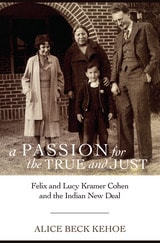
A Passion for the True and Just
Felix and Lucy Kramer Cohen and the Indian New DealAlice Beck Kehoe
University of Arizona Press, 2014
Kehoe argues that, due to anti-Semitism in 1930s America, Cohen could not speak for his legislation before Congress, and that Collier, an upper-class WASP, became the spokesman as well as the administrator. According to the author, historians of the Indian New Deal have not given due weight to Cohen’s work, nor have they recognized its foundation in his liberal secular Jewish culture. Both Felix and Lucy Cohen shared a belief in the moral duty of mitzvah, creating a commitment to the “true and the just” that was rooted in their Jewish intellectual and moral heritage, and their Social Democrat principles.
A Passion for the True and Just takes a fresh look at the Indian New Deal and the radical reversal of US Indian policies it caused, moving from ethnocide to retention of Indian homelands. Shifting attention to the Jewish tradition of moral obligation that served as a foundation for Felix and Lucy Kramer Cohen (and her professor Franz Boas), the book discusses Cohen’s landmark contributions to the principle of sovereignty that so significantly influenced American legal philosophy.
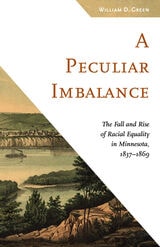
A Peculiar Imbalance
The Fall and Rise of Racial Equality in Minnesota, 1837–1869William D. Green
University of Minnesota Press, 2015
A Peculiar Imbalance is the little-known history of the black experience in Minnesota in the mid-1800s, a time of dramatic change in the region. William D. Green explains how, as white progressive politicians pushed for statehood, black men who had been integrated members of the community, owning businesses and maintaining good relationships with their neighbors, found themselves denied the right to vote or to run for office in those same communities.
As Minnesota was transformed from a wilderness territory to a state, the concepts of race and ethnicity and the distinctions among them made by Anglo-Americans grew more rigid and arbitrary. A black man might enjoy economic success and a middle-class lifestyle but was not considered a citizen under the law. In contrast, an Irish Catholic man was able to vote—as could a mixed-blood Indian—but might find himself struggling to build a business because of the ethnic and religious prejudices of the Anglo-American community. A Peculiar Imbalance examines these disparities, reflecting on the political, social, and legal experiences of black men from 1837 to 1869, the year of black suffrage.
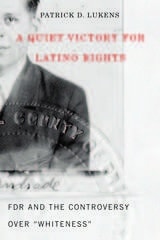
A Quiet Victory for Latino Rights
FDR and the Controversy Over "Whiteness"Patrick D. Lukens
University of Arizona Press, 2012
In 1935 a federal court judge handed down a ruling that could have been disastrous for Mexicans, Mexican Americans, and all Latinos in the United States. However, in an unprecedented move, the Roosevelt administration wielded the power of "administrative law" to neutralize the decision and thereby dealt a severe blow to the nativist movement. A Quiet Victory for Latino Rights recounts this important but little-known story.
To the dismay of some nativist groups, the Immigration Act of 1924, which limited the number of immigrants who could be admitted annually, did not apply to immigrants from Latin America. In response to nativist legal maneuverings, the 1935 decision said that the act could be applied to Mexican immigrants. That decision, which ruled that the Mexican petitioners were not "free white person[s]," might have paved the road to segregation for all Latinos.
The League of United Latin American Citizens (LULAC), founded in 1929, had worked to sensitize the Roosevelt administration to the tenuous position of Latinos in the United States. Advised by LULAC, the Mexican government, and the US State Department, the administration used its authority under administrative law to have all Mexican immigrants—and Mexican Americans—classified as "white." It implemented the policy when the federal judiciary "acquiesced" to the New Deal, which in effect prevented further rulings.
In recounting this story, complete with colorful characters and unlikely bedfellows, Patrick D. Lukens adds a significant chapter to the racial history of the United States.
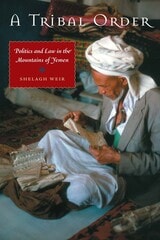
A Tribal Order
Politics and Law in the Mountains of YemenBy Shelagh Weir
University of Texas Press, 2006
2008 — British-Kuwait Friendship Prize in Middle Eastern Studies – British Society for Middle Eastern Studies
A Tribal Order describes the politico-legal system of Jabal Razih, a remote massif in northern Yemen inhabited by farmers and traders. Contrary to the popular image of Middle Eastern tribes as warlike, lawless, and invariably opposed to states, the tribes of Razih have stable structures of governance and elaborate laws and procedures for maintaining order and resolving conflicts with a minimum of physical violence. Razihi leaders also historically cooperated with states, provided the latter respected their customs, ideals, and interests. Weir considers this system in the context of the rugged environment and productive agricultural economy of Razih, and of centuries of continuous rule by Zaydi Muslim regimes and (latterly) the republican governments of Yemen.
The book is based on Weir's extended anthropological fieldwork on Jabal Razih, and on her detailed study of hundreds of handwritten contracts and treaties among and between the tribes and rulers of Razih. These documents provide a fascinating insight into tribal politics and law, as well as state-tribe relations, from the early seventeenth to the late twentieth century. A Tribal Order is also enriched by case histories that vividly illuminate tribal practices. Overall, this unusually wide-ranging work provides an accessible account of a remarkable Arabian society through time.

Aboriginal Resource Use in Canada
Historical and Legal AspectsKerry Abel
University of Manitoba Press, 1991
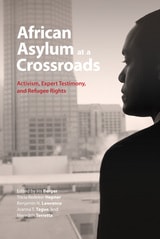
African Asylum at a Crossroads
Activism, Expert Testimony, and Refugee RightsIris Berger
Ohio University Press, 2015
African Asylum at a Crossroads: Activism, Expert Testimony, and Refugee Rights examines the emerging trend of requests for expert opinions in asylum hearings or refugee status determinations. This is the first book to explore the role of court-based expertise in relation to African asylum cases and the first to establish a rigorous analytical framework for interpreting the effects of this new reliance on expert testimony.
Over the past two decades, courts in Western countries and beyond have begun demanding expert reports tailored to the experience of the individual claimant. As courts increasingly draw upon such testimony in their deliberations, expertise in matters of asylum and refugee status is emerging as an academic area with its own standards, protocols, and guidelines. This deeply thoughtful book explores these developments and their effects on both asylum seekers and the experts whose influence may determine their fate.
Contributors: Iris Berger, Carol Bohmer, John Campbell, Katherine Luongo, E. Ann McDougall, Karen Musalo, Tricia Redeker Hepner, Amy Shuman, Joanna T. Tague, Meredith Terretta, and Charlotte Walker-Said.
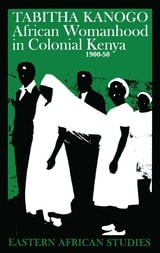
African Womanhood in Colonial Kenya, 1900–1950
1900-1950Tabitha Kanogo
Ohio University Press, 2000
This book explores the history of African womanhood in colonial Kenya. By focussing on key sociocultural institutions and practices around which the lives of women were organized, and on the protracted debates that surrounded these institutions and practices during the colonial period, it investigates the nature of indigenous, mission, and colonial control of African women.
The pertinent institutions and practices include the legal and cultural status of women, clitoridectomy, dowry, marriage, maternity and motherhood, and formal education. By following the effects of the all-pervasive ideological shifts that colonialism produced in the lives of women, the study investigates the diverse ways in which a woman’s personhood was enhanced, diminished, or placed in ambiguous predicaments by the consequences, intended and unintended, of colonial rule as administered by both the colonizers and the colonized. The study thus tries to historicize the reworkings of women’s lives under colonial rule. The transformations that resulted from these reworkings involved the negotiation and redefinition of the meaning of individual liberties and of women’s agency, along with the reconceptualization of kinship relations and of community.
These changes resulted in—and often resulted from—increased mobility for Kenyan women, who were enabled to cross physical, cultural, economic, social, and psychological frontiers that had been closed to them prior to colonial rule. The conclusion to which the experiences of women in colonial Kenya points again and again is that for these women, the exercise of individual agency, whether it was newly acquired or repeatedly thwarted, depended in large measure on the unleashing of forces over which no one involved had control. Over and over, women found opportunities to act amid the conflicting policies, unintended consequences, and inconsistent compromises that characterized colonial rule.
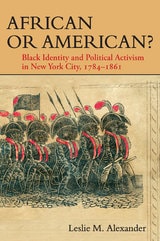
African or American?
Black Identity and Political Activism in New York City, 1784-1861Leslie M. ALexander
University of Illinois Press, 2012
During the early national and antebellum eras, black leaders in New York City confronted the tenuous nature of Northern emancipation. Despite the hope of freedom, black New Yorkers faced a series of sociopolitical issues including the persistence of Southern slavery, the threat of forced removal, racial violence, and the denial of American citizenship. Even efforts to create community space within the urban landscape, such as the African Burial Ground and Seneca Village, were eventually demolished to make way for the city's rapid development. In this illuminating history, Leslie M. Alexander chronicles the growth and development of black activism in New York from the formation of the first black organization, the African Society, in 1784 to the eve of the Civil War in 1861. In this critical period, black activists sought to formulate an effective response to their unequal freedom. Examining black newspapers, speeches, and organizational records, this study documents the creation of mutual relief, religious, and political associations, which black men and women infused with African cultural traditions and values.
As Alexander reveals, conflicts over early black political strategy foreshadowed critical ideological struggles that would bedevil the black leadership for generations to come. Initially, black leaders advocated racial uplift through a sense of communalism and connection to their African heritage. Yet by the antebellum era, black activists struggled to reconcile their African identity with a growing desire to gain American citizenship. Ultimately, this battle resulted in competing agendas; while some leaders argued that the black community should dedicate themselves to moral improvement and American citizenship, others began to consider emigrating to Africa or Haiti. In the end, the black leadership resolved to assert an American identity and to expand their mission for full equality and citizenship in the United States. This decision marked a crucial turning point in black political strategy, for it signaled a new phase in the quest for racial advancement and fostered the creation of a nascent Black Nationalism.
Aging And The Law
Lawrence Frolik
Temple University Press, 1999
After an introduction covering the nature of elder law, social attitudes toward the elderly, aging and ethnicity, and generational justice, the book includes sections on work, income, and wealth; housing; mental capacity; health care decision making; long-term care; health care finance; family and social issues; and abuse, neglect, victimization, and elderly criminals. It concludes with essays on legal representation and ethical issues. The essays have been edited to make them easily accessible to students and the general reader, and Professor Frolik has supplied introductions to the sections, as well as summaries of issues for which the essays could not be included.
Both comprehensive and engaging, Aging and the Law brings together essays by lawyers, social workers, health care professionals, and policy makers, as well as selected case law and congressional hearings.
Aging and Old Age
Richard A. Posner
University of Chicago Press, 1995
Aging and Old Age offers fresh insight into a wide range of social and political issues relating to the elderly, such as health care, crime, social security, and discrimination. From the dread of death to the inordinate law-abidingness of the old, from their loquacity to their penny-pinching, Posner paints a surprisingly rich, revealing, and unsentimental portrait of the millions of elderly people in the United States. He explores issues such as age discrimination in employment, creativity and leadership as functions of age, and the changing social status of the elderly. Why are old people, presumably with less to lose, more unwilling to take risks than young people? Why don't the elderly in the United States command the respect and affection they once did and still do in other countries? How does aging affect driving and criminal records? And how does aging relate to creativity across different careers?
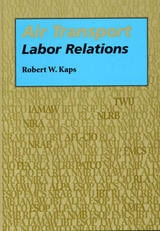
Air Transport Labor Relations
Robert W. Kaps
Southern Illinois University Press, 1997
Robert W. Kaps examines air transport labor law in the United States as well as the underlying legislative and policy directives established by the federal government. The body of legislation governing labor relations in the private sector of the U.S. economy consists of two separate and distinct acts: the Railway Labor Act (RLA), which governs labor relations in the railroad and airline industries, and the National Labor Relations Act (NLRA), which governs labor relations in all other industrial sectors.
Although the NLRA closely follows the pattern established by the RLA, Kaps notes that the two laws are distinguishable in several important areas. Labor contracts negotiated under the RLA continue in perpetuity, for example, whereas all other labor contracts expire at a specified date. Other important areas of difference relate to the collective bargaining process itself, the procedures for the arbitration of disputes and grievances, and the spheres of authority and jurisdiction to consider such matters as unfair labor practices.
Congress established a special labor law for railroad and airline workers for several reasons. Because of transportation’s critical importance to the economy, an essential goal of public policy has been to ensure that both passenger and freight transportation services continue without interruption. Production can cease—at least temporarily—in most other industries without causing significant harm to the economy. When transportation stops, however, production stops. Thus Congress saw fit to enact a statute that contained provisions to ensure that labor strife would not halt rail services. Primarily because of the importance of air mail transportation, the Railway Labor Act of 1926 was extended to the airline industry in 1936.
The first section of this book introduces labor policy and presents a history of the labor movement in the United States. Discussing early labor legislation, Kaps focuses on unfair labor practices and subsequent major labor statutes.
The second section provides readers with a comparison of labor provisions that apply to the railroad and airline industries as well as to the remainder of the economy.
The final section centers on the evolution of labor in the airline industry. The author pays particular attention to recent events affecting labor in commercial aviation, particularly the effect of airline deregulation on airline labor.
Alaska Natives & American Laws
David Case
University of Alaska Press, 2002
Alaska Natives and American Laws
Third EditionDavid S. Case and David A. Voluck
University of Alaska Press, 2012
Now in its third edition, Alaska Natives and American Laws is still the only work of its kind, canvassing federal law and its history as applied to the indigenous peoples of Alaska. Covering 1867 through 2011, the authors offer lucid explanations of the often-tangled history of policy and law as applied to Alaska’s first peoples. Divided conceptually into four broad themes of indigenous rights to land, subsistence, services, and sovereignty, the book offers a thorough and balanced analysis of the evolution of these rights in the forty-ninth state.
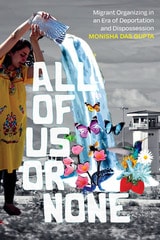
All of Us or None
Migrant Organizing in an Era of Deportation and DispossessionMonisha Das Gupta
Duke University Press, 2024
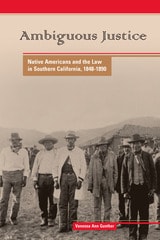
Ambiguous Justice
Native Americans and the Law in Southern California, 1848-1890Vanessa Ann Gunther
Michigan State University Press, 2006
In 1769, Spain took action to solidify control over its northern New World territories by establishing a series of missions and presidios in what is now modern California. To populate these remote establishments, the Spanish crown relied on Franciscan priests, whose role it was to convince the Native Californian population to abandon their traditional religious practices and adopt Catholicism. During their tutelage, the Indians of California would be indoctrinated into Spanish society, where they would learn obedience to the church and crown.
The legal system of Southern California has been used by Anglo populations as a social and demographic tool to control Native Americans. Following the Mexican-American War and the 1849 Gold Rush, as California property values increased and transportation corridors were established, Native Americans remained a sharply declining presence in many communities, and were likely to be charged with crimes. The sentences they received were lighter than those given to Anglo offenders, indicating that the legal system was used as a means of harassment. Additionally, courts chronicled the decline of the once flourishing native populations with each case of drunkenness, assault, or rape that appeared before the bench. Nineteenth-century American society had little sympathy for the plight of Indians or for the destruction of their culture. Many believed that the Indians of Southern California would fade from history because of their inability to adapt to a changing world. While many aspects of their traditional culture have been irreparably lost, the people of southern California are, nevertheless, attempting to recreate the cultures that were challenged by the influx of Europeans and later Americans to their lands.
Amer Indian Law Deskbook 3ed
Hardy Conference of Western Attorneys General
University Press of Colorado, 2004
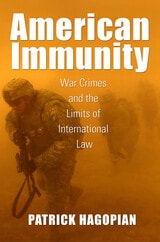
American Immunity
War Crimes and the Limits of International LawPatrick Hagopian
University of Massachusetts Press, 2013
In 1955 the Supreme Court ruled that veterans of the U.S. armed forces could not be court-martialed for overseas crimes that were not detected until after they had left military service. Territorial limitations placed such acts beyond the jurisdiction of civilian courts, and there was no other American court in which they could be adjudicated. As a result, a jurisdictional gap emerged that for decades exempted former troops from prosecution for war crimes. “This was not merely a theoretical possibility,” Patrick Hagopian writes. Over a dozen former soldiers who participated in the My Lai massacre did in fact “get away with murder.” Further court rulings expanded the gap to cover civilian employees and contractors that accompanied the armed forces.
In American Immunity, Hagopian places what he calls the “superpower exemption” in the context of a long-standing tension between international law and U.S. sovereignty. He shows that despite the U.S. role in promulgating universal standards of international law and forming institutions where those standards can be enforced, the United States has repeatedly refused to submit its own citizens and troops to the jurisdiction of international tribunals and failed to uphold international standards of justice in its own courts.
In 2000 Congress attempted to close the jurisdictional gap with passage of the Military Extraterritorial Jurisdiction Act. The effectiveness of that legislation is still in question, however, since it remains unclear how willing civilian American juries will be to convict veterans for conduct in foreign war zones.
American Indian Constitutional Reform and the Rebuilding of Native Nations
Edited by Eric D. Lemont
University of Texas Press, 2006
Since 1975, when the U.S. government adopted a policy of self-determination for American Indian nations, a large number of the 562 federally recognized nations have seized the opportunity to govern themselves and determine their own economic, political, and cultural futures. As a first and crucial step in this process, many nations are revising constitutions originally developed by the U.S. government to create governmental structures more attuned to native people's unique cultural and political values. These new constitutions and the governing institutions they create are fostering greater governmental stability and accountability, increasing citizen support of government, and providing a firmer foundation for economic and political development.
This book brings together for the first time the writings of tribal reform leaders, academics, and legal practitioners to offer a comprehensive overview of American Indian nations' constitutional reform processes and the rebuilding of native nations. The book is organized in three sections. The first part investigates the historical, cultural, economic, and political motivations behind American Indian nations' recent reform efforts. The second part examines the most significant areas of reform, including criteria for tribal membership/citizenship and the reform of governmental institutions. The book concludes with a discussion of how American Indian nations are navigating the process of reform, including overcoming the politics of reform, maximizing citizen participation, and developing short-term and long-term programs of civic education.
American Indian History on Trial
Historical Expertise in Tribal LitigationE. Richard Hart
University of Utah Press, 2017
Hart, a historian who has testified in cases that have resulted in roughly a billion dollars in judgments, uses specific cases to explain at length what kind of historical research and documentation is necessary for tribes seeking to protect and claim their rights under United States law. He demonstrates the legal questions that Native Americans face by exploring the cultural history and legal struggles of six Indian nations. He recounts how these were addressed by expert testimony grounded in thorough historical understanding, research, and argumentation. The case studies focus on the Wenatchi, Coeur d’Alene, Hualapai, Amah Mutsun, Klamath, and Zuni peoples but address issues relevant to many American tribes.
American Indian Law Deskbook, Fourth Edition
Conference of Western Attorneys General Conference of Western Attorneys General
University Press of Colorado, 2008
Included are:
-The evolution of federal statutory Indian law and the judicial foundations of federal Indian policy.
-An extensive compilation and analysis of federal and state court decisions.
- Reservation and Indian lands ownership and property interests.
-The parameters of criminal jurisdiction in Indian country.
-Concepts of tribal sovereignty and jurisdiction relating to a number of specific areas, including tribal courts, hunting and fishing, environmental regulation, water rights, gaming, and child welfare.
-Cooperative approaches used by the states and tribes for resolving jurisdictional disputes and promoting better relations.
Thorough, scholarly, and balanced, the American Indian Law Deskbook, Fourth Edition is an invaluable reference for a wide range of people working with Indian tribes, including attorneys, legal scholars, government officials, social workers, state and tribal jurists, and historians. This revised edition includes information from more recent court decisions, federal statutes, administrative regulations, and law reviews.
American Indian Sovereignty and the U.S. Supreme Court
The Masking of JusticeBy David E. Wilkins
University of Texas Press, 1997
"Like the miner's canary, the Indian marks the shift from fresh air to poison gas in our political atmosphere; and our treatment of Indians, even more than our treatment of other minorities, reflects the rise and fall in our democratic faith," wrote Felix S. Cohen, an early expert in Indian legal affairs.
In this book, David Wilkins charts the "fall in our democratic faith" through fifteen landmark cases in which the Supreme Court significantly curtailed Indian rights. He offers compelling evidence that Supreme Court justices selectively used precedents and facts, both historical and contemporary, to arrive at decisions that have undermined tribal sovereignty, legitimated massive tribal land losses, sanctioned the diminishment of Indian religious rights, and curtailed other rights as well.
These case studies—and their implications for all minority groups—make important and troubling reading at a time when the Supreme Court is at the vortex of political and moral developments that are redefining the nature of American government, transforming the relationship between the legal and political branches, and altering the very meaning of federalism.
American Indian Treaties
A Guide to Ratified and Unratified Colonial, United States, State, Foreign, and Intertribal Treaties and Agreements, 1607-1911David DeJong
University of Utah Press, 2015
When it comes to American Indian treaties, the American polity too often forgets the realities of history. Prevailing perceptions are often not only inaccurate but also premised on outright falsehoods. Treaty-making was profoundly influenced by tribal conceptions of diplomacy. Colonial and early U.S. treaties especially were clothed in ritual, metaphor, and covenants that emphasized the sacred nature and purpose of diplomacy and represented a time when tribal nations were equal partners. To understand the nature and meaning of tribal treaties one needs to read them and recognize their sacred pledges and meaning, which are still relevant today.
This volume examines intertribal treaties and treaty-making and provides understanding of both the agreements and the diplomatic protocols in which they were enmeshed. It summarizes colonial Indian treaty discourse, intertribal treaties and diplomacy, the different eras of ratified and unratified U.S. treaties, foreign and state treaties with Indian nations, and the Indian agreements that followed the cessation of official treaty-making. It provides extensive lists of over 1,500 Indian treaties from all tribal diplomatic eras and includes dates, participants, purposes, and references.
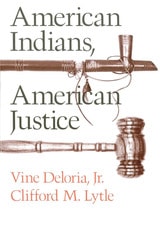
American Indians, American Justice
By Vine Deloria, Jr., and Clifford M. Lytle
University of Texas Press, 1983
Baffled by the stereotypes presented by Hollywood and much historical fiction, many other Americans find the contemporary American Indian an enigma. Compounding their confusion is the highly publicized struggle of the contemporary Indian for self-determination, lost land, cultural preservation, and fundamental human rights—a struggle dramatized both by public acts of protest and by precedent-setting legal actions. More and more, the battles of American Indians are fought—and won—in the political arena and the courts.
American Indians, American Justice explores the complexities of the present Indian situation, particularly with regard to legal and political rights. It is the first book to present an overview of federal Indian law in language readably accessible to the layperson. Remarkably comprehensive, it is destined to become a standard sourcebook for all concerned with the plight of the contemporary Indian.
Beginning with an examination of the historical relationship of Indians and the courts, the authors describe how tribal courts developed and operate today, and how they relate to federal and state governments. They define such key legal concepts as tribal sovereignty and Indian Country. By comparing and contrasting the workings of Indian and non-Indian legal institutions, the authors illustrate how Indian tribes have adapted their customs, values, and institutions to the demands of the modern world. Describing the activities of attorneys and Indian advocates in asserting and defending Indian rights, they identify the difficulties typically faced by Indians in the criminal and civil legal arenas and explore the public policy and legal rights of Indians as regards citizenship, voting rights, religious freedom, and basic governmental services.
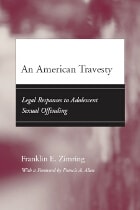
An American Travesty
Legal Responses to Adolescent Sexual OffendingFranklin E. Zimring
University of Chicago Press, 2004
An American Travesty is the first scholarly book in half a century to analyze the justice system’s response to sexual misconduct by children and adolescents in the United States. Writing with a refreshing dose of common sense, Franklin E. Zimring discusses our society's failure to consider the developmental status of adolescent sex offenders. Too often, he argues, the American legal system ignores age and developmental status when adjudicating young sexual offenders, in many cases responding as they would to an adult.
“An opinionated, articulate, and forceful critique of current politics and practices. . . . I would recommend this book for anyone interested in rethinking the fundamental questions of how our courts and systems should respond to these cases.”—Law and Politics Book Review
“One of the most important new books in the field of juvenile justice. . . . Zimring offers a thoughtful, research-based analysis of what went wrong with legal policy development.”—Barry Krisberg, President, National Council on Crime and Delinquency
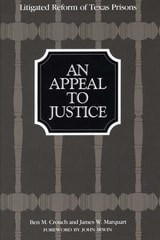
An Appeal to Justice
Litigated Reform of Texas PrisonsBy Ben M. Crouch and James W. Marquart
University of Texas Press, 1989
How does a prison achieve institutional order while safeguarding prisoners' rights? Since the early 1960s, prison reform advocates have aggressively used the courts to extend rights and improve life for inmates, while prison administrators have been slow to alter the status quo. Litigated reform has been the most significant force in obtaining change.
An Appeal to Justice is a critical tudy of how the Texas Department of Corrections was transformed by Ruiz v. Estelle, the most sweeping class-action suit in correctional law history. Orders from federal judge William W. Justice rapidly moved the Texas system from one of the most autonomous, isolated, and paternalistic system to a more constitutional bureaucracy. In many respects the Texas experience is a microcosm of the transformation of American corrections over the second half of the twentieth century.
This is a careful account of TDC's fearful past as a plantation system, its tumultuous litigated reform, and its subsequent efforts to balance prisoner rights and prison order. Of major importance is the detailed examination of the broad stages of the reform process (and its costs and benefits) and an intimate look at prison brutality and humanity. The authors examine the terror tactics of the inmate guards, the development of prisoner gangs and widespread violence during the reforms, and the stability that eventually emerged. They also detail the change of the guard force from a relatively small, cohesive cadre dependent on discretion, personal loyalty, and physical dominance to a larger and more fragmented security staff controlled by formal procedures.
Drawing on years of research in archival sources and on hundreds of interviews with prisoners, administrators, and staff, An Appeal to Justice is a unique basis for assessing the course and consequences of prison litigation and will be valuable reading for legislators, lawyers, judges, prison administrators, and concerned citizens, as well as prison and public policy scholars.
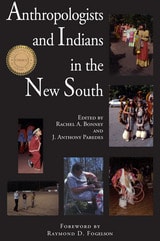
Anthropologists and Indians in the New South
Edited by Rachel Bonney and J. Anthony Paredes; Foreword by Raymond D. Fogelson
University of Alabama Press, 2001
A clear assessment of the growing mutual respect and strengthening bond between modern Native Americans and the researchers who explore their past
Southern Indians have experienced much change in the last half of the 20th century. In rapid succession since World War II, they have passed through the testing field of land claims litigation begun in the 1950s, played upon or retreated from the civil rights movement of the 1960s, seen the proliferation of “wannabe” Indian groups in the 1970s, and created innovative tribal enterprises—such as high-stakes bingo and gambling casinos—in the 1980s. The Native American Graves Protection and Repatriation Act of 1990 stimulated a cultural renewal resulting in tribal museums and heritage programs and a rapprochement with their western kinsmen removed in “Old South” days.
Anthropology in the South has changed too, moving forward at the cutting edge of academic theory. This collection of essays reflects both that which has endured and that which has changed in the anthropological embrace of Indians from the New South. Beginning as an invited session at the 30th-anniversary meeting of the Southern Anthropological Society held in 1996, the collection includes papers by linguists, archaeologists, and physical anthropologists, as well as comments from Native Americans.
This broad scope of inquiry—ranging in subject from the Maya of Florida, presumed biology, and alcohol-related problems to pow-wow dancing, Mobilian linguistics, and the “lost Indian ancestor” myth—results in a volume valuable to students, professionals, and libraries. Anthropologists and Indians in the New South is a clear assessment of the growing mutual respect and strengthening bond between modern Native Americans and the researchers who explore their past.

Applications Of Feminist Legal Theory
edited by D. Kelly Weisberg
Temple University Press, 1996
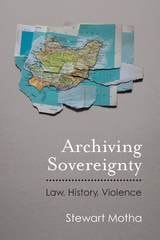
Archiving Sovereignty
Law, History, ViolenceStewart Motha
University of Michigan Press, 2018
Sovereignty is often cast as a limit-concept, constituent force, determining the boundary of law. Archiving Sovereignty reverses this to explain how judicial pronouncements inscribe and sustain extravagant claims to exceptionality and sovereign solitude. This wide-ranging, critical work distinguishes between myths that sustain neocolonial orders and fictions that generate new forms of political and ethical life.
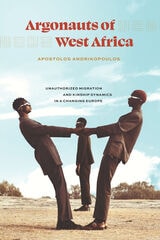
Argonauts of West Africa
Unauthorized Migration and Kinship Dynamics in a Changing EuropeApostolos Andrikopoulos
University of Chicago Press, 2023
In rapidly changing and highly precarious contexts, unauthorized African migrants turn to kinship in search of security, stability, and predictability. Through the exchange of identity documents between “siblings,” assistance in obtaining such documentation through kinship networks, and marriages that provide access to citizenship, new assemblages of kinship are continually made and remade to navigate the shifting demands of European states. These new kinship relations, however, often prove unreliable, taking on new, unexpected dynamics in the face of codependency; they become more difficult to control than those who enter into such relations can imagine. Through unusually close ethnographic work in West African migrant communities in Amsterdam, Apostolos Andrikopoulos reveals the unseen dynamics of kinship through shared papers, the tensions of race and gender that develop in mutually beneficial marriages, and the vast, informal networks of people, information, and documentation on which migrants rely. Throughout Argonauts of West Africa, Andrikopoulos demonstrates how inequality, exclusionary practices, and the changing policies of an often-violent state demand innovative ways of doing kinship to successfully navigate complex migration routes.
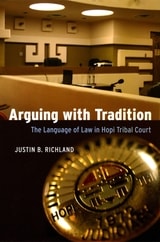
Arguing with Tradition
The Language of Law in Hopi Tribal CourtJustin B. Richland
University of Chicago Press, 2008
Like many indigenous legal institutions across North America, the Hopi Tribal Court was created in the image of Anglo-American-style law. But Richland shows that in recent years, Hopi jurists and litigants have called for their courts to develop a jurisprudence that better reflects Hopi culture and traditions. Providing unprecedented insights into the Hopi and English courtroom interactions through which this conflict plays out, Richland argues that tensions between the language of Anglo-style law and Hopi tradition both drive Hopi jurisprudence and make it unique. Ultimately, Richland’s analyses of the language of Hopi law offer a fresh approach to the cultural politics that influence indigenous legal and governmental practices worldwide.
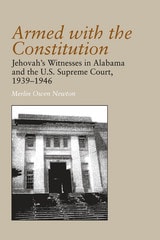
Armed with the Constitution
Jehovah's Witnesses in Alabama and the U.S Supreme Court, 1939-1946Merlin Owen Newton
University of Alabama Press, 1995
Armed with the Constitution stresses the courage of a black man, Rosco Jones, and a white woman, Grace Marsh, who dared to challenge the status quo in Alabama in the early 1940s. These two Jehovah’s Witnesses helped to lay a foundation for testing the constitutionality of state and local laws, establishing precedents that the Civil Rights movement, the feminist movement, and similar forces could follow. Newton has prepared a finely woven tale of oral, legal, and social history that opens a window on the world of the Jehovah’s Witnesses in Alabama.
More than a legal study, this book is also a dramatic history of two powerful personalities whose total commitment to their faith enabled them to carry the Jehovah’s Witnesses’ battle from rural Alabama to the halls of the U.S. Supreme Court.
Arresting Dress
Cross-Dressing, Law, and Fascination in Nineteenth-Century San FranciscoClare Sears
Duke University Press, 2015
Ashes of Immortality
Widow-Burning in IndiaCatherine Weinberger-Thomas
University of Chicago Press, 1999
Ashes of Immortality attempts to see the satis through Hindu eyes, providing an extensive experiential and psychoanalytic account of ritual self-sacrifice and self-mutilation in South Asia. Based on fifteen years of fieldwork in northern India, where the state-banned practice of sati reemerged in the 1970s, as well as extensive textual analysis, Weinberger-Thomas constructs a radically new interpretation of satis. She shows that their self-immolation transcends gender, caste and class, region and history, representing for the Hindus a path to immortality.