Results by title
3 books match the query 'Leong, Elaine'
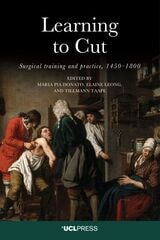
Learning to Cut
Surgical Training and Practice, 1450–1800Edited by Maria Pia Donato, Elaine Leong, and Tillmann Taape
University College London, 2026
The first-ever volume to offer a broader European narrative on surgical training and education in the early modern era.
This volume brings together case studies from the French, Italian, German, and English contexts to reveal diverse modes of surgical teaching and learning that were shaped by local contexts in early modern towns and cities. The chapters reveal the many spaces where practitioners learned and experienced surgery, shedding new light on the practice of early modern surgery.
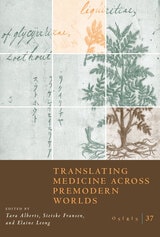
Osiris, Volume 37
Translating Medicine across Premodern WorldsEdited by Tara Alberts, Sietske Fransen, and Elaine Leong
University of Chicago Press Journals, 2022
This volume of Osiris turns the analytical lens of translation onto medical knowledge and practices across the premodern world. Understandings of the human body, and of diseases and their cures, were influenced by a range of religious, cultural, environmental, and intellectual factors. As a result, complex systems of translation emerged as people crossed linguistic and territorial boundaries to share not only theories and concepts, but also materials, such as drugs, amulets, and surgical tools. The studies here reveal how instances of translation helped to shape and, in some cases, reimagine these ideas and objects to fit within local frameworks of medical belief.
Translating Medicine across Premodern Worlds features case studies located in geographically and temporally diverse contexts, including ninth-century Baghdad, sixteenth-century Seville, seventeenth-century Cartagena, and nineteenth-century Bengal. Throughout, the contributors explore common themes and divergent experiences associated with a variety of historical endeavors to “translate” knowledge about health and the body across languages, practices, and media. By deconstructing traditional narratives and de-emphasizing well-worn dichotomies, this volume ultimately offers a fresh and innovative approach to histories of knowledge.
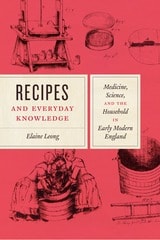
Recipes and Everyday Knowledge
Medicine, Science, and the Household in Early Modern EnglandElaine Leong
University of Chicago Press, 2018
In Recipes and Everyday Knowledge, Elaine Leong situates recipe knowledge and practices among larger questions of gender and cultural history, the history of the printed word, and the history of science, medicine, and technology. The production of recipes and recipe books, she argues, were at the heart of quotidian investigations of the natural world or “household science”. She shows how English homes acted as vibrant spaces for knowledge making and transmission, and explores how recipe trials allowed householders to gain deeper understandings of sickness and health, of the human body, and of natural and human-built processes. By recovering this story, Leong extends the parameters of natural inquiry and productively widens the cast of historical characters participating in and contributing to early modern science.