Results by title
5 books match the query 'Lermontov, Mikhail I͡Urʹevich'
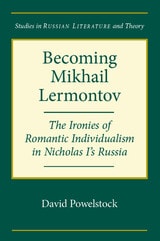
Becoming Mikhail Lermontov
The Ironies of Romantic Individualism in Nicholas I's RussiaDavid Powelstock
Northwestern University Press, 2011
Mikhail Lermontov (1814-1841) is one of Russia's most prominent poets--and one of its most puzzling. In this radically new interpretation, David Powelstock reveals how the seeming contradictions in Lermontov's life and works can be understood as manifestations of a coherent worldview.
By bringing to light Lermontov's operative version of Romantic individualism, Powelstock is able to make sense of the poet's relationship to "romantic irony," his highly modern concept of the reader (both real, and implied in the text), and his vexed passion for his predecessor Alexander Pushkin--a relationship that is almost always treated sentimentally, but is here given its true competitive edge. Furthermore, Powelstock offers the most persuasive account ever given of Lermontov's exceptionally odd treatment of, and success with, women--both in real life and in fiction--and of his cruel overlapping of these two planes.
Clarifying what has remained perplexing for so long, and correcting what has been misinterpreted, Powelstock's work illuminates Lermontov's views of dignity, death, love, nature, society, and ethics--and, finally, gives us an intellectual biography that is deeper and more subtle than any written before.
[more]
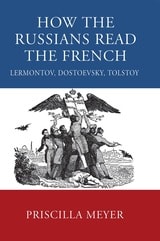
How the Russians Read the French
Lermontov, Dostoevsky, TolstoyPriscilla Meyer
University of Wisconsin Press, 2008
Russian writers of the nineteenth century were quite consciously creating a new national literary tradition. They saw themselves self-consciously through Western European eyes, at once admiring Europe and feeling inferior to it. This ambivalence was perhaps most keenly felt in relation to France, whose language and culture had shaped the world of the Russian aristocracy from the time of Catherine the Great.
In How the Russians Read the French, Priscilla Meyer shows how Mikhail Lermontov, Fyodor Dostoevsky, and Lev Tolstoy engaged with French literature and culture to define their own positions as Russian writers with specifically Russian aesthetic and moral values. Rejecting French sensationalism and what they perceived as a lack of spirituality among Westerners, these three writers attempted to create moral and philosophical works of art that drew on sources deemed more acceptable to a Russian worldview, particularly Pushkin and the Gospels. Through close readings of A Hero of Our Time, Crime and Punishment, and Anna Karenina, Meyer argues that each of these great Russian authors takes the French tradition as a thesis, proposes his own antithesis, and creates in his novel a synthesis meant to foster a genuinely Russian national tradition, free from imitation of Western models.
Winner, University of Southern California Book Prize in Literary and Cultural Studies, American Association for the Advancement of Slavic Studies
[more]
Lermontov's "A Hero of Our Time"
A Critical CompanionLewis Bagby
Northwestern University Press, 2001
Praised as the first Russian novel of psychological realism and as a critique of the repressive era in which Mikhail Lermontov lived, A Hero of Our Time brought to life the political and social ideas that at that time could only be expressed indirectly. This latest volume in the acclaimed Northwestern/AATSEEL Critical Companions to Russian Literature series presents diverse perspectives of leading Slavic literary theorists and specialists, ethnologists, formalist critics, and Western humanists. Lending additional breadth and depth are conservative and radical reviews of the novel written at the time of its publication, plus two new essays, one on ethnic identity and the other on women's issues in the novel.
[more]
Lermontov's Narratives of Heroism
Vladimir Golstein
Northwestern University Press, 2012
This is the first study of Russian writer Mikhail Lermontov (1814-41) that attempts to integrate the in-depth interpretations of all his major texts--including his famous A Hero of Our Time, the novel that laid the foundation for the Russian psychological novel.
Lermontov's explorations of the virtues and limitations of heroic, self-reliant conduct have subsequently become obscured or misread. This new book focuses upon the peculiar, disturbing, and arguably most central feature of Russian culture: its suspicion of and hostility toward individual achievement and self-assertion. The analysis and interpretation of Lermontov's texts enables Golstein to address broader cultural issues by exploring the reasons behind the persistent misreading of Lermontov's major works and by investigating the cultural attitudes that shaped Russia's reaction to the challenges of modernity.
Lermontov's explorations of the virtues and limitations of heroic, self-reliant conduct have subsequently become obscured or misread. This new book focuses upon the peculiar, disturbing, and arguably most central feature of Russian culture: its suspicion of and hostility toward individual achievement and self-assertion. The analysis and interpretation of Lermontov's texts enables Golstein to address broader cultural issues by exploring the reasons behind the persistent misreading of Lermontov's major works and by investigating the cultural attitudes that shaped Russia's reaction to the challenges of modernity.
[more]
Writing as Exorcism
The Personal Codes of Pushkin, Lermontov, and GogolIlya Kutik
Northwestern University Press, 2005
"Sometimes it takes a poet to read a poet. In this inspired, idiosyncratic study, Ilya Kutik offers exemplary interpretations of three Russian writers, of the lessons of fatalism, and of the complexities of reading." —from the Introduction
A remarkable literary performance in its own right, this interpretive essay brings a highly original poetic sensibility to bear on the lives and works of three major Russian writers. It is Ilya Kutik's contention that many writers are tormented by secret fears and desires that only writing—in particular, the use of certain words and images—can exorcise. Making this biographical approach peculiarly his own—and susceptible to the nuances of comedy, tragedy, and critical equanimity—Kutik reads works of Alexander Pushkin, Mikhail Lermontov, and Nikolai Gogol, three Russian writers who were demonstrably subject to the whims, superstitions, and talismans that Kutik identifies. Exposing the conjunction of literary effort and private act in writings such as "The Queen of Spades," Dead Souls, and A Hero of Our Time, Kutik's work gives us a new way of understanding these masterpieces of Russian literature and their authors, and a new way of reading the mysteries of life and literature as mutually enriching.
A remarkable literary performance in its own right, this interpretive essay brings a highly original poetic sensibility to bear on the lives and works of three major Russian writers. It is Ilya Kutik's contention that many writers are tormented by secret fears and desires that only writing—in particular, the use of certain words and images—can exorcise. Making this biographical approach peculiarly his own—and susceptible to the nuances of comedy, tragedy, and critical equanimity—Kutik reads works of Alexander Pushkin, Mikhail Lermontov, and Nikolai Gogol, three Russian writers who were demonstrably subject to the whims, superstitions, and talismans that Kutik identifies. Exposing the conjunction of literary effort and private act in writings such as "The Queen of Spades," Dead Souls, and A Hero of Our Time, Kutik's work gives us a new way of understanding these masterpieces of Russian literature and their authors, and a new way of reading the mysteries of life and literature as mutually enriching.
[more]