Results by title
5 books match the query 'Lesbian authors'
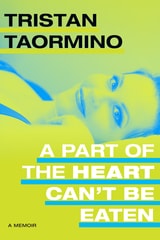
A Part of the Heart Can't Be Eaten
A MemoirTristan Taormino
Duke University Press, 2023
In A Part of the Heart Can’t Be Eaten, award-winning author, sex educator, filmmaker, and podcast host Tristan Taormino shares her coming-of-age story, revealing how her radical sexuality and unconventional career grew out of an extraordinary queer father-daughter relationship. Raised by a hard-working single mother on Long Island, Tristan got her sex ed from the 1980s TV show Solid Gold and The Joy of Sex. She spent summers at drag shows in Provincetown with her father, Bill, who had come out as gay in the mid-1970s. Her sexual identity bloomed during her college years at Wesleyan University, where she discovered her desire for butches and kinky sex.
Tristan’s world began to fall apart when her dad was diagnosed with AIDS. After a series of devastating events, she moved to the messy, glorious world of 1990s New York City. In the midst of grief and depression, she helped change queer sexual subculture with her zine Pucker Up, her infamous The Village Voice column, and her editorship of legendary lesbian porn magazine On Our Backs. After the publication of her first book, The Ultimate Guide to Anal Sex for Women, Tristan followed her own path that marked the beginning of her work as a trailblazing feminist pornographer.
After a lifetime of outrageous adventures, Tristan reflects on the bonds, loss, and mental-health struggles that shaped her. She weaves together history from her father’s unpublished memoir, exploring the surprising ways their personal patterns converge and diverge. Bracingly emotional and erotically charged, A Part of the Heart Can’t Be Eaten reveals the transformative power of queer pleasure and defiance.
[more]
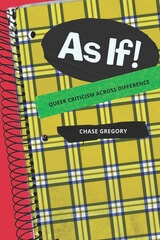
As If!
Queer Criticism Across DifferenceChase Gregory
Duke University Press, 2025
In As If!, Chase Gregory explores the stylistically strategic, often campy, and productively fraught cross-identifications of early queer criticism. Gregory calls this form of aids-era criticism as if!—a mode of writing in which authors struggle to read, write, and identify with and across categories of race, sexuality, and gender. Analyzing the work of Robert Reid-Pharr, Deborah E. McDowell, Barbara Johnson, and Eve Kosofsky Sedgwick, Gregory shows how their writing productively challenges fixed ideas of identity and knowledge production. Using these four writers as case studies of a larger trend within early queer criticism, Gregory demonstrates that even when critical attempts at relation are met by impasse, as if! criticism breaks down social relation, especially within those fields influenced by queer theory, deconstructionist feminist theory, and Black feminist theory. By advocating a return to as if! criticism as a politically useful blueprint for contemporary cultural inquiry, Gregory draws attention to the obstacles to forging identification across difference and insists on the impossible project of solidarity across such difference.
[more]
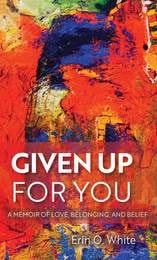
Given Up for You
A Memoir of Love, Belonging, and BeliefErin O. White
University of Wisconsin Press, 2018
In this candid and revelatory memoir, Erin O. White shares her hunger for both romantic and divine love, and how these desires transformed her life. In the late 1990s, she spent Saturday nights with her girlfriend and Sunday mornings in Catholic confirmation classes. But when the Church closed its doors to her, she was faced with a question: What does a lesbian believer do with her longing for God? Given Up for You explores these yearnings with bittersweet conviction, plumbing the depths of heart and soul.
[more]
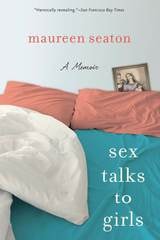
Sex Talks to Girls
A MemoirMaureen Seaton
University of Wisconsin Press, 2008
Sex Talks to Girls chronicles the outward antics of a woman on an inward journey to self through the routes of religion, sex, sobriety, and kids. Recasting herself in this memoir as “Molly Meek,” Maureen Seaton interprets the emergence of Molly’s identity in luxurious and very funny prose.
Molly alternately finds herself in the surprising company of winos, swingers, and drag kings; in love with Jesus H. Christ and a butch named Mars; in charge of two children; writing stories that shrink painfully to poems without her permission; and incapable of figuring out how she landed in any of these predicaments. She is, by turns, a little saint, a Stepford wife, a bi-mom, and a femme with super powers. Her transformation—from near-nun to full-fledged sexual being, accidentally becoming conscious in the process and delighting in the spree—is the story of a life set on play and a woman heroically committed to seeing it through.
Winner, Lesbian Memoir/Biography, Lambda Literary Foundation Book Awards
[more]

The Lives of Jessie Sampter
Queer, Disabled, ZionistSarah Imhoff
Duke University Press, 2022
In The Lives of Jessie Sampter, Sarah Imhoff tells the story of an individual full of contradictions. Jessie Sampter (1883–1938) was best known for her Course in Zionism (1915), an American primer for understanding support of a Jewish state in Palestine. In 1919, Sampter packed a trousseau, declared herself “married to Palestine,” and immigrated there. Yet Sampter’s own life and body hardly matched typical Zionist ideals. Although she identified with Judaism, Sampter took up and experimented with spiritual practices from various religions. While Zionism celebrated the strong and healthy body, she spoke of herself as “crippled” from polio and plagued by sickness her whole life. While Zionism applauded reproductive women’s bodies, Sampter never married or bore children; in fact, she wrote of homoerotic longings and had same-sex relationships. By charting how Sampter’s life did not neatly line up with her own religious and political ideals, Imhoff highlights the complicated and at times conflicting connections between the body, queerness, disability, religion, and nationalism.
[more]