Results by title
3 books match the query 'Lesbians, Black'
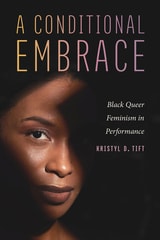
A Conditional Embrace
Black Queer Feminism in PerformanceKristyl D. Tift
The Ohio State University Press, 2026
Uses an intersectional and intertextual methodology to present a rigorous yet accessible study of Black queer women artists in theater and film.
In A Conditional Embrace, Kristyl D. Tift seeks to understand how Black queer women theater and film artists depict their own survival in heterosexist temporalities and spaces. Using the framework of lovin’ on—a theory inspired by Black feminist thought, performance theory, and queer theory—Tift closely reads the works of a selection of artists to investigate the “conditional embrace” of Black queer art in society. Her intersectional and intertextual methodology considers the text and body as part and parcel of performance work, allowing her to examine the multiple and complex intersections of identity at play in works meant to be read and performed. Tift puts the work of more visible artists such as Dee Rees, Sharon Bridgforth, and Staceyann Chin in direct conversation with lesser-known contributors to Black queer feminist performance such as Shirlene Holmes and Donnetta Lavinia Grays, analyzing not only their plays, installations, and poetry but also interviews, personal essays, performances, and more. Centering the works of artists situated, by birth or migration, in the Southern US and the Caribbean, A Conditional Embrace explores how artists at the margins of art and society represent Black queer women’s survival through processes of self-making, community-building, and homemaking.
In A Conditional Embrace, Kristyl D. Tift seeks to understand how Black queer women theater and film artists depict their own survival in heterosexist temporalities and spaces. Using the framework of lovin’ on—a theory inspired by Black feminist thought, performance theory, and queer theory—Tift closely reads the works of a selection of artists to investigate the “conditional embrace” of Black queer art in society. Her intersectional and intertextual methodology considers the text and body as part and parcel of performance work, allowing her to examine the multiple and complex intersections of identity at play in works meant to be read and performed. Tift puts the work of more visible artists such as Dee Rees, Sharon Bridgforth, and Staceyann Chin in direct conversation with lesser-known contributors to Black queer feminist performance such as Shirlene Holmes and Donnetta Lavinia Grays, analyzing not only their plays, installations, and poetry but also interviews, personal essays, performances, and more. Centering the works of artists situated, by birth or migration, in the Southern US and the Caribbean, A Conditional Embrace explores how artists at the margins of art and society represent Black queer women’s survival through processes of self-making, community-building, and homemaking.
[more]
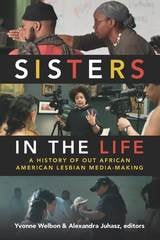
Sisters in the Life
A History of Out African American Lesbian Media-MakingYvonne Welbon and Alexandra Juhasz, editors
Duke University Press, 2018
From experimental shorts and web series to Hollywood blockbusters and feminist porn, the work of African American lesbian filmmakers has made a powerful contribution to film history. But despite its importance, this work has gone largely unacknowledged by cinema historians and cultural critics. Assembling a range of interviews, essays, and conversations, Sisters in the Life tells a full story of African American lesbian media-making spanning three decades. In essays on filmmakers including Angela Robinson, Tina Mabry and Dee Rees; on the making of Cheryl Dunye's The Watermelon Woman (1996); and in interviews with Coquie Hughes, Pamela Jennings, and others, the contributors center the voices of black lesbian media makers while underscoring their artistic influence and reach as well as the communities that support them. Sisters in the Life marks a crucial first step in narrating the history and importance of these compelling yet unsung artists.
Contributors. Jennifer DeVere Brody, Jennifer DeClue, Raul Ferrera-Balanquet, Alexis Pauline Gumbs, Thomas Allen Harris, Devorah Heitner, Pamela L. Jennings, Alexandra Juhasz, Kara Keeling, Candace Moore, Marlon Moore, Michelle Parkerson, Roya Rastegar, L. H. Stallings, Yvonne Welbon, Patricia White, Karin D. Wimbley
Contributors. Jennifer DeVere Brody, Jennifer DeClue, Raul Ferrera-Balanquet, Alexis Pauline Gumbs, Thomas Allen Harris, Devorah Heitner, Pamela L. Jennings, Alexandra Juhasz, Kara Keeling, Candace Moore, Marlon Moore, Michelle Parkerson, Roya Rastegar, L. H. Stallings, Yvonne Welbon, Patricia White, Karin D. Wimbley
[more]
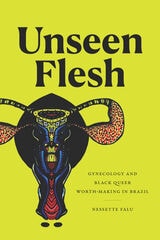
Unseen Flesh
Gynecology and Black Queer Worth-Making in BrazilNessette Falu
Duke University Press, 2023
In Unseen Flesh Nessette Falu explores how Black lesbians in Brazil define and sustain their well-being and self-worth against persistent racial, sexual, class, and gender-based prejudice. Focusing on the trauma caused by interactions with gynecologists, Falu draws on in-depth ethnographic work among the Black lesbian community to reveal their profoundly negative affective experiences within Brazil’s deeply biased medical system. In the face of such entrenched, intersectional intimate violence, Falu’s informants actively pursue well-being in ways that channel their struggle for self-worth toward broader goals of social change, self care, and communal action. Demonstrating how the racist and heteronormative underpinnings of gynecology erase Black lesbian subjecthood through mental, emotional, and physical traumas, Falu explores the daily resistance and abolitionist practices of worth-making that claim and sustain Black queer identity and living. Falu rethinks the medicalization of race, sex, and gender in Brazil and elsewhere while offering a new perspective on Black queer life through well-being grounded in relationships, socioeconomic struggles, the erotic, and freedom strivings.
[more]