Results by title
4 books match the query 'Lesbos (Greece : Municipality)'

Fictions of Sappho, 1546-1937
Joan DeJean
University of Chicago Press, 1989
Considering Sappho as a creature of translation and interpretation, a figment whose features have changed with social mores and aesthetics, Joan DeJean constructs a fascinating history of the sexual politics of literary reception. The association of Sappho with female homosexuality has made her a particularly compelling and yet problematic subject of literary speculation; and in the responses of different cultures to the challenge the poet presents, DeJean finds evidence of the standards imposed on female sexuality through the ages. She focuses largely though not exclusively on the French tradition, where the Sapphic presence is especially pervasive. Tracing re-creations of Sappho through translation and fiction from the mid-sixteenth century to the period just prior to World War II, DeJean shows how these renderings reflect the fantasies and anxieties of each writer as well as the mentalité of his or her day.
[more]

New Borders
Migration, Hotspots and the European SuperstateAntonis Vradis, Evie Papada, Joe Painter, and Anna Papoutsi
Pluto Press, 2018
New Borders is the culmination of two years of research on the Mediterranean migration crisis of 2015-16. The book focuses on Lesbos, a Greek island that came under intense media and political scrutiny as more than one million people crossed its borders, changing and remaking life there. When these migrants—more than ten times the island’s earlier population—landed on Lesbos’s shores, local authorities were dismantled and replaced by supranational law and authority. In the ensuing months, reception turned to detention, rescue to registration, and refuge to duress.
As borders across Europe have come to symbolize the European Union, this book provides answers to questions of European policy, the securitization of national boundaries, and how legislation determines who is free to belong to a place.
As borders across Europe have come to symbolize the European Union, this book provides answers to questions of European policy, the securitization of national boundaries, and how legislation determines who is free to belong to a place.
[more]
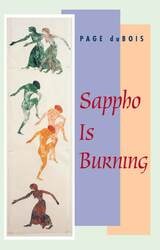
Sappho Is Burning
Page duBois
University of Chicago Press, 1995
To know all we know about Sappho is to know little. Her poetry, dating from the seventh century B.C.E., comes to us in fragments, her biography as speculation. How is it then, Page duBois asks, that this poet has come to signify so much? Sappho Is Burning offers a new reading of this archaic lesbian poet that acknowledges the poet's distance and difference from us and stresses Sappho's inassimilability into our narratives about the Greeks, literary history, philosophy, the history of sexuality, the psychoanalytic subject.
In Sappho is Burning, duBois reads Sappho as a disruptive figure at the very origin of our story of Western civilization. Sappho is beyond contemporary categories, inhabiting a space outside of reductively linear accounts of our common history. She is a woman, but also an aristocrat, a Greek, but one turned toward Asia, a poet who writes as a philosopher before philosophy, a writer who speaks of sexuality that can be identified neither with Michel Foucault's account of Greek sexuality, nor with many versions of contemporary lesbian sexuality. She is named as the tenth muse, yet the nine books of her poetry survive only in fragments. She disorients, troubles, undoes many certitudes in the history of poetry, the history of philosophy, the history of sexuality. DuBois argues that we need to read Sappho again.
In Sappho is Burning, duBois reads Sappho as a disruptive figure at the very origin of our story of Western civilization. Sappho is beyond contemporary categories, inhabiting a space outside of reductively linear accounts of our common history. She is a woman, but also an aristocrat, a Greek, but one turned toward Asia, a poet who writes as a philosopher before philosophy, a writer who speaks of sexuality that can be identified neither with Michel Foucault's account of Greek sexuality, nor with many versions of contemporary lesbian sexuality. She is named as the tenth muse, yet the nine books of her poetry survive only in fragments. She disorients, troubles, undoes many certitudes in the history of poetry, the history of philosophy, the history of sexuality. DuBois argues that we need to read Sappho again.
[more]

Wind–Mountain–Oak
The Poems of SapphoDan Beachy-Quick
Tupelo Press, 2023
Dan Beachy-Quick writes, “There are depths within the denotative life of Greek words that English seldom allows readers in translation to access. At some basic level, I wanted to offer a translation that traced out some of those complexities into an apprehendable substance in the poems themselves—sometimes by allowing an image to unfold more fully than is the norm, at other times by giving some sense of a word’s complicated life, the compound nature of the Greek language, or by translating the same line in multiple ways. The hope, far-fetched as it might be, is to give a reader in English some semblance of how an ancient Greek listener might hear these songs. I’ve also veered away from the various traditions of ordering the poems. I’ve clustered them into groups that seem to loosely trace the entirety of life, from childhood to older age, from the birth of desire to the fear of no longer being desirable. In a quiet way, I mean the book to read as a kind novel, a bildungsroman, so that a larger sense of the life—the poem of the life—becomes palpable. “
[more]