Results by title
4 books match the query 'Lesson'
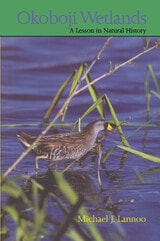
Okoboji Wetlands
A Lesson in Natural HistoryMichael J. Lannoo
University of Iowa Press, 1996
Lake Okoboji in northwest Iowa is the jewel of the Iowa Great Lakes. A region of wetlands formed by prairie potholes, the area is rich with lakes, sloughs, fens, creeks, prairies, and kettleholes. In this readable and beautifully illustrated volume, Michael Lannoo presents an extensive natural history of Okoboji and its cherished wetlands that examines that world of our grandparents, compares it to today's world, and extrapolates to the world of our grandchildren.
[more]

Teaching Information Literacy Threshold Concepts
LessonPatricia Bravender
Assoc of College & Research Libraries, 2015
[more]
The Lesson of Carl Schmitt
Four Chapters on the Distinction between Political Theology and Political PhilosophyHeinrich Meier
University of Chicago Press, 1998
This book is the culmination of Heinrich Meier's acclaimed analyses of the controversial thought of Carl Schmitt. Meier identifies the core of Schmitt's thought as political theology—that is, political theorizing that claims to have its ultimate ground in the revelation of a mysterious or supra-rational God. This radical, but half-hidden, theological foundation unifies the whole of Schmitt's often difficult and complex oeuvre, cutting through the intentional deceptions and unintentional obfuscations that have eluded previous commentators.
Relating this religious dimension to Schmitt's support for National Socialism and his continuing anti-Semitism, Meier compels the reader to come to terms with the irreconcilable differences between political theology and political philosophy. His book will give pause to those who have tended to gloss over the troubling aspects of some of Schmitt's ideas.
With editions in German, French, Italian, and now English, Meier's two books on Schmitt have dramatically reoriented the international debate about Carl Schmitt and his significance for twentieth-century political thought.
"Standing far above the rest . . . is Heinrich Meier's new study, Die Lehre Carl Schmitts, which covers all of Schmitt's writings. . . . Meier's work has forced everyone to take a second look at the assumptions underlying Schmitt's better-known writings and reconsider some that have been ignored."—Mark Lilla, reviewing the German edition in The New York Review of Books
[more]
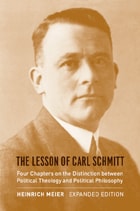
The Lesson of Carl Schmitt
Four Chapters on the Distinction between Political Theology and Political Philosophy, Expanded EditionHeinrich Meier
University of Chicago Press, 2011
Heinrich Meier’s work on Carl Schmitt has dramatically reoriented the international debate about Schmitt and his significance for twentieth-century political thought. In The Lesson of Carl Schmitt, Meier identifies the core of Schmitt’s thought as political theology—that is, political theorizing that claims to have its ultimate ground in the revelation of a mysterious or suprarational God. This radical, but half-hidden, theological foundation underlies the whole of Schmitt’s often difficult and complex oeuvre, rich in historical turns and political convolutions, intentional deceptions and unintentional obfuscations.
In four chapters on morality, politics, revelation, and history, Meier clarifies the difference between political philosophy and Schmitt’s political theology and relates the religious dimension of his thought to his support for National Socialism and his continuing anti-Semitism. New to this edition are two essays that address the recently published correspondences of Schmitt—particularly with Hans Blumberg—and the light it sheds on his conception of political theology.
[more]