Results by title
6 books match the query 'Let'
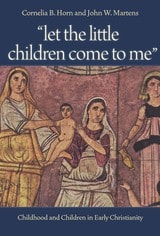
"Let the Little Children Come to Me"
Childhood and Children in Early Christianity"Cornelia B. Horn
Catholic University of America Press, 2009
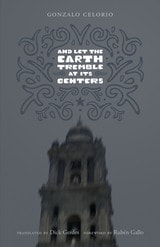
And Let the Earth Tremble at Its Centers
By Gonzalo Celorio
University of Texas Press, 2009
Professor Juan Manuel Barrientos prefers footsteps to footnotes. Fighting a hangover, he manages to keep his appointment to lead a group of students on a walking lecture among the historic buildings of downtown Mexico City. When the students fail to show up, however, he undertakes a solo tour that includes more cantinas than cathedrals. Unable to resist either alcohol itself or the introspection it inspires, Professor Barrientos muddles his personal past with his historic surroundings, setting up an inevitable conclusion in the very center of Mexico City.
First published in Mexico in the late 1990s, And Let the Earth Tremble at Its Centers was immediately lauded as a contemporary masterpiece in the long tradition of literary portraits of Mexico City. It is a book worthy of its dramatic title, which is drawn from a line in the Mexican national anthem.
Gonzalo Celorio first earned a place among the leading figures of Mexican letters for his scholarship and criticism, and careful readers will recognize a scholar's attention to accuracy within the novel's dyspeptic descriptions of Mexico City. The places described are indeed real (this edition includes a map that marks those visited in the story), though a few have since closed or been put to new uses. Dick Gerdes's elegant translation now preserves them all for a new audience.

Let the Games Begin!
Engaging Students with Interactive Information Literacy InstructionTheresa R. McDevitt
American Library Association, 2011
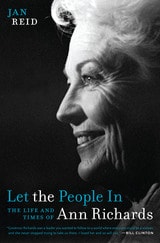
Let the People In
The Life and Times of Ann RichardsBy Jan Reid
University of Texas Press, 2012
Winner, Coral Horton Tullis Memorial Prize, Texas State Historical Association, 2012
Liz Carpenter Award for Research in the History of Women, Texas State Historical Association, 2012
When Ann Richards delivered the keynote of the 1988 Democratic National Convention and mocked President George H. W. Bush—“Poor George, he can’t help it. He was born with a silver foot in his mouth”—she instantly became a media celebrity and triggered a rivalry that would alter the course of American history. In 1990, Richards won the governorship of Texas, upsetting the GOP’s colorful rancher and oilman Clayton Williams. The first ardent feminist elected to high office in America, she opened up public service to women, blacks, Hispanics, Asian Americans, gays, and the disabled. Her progressive achievements and the force of her personality created a lasting legacy that far transcends her rise and fall as governor of Texas.
In Let the People In, Jan Reid draws on his long friendship with Richards, interviews with her family and many of her closest associates, her unpublished correspondence with longtime companion Bud Shrake, and extensive research to tell a very personal, human story of Ann Richards’s remarkable rise to power as a liberal Democrat in a conservative Republican state. Reid traces the whole arc of Richards’s life, beginning with her youth in Waco, her marriage to attorney David Richards, her frustration and boredom with being a young housewife and mother in Dallas, and her shocking encounters with Lyndon Johnson and Jimmy Carter. He follows Richards to Austin and the wild 1970s scene and describes her painful but successful struggle against alcoholism. He tells the full, inside story of Richards’s rise from county office and the state treasurer’s office to the governorship, where she championed gun control, prison reform, environmental protection, and school finance reform, and he explains why she lost her reelection bid to George W. Bush, which evened his family’s score and launched him toward the presidency. Reid describes Richards’s final years as a world traveler, lobbyist, public speaker, and mentor and inspiration to office holders, including Hillary Clinton. His nuanced portrait reveals a complex woman who battled her own frailties and a good-old-boy establishment to claim a place on the national political stage and prove “what can happen in government if we simply open the doors and let the people in.”
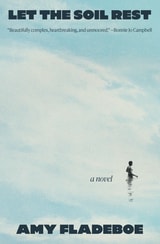
Let the Soil Rest
A NovelAmy Fladeboe
Northwestern University Press, 2027
Reaching across miles and memory to deconstruct the American Dream in the Midwest Rust Belt
Arjan, a teen refugee from postcommunist Albania, and Jess, a Midwestern high schooler, strike up an unlikely friendship working a seasonal job on a farm in Michigan. Now in their thirties, the two have taken different paths—he chasing the American Dream with a running rotation of day-labor gigs, and she living on the road and off the grid, trying to escape the very same ideal. When Jess lands in Hamtramck, just a few miles from her suburban Detroit upbringing after years wandering, they find themselves trudging the same unplowed sidewalks, spinning loads at the same laundromat, and picking the same jukebox songs at the local dive. Both are haunted by the ghosts of childhood traumas, a chorus of the collective unconscious that takes us from the Albanian coast to the Rust Belt heartland. So near one another and yet so far apart, they must reach across miles and memories to discover that the most important voice in our heads is our own.
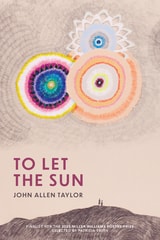
To Let the Sun
John Allen Taylor
University of Arkansas Press, 2025
Finalist, 2025 Miller Williams Poetry Prize
John Allen Taylor’s debut poetry collection To Let the Sun opens with an invitation both generous and resolute: “take a walk with me . . . I hope you’ll come / though I am going anyway.” These poems peel back the layers of recovery as an adult from childhood sexual abuse, the myriad ways a body can change to protect itself from memory, and the difficulty of looking at abuse head-on. Taylor uses a poetics of reclamation to write the child-self from a perspective beyond trauma, to document the messiness of survival, the child’s flight from himself, and the uncertain path home—to a life filled with small and perfect things. Through hermit crabs and golden pothos, fungal gnats and beet seed, the speaker reclaims himself: “I am not lost . . . I know memory / is not healed by time, but / by the oddities / with which we adorn our lives, / the fragilities we need to know / we’re needed by.