Results by title
3 books match the query 'Lettered City'
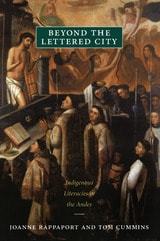
Beyond the Lettered City
Indigenous Literacies in the AndesJoanne Rappaport and Tom Cummins
Duke University Press, 2012
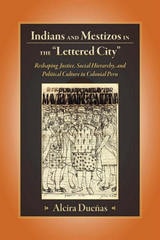
Indians and Mestizos in the "Lettered City"
Reshaping Justice, Social Hierarchy, and Political Culture in Colonial PeruAlcira Duenas
University Press of Colorado, 2010
Scholars have long assumed that Spanish rule remained largely undisputed in Peru between the 1570s and 1780s, but educated elite Indians and mestizos challenged the legitimacy of Spanish rule, criticized colonial injustice and exclusion, and articulated the ideas that would later be embraced in the Great Rebellion in 1781. Their movement extended across the Atlantic as the scholars visited the seat of the Spanish empire to negotiate with the king and his advisors for social reform, lobbied diverse networks of supporters in Madrid and Peru, and struggled for admission to religious orders, schools and universities, and positions in ecclesiastic and civil administration.
Indians and Mestizos in the "Lettered City" explores how scholars contributed to social change and transformation of colonial culture through legal, cultural, and political activism, and how, ultimately, their significant colonial critiques and campaigns redefined colonial public life and discourse. It will be of interest to scholars and students of colonial history, colonial literature, Hispanic studies, and Latin American studies.
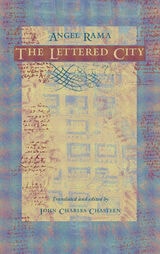
The Lettered City
Angel Rama
Duke University Press, 1996
Starting with the colonial period, Rama undertakes a historical analysis of the hegemonic influences of the written word. He explores the place of writing and urbanization in the imperial designs of the Iberian colonialists and views the city both as a rational order of signs representative of Enlightenment progress and as the site where the Old World is transformed—according to detailed written instructions—in the New. His analysis continues by recounting the social and political challenges faced by the letrados as their roles in society widened to include those of journalist, fiction writer, essayist, and political leader, and how those roles changed through the independence movements of the nineteenth century. The coming of the twentieth century, and especially the gradual emergence of a mass reading public, brought further challenges. Through a discussion of the currents and countercurrents in turn-of-the-century literary life, Rama shows how the city of letters was finally “revolutionized.”
Already crucial in setting the terms for debate concerning the complex relationships among intellectuals, national formations, and the state, this elegantly written and translated work will be read by Latin American scholars in a wide range of disciplines, and by students and scholars in the fields of anthropology, cultural geography, and postcolonial studies.