Results by title
5 books match the query 'Levi, Primo'

Conversations with Primo Levi
Ferdinando Camon
Northwestern University Press, 1989
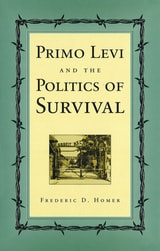
Primo Levi and the Politics of Survival
Frederic D. Homer
University of Missouri Press, 2001
At the age of twenty-five, Primo Levi was sent to Hell. Levi, an Italian chemist from Turin, was one of many swept up in the Holocaust of World War II and sent to die in the German concentration camp in Auschwitz. Of the 650 people transported to the camp in his group, only 15 men and 9 women survived. After Soviet liberation of the camp in 1945, Levi wrote books, essays, short stories, poetry, and a novel, in which he painstakingly described the horrors of his experience at Auschwitz. He also spent the rest of his life struggling with the fact that he was not among those who were killed.
In Primo Levi and the Politics of Survival, Frederic D. Homer looks at Primo Levi's life but, more important, shows him to be a significant political philosopher. In the course of his writings, Levi asked and answered his most haunting question: can someone be brutalized by a terrifying experience and, upon return to "ordinary life," recover from the physical and moral destruction he has suffered? Levi used this question to develop a philosophy positing that although man is no match for life, he can become better prepared to contend with the tragedies in life.
According to Levi, the horrors of the world occur because of the strength of human tendencies, which make relationships between human beings exceedingly fragile. He believed that we are ill-constituted beings who have tendencies toward violence and domination, dividing ourselves into Us and Them, with very shallow loyalties. He also maintained that our only refuge is in education and responsibility, which may counter these tendencies. Homer calls Levi's philosophy "optimistic pessimism."
As Homer demonstrates, Levi took his past experiences into account to determine that goodwill and democratic institutions do not come easily to people. Liberal society is to be earned through discipline and responsibility toward our weaknesses. Levi's answer is "civilized liberalism." To achieve this we must counter some of our most stubborn tendencies.
Homer also explores the impact of Levi's death, an apparent suicide, on the way in which his work and theories have been perceived. While several critics discount Levi's work because of the nature of his death, Homer argues that his death is consistent with his philosophy. A book rich in brutally honest philosophy, Primo Levi and the Politics of Survival compels one to look at serious questions about life, tragedy, optimism, solidarity, violence, and human nature.
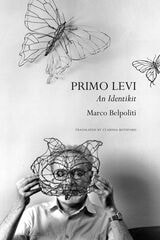
Primo Levi
An IdentikitMarco Belpoliti
Seagull Books, 2022
Over the last seventy years, Primo Levi (1919–87) has been recognized as the foremost literary witness of the extermination of the European Jews. In Primo Levi: An Identikit, a product of twenty years of research, Marco Belpoliti explores Levi’s tormented life, his trajectory as a writer and intellectual, and, above all, his multifaceted and complex oeuvre.
Organized in a mosaic format, this volume devotes a different chapter to each of Levi’s books. In addition to tracing the history of each book’s composition, publication, and literary influences, Belpoliti explores their contents across the many worlds of Primo Levi: from chemistry to anthropology, biology to ethology, space flights to linguistics. If This Is a Man, his initially rejected masterpiece, is also reread with a fresh perspective. We learn of dreams, animals, and travel; of literary writing, comedy, and tragedy; of shame, memory, and the relationship with other writers such as Franz Kafka and Georges Perec, Jean Améry and Varlam Shalamov. Fundamental themes such as Judaism, the camp, and testimony innervate the book, which is complemented by photographs and letters found by the author in hitherto unexplored archives.
This will be the definitive book on Primo Levi, a treasure trove of stories and reflections that paint a rich, nuanced composite portrait of one of the twentieth century’s most unique and urgent voices.
Rage Is the Subtext
Readings in Holocaust Literature and FilmSusan Derwin
The Ohio State University Press, 2012
Rage Is the Subtext charts the internal shifts of Holocaust survivors who tell their stories of suffering, loss, and endurance. Susan Derwin locates the healing effect of literary testimony in its capacity to represent the reactions of survivors to traumatic experience, while concealing other more unsettling responses from view. Beneath the explicit concerns of works by Primo Levi, Saul Friedländer, Binjamin Wilkomirski, Imre Kertész and Liliana Cavani, Derwin uncovers unspoken reserves of rage, which then become legible as formal properties of the text.
The Soul of Brutes
Carlo Ginzburg
Seagull Books, 2022
Carlo Ginzburg has been at the forefront of the discipline of microhistory ever since his earliest works were published to great acclaim in the 1970s. The Soul of Brutes brings together four of Ginzburg’s recent scintillating essays and lectures that testify to the diversity of his thoughts on history and philosophy.
“Civilization and Barbarism” resurrects a sixteenth-century debate between two thinkers in Spain about the humanness, or lack thereof, of Native Americans, and highlights the influence of classical thinkers, from Herodotus to Aristotle, and the iterations and interpretations through which their writings have traversed down to the Cinquecento. In “The Soul of Brutes” Ginzburg traces the genealogy of the debate on the rationality of animals and the limits of their imagination, from Plutarch and Aristotle to sixteenth-century thinkers like Pietro Pomponazzi and Girolamo Rorario. Following Montaigne, he provokes, are we to beasts as they seem to us? In “Calvino, Manzoni and the Grey Zone,” Carlo Ginzburg pithily writes about the mental dialogue between Holocaust survivor Primo Levi and two Italians who profoundly influenced Levi’s search for these “unexplored pockets of exception”—his contemporary Italo Calvino and the nineteenth-century novelist and philosopher Alessandro Manzoni. And finally, in “Schema and Bias”, he probes whether the historian can clearly see into the past, peering through the layers of bias, which include their own prejudices, or if relativism is the only path.
With several beautifully reproduced color illustrations, The Soul of Brutes will interest not only scholars of history, philosophy, and art, but also general intellectual readers.