Results by title
6 books match the query 'Lewis'
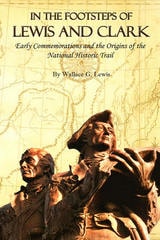
In the Footsteps of Lewis and Clark
Early Commemorations and the Origins of the National Historic TrailWallace G. Lewis
University Press of Colorado, 2024
The first significant stirrings of national public interest in Lewis and Clark coincided with the beginning of a nationwide fascination with transcontinental automobile touring. Americans began to reconnect with the past and interact with the history of Western expansion by becoming a new breed of "frontier explorer" via their cars. As a result, early emphasis on local plaques and monuments yielded to pageants, reenactments, and, ultimately, attempts to retrace the route, promoting conservation and recreation along its length.
Wallace G. Lewis details the ingenuity that inspired the establishment of the Lewis and Clark National Historic Trail, opening a window to how America reimagines, recreates, and remembers its own past. In the Footsteps of Lewis and Clark will appeal to both scholarly and armchair historians interested in the Western frontier as experienced by both Lewis and Clark and those retracing their steps today.
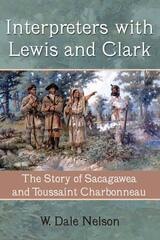
Interpreters with Lewis and Clark
The Story of Sacagawea and Toussaint CharbonneauW. Dale Nelson
University of North Texas Press, 2003
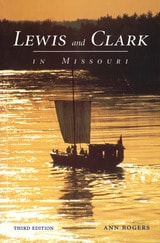
Lewis and Clark in Missouri
Ann Rogers
University of Missouri Press, 2002
The Geometry of Modernism
The Vorticist Idiom in Lewis, Pound, H.D., and YeatsBy Miranda B. Hickman
University of Texas Press, 2006
Addressing both the literature and the visual arts of Anglo-American modernism, The Geometry of Modernism recovers a crucial development of modernism's early years that until now has received little sustained critical attention: the distinctive idiom composed of geometric forms and metaphors generated within the early modernist movement of Vorticism, formed in London in 1914. Focusing on the work of Wyndham Lewis, leader of the Vorticist movement, as well as Ezra Pound, H.D., and William Butler Yeats, Hickman examines the complex of motives out of which Lewis initially forged the geometric lexicon of Vorticism—and then how Pound, H.D., and Yeats later responded to it and the values that it encoded, enlisting both the geometric vocabulary and its attendant assumptions and ideals, in transmuted form, in their later modernist work.
Placing the genesis and appropriation of the geometric idiom in historical context, Hickman explores how despite its brevity as a movement, Vorticism in fact exerted considerable impact on modernist work of the years between the wars, in that its geometric idiom enabled modernist writers to articulate their responses to both personal and political crises of the 1930s and 1940s. Informed by extensive archival research as well as treatment of several of the least-known texts of the modernist milieu, The Geometry of Modernism clarifies and enriches the legacy of this vital period.
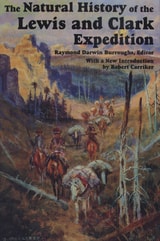
The Natural History of Lewis and Clark Expedition
Raymond Darwin Burroughs
Michigan State University Press, 1995
First published in 1961, The Natural History of the Lewis and Clark Expedition was the first work to discuss in detail the contributions to America's natural history made by the Corps of Discovery (1804-1806), or the Lewis and Clark Expedition, as it is popularly known. Raymond Darwin Burroughs tallied the quantity of game killed and consumed during the course of the expedition.
This paperback edition of Burroughs' work contains the entire original text, as well as a new introduction by Lewis and Clark scholar Robert Carriker. The major contribution of The Natural History of the Lewis and Clark Expedition was to organize and catalog the disparate discussions of animal and plant life that are scattered throughout the original journals by expedition members. These observations are presented in the explorers' words along with Burroughs's expert commentary.
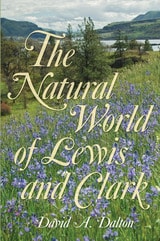
The Natural World of Lewis and Clark
David A. Dalton
University of Missouri Press, 2007
On their journey westward, Lewis and Clark demonstrated an amazing ability to identify the new plants and animals they encountered, and their observations enriched science’s understanding of the trans-Mississippi West. Others have written about their discoveries and have faithfully cataloged their findings; now a twenty-first-century biologist reexamines some of those discoveries in the light of modern science to show for the first time their lasting biological significance.
The Natural World of Lewis and Clark interprets the expedition’s findings from a modern perspective to show how advances such as DNA research, modern understanding of proteins, and the latest laboratory methods shed new light on them. David Dalton recounts the expedition’s observations and, in clear, readily accessible terms, relates them to principles of ecology, genetics, physiology, and even animal behavior.
Writing in informal language with a bit of wry humor, Dalton invites readers to imagine the West that Lewis and Clark found, revealing the dynamic features of nature and the dramatic changes that earlier peoples brought about. He explains surprising facts, ranging from why Indians used cottonwood bark as winter feed for horses to why the explorers experienced gastric distress with some foods, and even why the Expedition’s dog would have been well-advised to avoid a diet of salmon.
Dalton introduces the tools and techniques of today’s science in a way that won’t intimidate nonspecialist readers. Throughout the book he expertly balances botanical and zoological information, with coverage ranging from the extinction of large animals in North America a few thousand years ago to the expected effects of invasive species and climate change in the coming centuries.
Enhanced with unusual and informative illustrations—not only nature photography but also historical images—this book will fascinate any reader with an interest in the natural history of the American West as well as broader issues in conservation and ecology. The Natural World of Lewis and Clark tells the story behind the story of this remarkable expedition and shows that its legacy extended not only across a continent but also into our own time.