Results by title
4 books match the query 'Lewis, C. S. (Clive Staples)'
Bareface
A Guide to C.S. Lewis's Last NovelDoris T. Myers
University of Missouri Press, 2004
Imagination and the Arts in C.S. Lewis
Journeying to Narnia and Other WorldsPeter J. Schakel
University of Missouri Press, 2002
Imagination has long been regarded as central to C. S. Lewis's life and to his creative and critical works, but this is the first study to provide a thorough analysis of his theory of imagination, including the different ways he used the word and how those uses relate to each other. Peter Schakel begins by concentrating on the way reading or engaging with the other arts is an imaginative activity. He focuses on three books in which imagination is the central theme—Surprised by Joy, An Experiment in Criticism, and The Discarded Image—and shows the important role of imagination in Lewis's theory of education.
He then examines imagination and reading in Lewis's fiction, concentrating specifically on the Chronicles of Narnia, the most imaginative of his works. He looks at how the imaginative experience of reading the Chronicles is affected by the physical texture of the books, the illustrations, revisions of the texts, the order in which the books are read, and their narrative "voice," the "storyteller" who becomes almost a character in the stories.
Imagination and the Arts in C. S. Lewis also explores Lewis's ideas about imagination in the nonliterary arts. Although Lewis regarded engagement with the arts as essential to a well- rounded and satisfying life, critics of his work and even biographers have given little attention to this aspect of his life. Schakel reviews the place of music, dance, art, and architecture in Lewis's life, the ways in which he uses them as content in his poems and stories, and how he develops some of the deepest, most significant themes of his stories through them.
Schakel concludes by analyzing the uses and abuses of imagination. He looks first at "moral imagination." Although Lewis did not use this term, Schakel shows how Lewis developed the concept in That Hideous Strength and The Abolition of Man long before it became popularized in the 1980s and 1990s. While readers often concentrate on the Christian dimension of Lewis's works, equally or more important to him was their moral dimension.
Imagination and the Arts in C. S. Lewis will appeal to students and teachers of both children's literature and twentieth-century British writers. It will also be of value to readers who wish to compare Lewis's creations with more recent imaginative works such as the Harry Potter series.
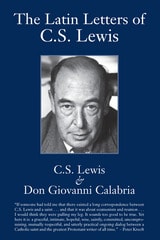
Latin Letters of C.S. Lewis
C.S. Lewis and Don Giovanni Calabria
St. Augustine's Press, 1999
Through the Open Door
A New Look at C.S. LewisDabney Adams Hart
University of Alabama Press, 1984
Unlocking the imagination, language, and vision that shaped C. S. Lewis's enduring legacy.
Through the Open Door: A New Look at C. S. Lewis offers a fresh and illuminating examination of one of the twentieth century's most beloved writers, scholars, and Christian thinkers. In this insightful study, Dabney Adams Hart moves beyond familiar assessments of C. S. Lewis as the creator of The Chronicles of Narnia to explore the intellectual foundations that shaped his work as a literary critic, educator, and defender of the Christian faith. Drawing on Lewis's essays, criticism, fiction, and apologetic writings, Hart reveals the central importance of imagination, language, myth, and meaning in Lewis's understanding of literature and human experience.
Rather than treating Lewis's diverse writings as separate endeavors, Hart demonstrates how they reflect a coherent and unified vision of truth, beauty, and morality. The book shows how Lewis used story and symbolism to address enduring questions about faith, reason, and the search for purpose in a modern world. Accessible to general readers while engaging for scholars, this volume provides valuable insight into the ideas that continue to make Lewis a significant figure in literary and religious studies. An important contribution to Lewis scholarship, Through the Open Door invites readers to discover anew the imagination and intellect behind one of the most influential Christian authors of the modern era.