Results by title
6 books match the query 'Lexicology'
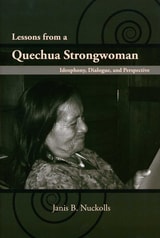
Lessons from a Quechua Strongwoman
Ideophony, Dialogue, and PerspectiveJanis B. Nuckolls
University of Arizona Press, 2010
This book is a fascinating look at ideophones—words that communicate succinctly through imitative sound qualities. They are at the core of Quechua speakers’ discourse—both linguistic and cultural—because they allow agency and reaction to substances and entities as well as beings. Nuckolls shows that Luisa Cadena’s utterances give every individual, major or minor, a voice in her narrative. Sometimes as subtle as a barely felt movement or unintelligible sound, the language supports an amazingly wide variety of voices.
Cadena’s narratives and commentaries on everyday events reveal that sound imitation through ideophones, representations of dialogues between humans and nonhumans, and grammatical distinctions between a speaking self and an other are all part of a language system that allows for the possibility of shared affects, intentions, moral values, and meaningful, communicative interactions between humans and nonhumans.
Lexical Change and Variation in the Southeastern United States, 1930-1990
Ellen Johnson
University of Alabama Press, 1996
This book discusses words used in the Southeast and how they have changed
during the 20th century. It also describes how the lexicon varies according
to the speaker's age, race, education, sex, and place of residence
(urban versus rural; coastal versus piedmont versus mountain). Data collected
in the 1930s as part of the Linguistic Atlas of the Middle and South Atlantic
States project were compared with data collected in 1990 from similar speakers
in the same communities.
The results show that region was the most important
factor in differentiating dialects in the 1930s but that it is the least
important element in the 1990s, with age, education, race, and age all
showing about the same influence on the use of vocabulary. An appendix
contains a tally of the responses given by 78 speakers to 150 questions
about vocabulary items, along with speakers' commentary. Results
from the 1930s may be compared to those from 1990, making this a treasure
trove for anyone interested in regional terms or in how our speech is changing
as the South moves from an agricultural economy through industrialization
and into the information age.
Lexical Matters
Edited by Ivan A. Sag and Anna Szabolcsi
CSLI, 1992
Lexical Relations
Jean-Pierre Koenig
CSLI, 1999
Mixed Categories in the Hierarchical Lexicon
Robert P. Malouf
CSLI, 2000
This book presents a novel analysis of this and similar mixed category constructions in languages including Quechua, Tibetan, Arabic, Fijian, Dagaare, and Jacaltec. Under this analysis, Robert P. Malouf shows that verbal gerunds share the selectional properties of verbs and the distributional properties of nouns. He further shows that since different dimensions of grammatical information can vary independently, the behavior of mixed categories creates no paradox. These dimensions are in principle independent. However, certain types of mixed categories are quite common in the world's languages, while others are rare or nonexistent. The book discusses how cross-linguistic variation can be accounted for by a lexical categorial prototype. By stating these prototypes as default constraints in a hierarchy of lexical information, Malouf argues that one can bring insights from cognitive and functional approaches to linguistics into a formal analysis, thus building on the strengths of both approaches.
The Calusa
Linguistic and Cultural Origins and RelationshipsJulian Granberry
University of Alabama Press, 2012
Presents a full phonological and morphological analysis of the total corpus of surviving Calusa language data left by a literate Spanish captive held by the Calusa from his early youth to adulthood
The linguistic origins of Native American cultures and the connections between these cultures as traced through language in prehistory remain vexing questions for scholars across multiple disciplines and interests. Native American linguist Julian Granberry defines the Calusa language, formerly spoken in southwestern coastal Florida, and traces its connections to the Tunica language of northeast Louisiana.
Archaeologists, ethnologists, and linguists have long assumed that the Calusa language of southwest Florida was unrelated to any other Native American language. Linguistic data can offer a unique window into a culture’s organization over space and time; however, scholars believed the existing lexical data was insufficient and have not previously attempted to analyze or define Calusa from a linguistic perspective.
In The Calusa: Linguistic and Cultural Origins and Relationships, Granberry presents a full phonological and morphological analysis of the total corpus of surviving Calusa language data left by a literate Spanish captive held by the Calusa from his early youth to adulthood. In addition to further defining the Calusa language, this book presents the hypothesis of language-based cultural connections between the Calusa people and other southeastern Native American cultures, specifically the Tunica. Evidence of such intercultural connections at the linguistic level has important implications for the ongoing study of life among prehistoric people in North America. Consequently, this thoroughly original and meticulously researched volume breaks new ground and will add new perspectives to the broader scholarly knowledge of ancient North American cultures and to debates about their relationships with one another.