Results by title

2 books match the query 'Lezama Lima, José'
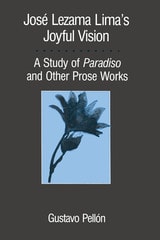
cover of José Lezama Lima's Joyful Vision: A Study of Paradiso and Other Prose Works

José Lezama Lima's Joyful Vision

A Study of Paradiso and Other Prose Works

By Gustavo Pellón

University of Texas Press, 1989

Cuba’s José Lezama Lima became the most controversial figure in the flowering of the Latin American novel with the 1966 publication of Paradiso. Hailed as a seminal writer of breathtaking originality by Julio Cortázar, Octavio Paz, and Mario Vargas Llosa, Lezama was also attacked by the Castro regime and others for his stylistic obscurity, erotic descriptions, and violation of literary norms. Indeed, his experimental fiction, written on the very boundaries of the novelistic genre, resists classification. José Lezama Lima’s Joyful Vision, a much-needed critical study of Paradiso, Oppiano Licario, and Lezama’s essays, is thus an exploration in reading, one that highlights and preserves the essential and persistent contradictions in Lezama’s theory and practice of literature.

Gustavo Pellón focuses his study on Lezama’s search for equilibrium, clarifying such oppositions in Lezama’s writings as the mystical quest for illumination through obscurity, the calculated cultivation of naïveté, the Proust-like fascination with yet ultimate condemnation of homosexuality, and a modernist (even postmodernist) narrative style that conveys a mystical (essentially medieval) worldview. Above all, Pellón shares his wonder at Lezama who, in an age of pessimism, maintained his joyful vision of art and existence.
[more]
cover of Queering Cold War Poetry: Ethics of Vulnerability in Cuba and the United States

Queering Cold War Poetry

Ethics of Vulnerability in Cuba and the United States

Eric Keenaghan

The Ohio State University Press, 2009

Many feel that individualism, and the security it demands, define democracy and freedom. This belief is characteristic of the attitude that thinkers from John Dewey to Michel Foucault have criticized as "liberalist." In actuality, we share intimate associations with one another through contacts established by our bodies and even by language.
In Queering Cold War Poetry, Eric Keenaghan offers queer theory, queer studies, and literary theory a new political and conceptual language for reevaluating past and present high valuations of individualism and security. He examines four Cold War poets from Cuba and the United States—Wallace Stevens, José Lezama Lima, Robert Duncan, and Severo Sarduy. These writers, who lived in an era when homosexuals were regarded as outsiders or even security threats, offer critiques of nationalism and liberalism. In their struggles against state and cultural mandates that foreclosed positive estimations of vulnerability, Stevens, Lezama, Duncan, and Sarduy radically revised ethics and identity in their day. Their work exemplifies how much modernist poetry disseminates experiences of differences that challenge prevailing attitudes about individuals' relationships to one another and to their nations. Through studies of Cuban and U.S. lyric and poetics, Queering Cold War Poetry clears the way for imagining what it means to belong to a passionate and compassionate citizenry which celebrates vulnerability, searches for difference in itself and each of its constituent individuals, and identifies less with a nation than with a global community.
 
[more]