Results by title
4 books match the query 'Liability (Law)'
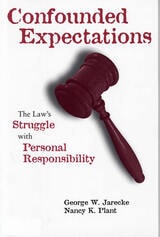
Confounded Expectations
The Law's Struggle with Personal ResponsibilityGeorge W. Jarecke and Nancy K. Plant
Southern Illinois University Press, 2000
George W. Jarecke and Nancy K. Plant present a selection of cases across a broad spectrum of American law to demonstrate that our society relies inappropriately on the legal system to cure ills the system was not designed to address.
Jarecke and Plant note that while we in the United States worry considerably about the problem of individual assumption of responsibility—whether for personal mistakes, financial setbacks, or pure bad luck—we appear uneasy about the concept and unclear about what it means on a daily basis. Not only are we incapable of accepting personal responsibility; we barely know what it means to do so.
Mistakenly, we turn to the legal system to solve this dilemma. Yet our laws as our legislators write them, as judges interpret them, as lawyers argue them, and as juries apply them send mixed messages about whether and how we should exercise personal responsibility.
Each chapter of Confounded Expectations features one main case to explain one legal theory, with other cases noted as examples of facets of each theory. To demonstrate the law that requires merchants to guarantee the quality of their products, for example, Jarecke and Plant discuss the case of the band mothers whose fund-raising luncheon menu included turkey salad contaminated by salmonella. Peripheral cases include a horse falsely sold as a gelding, a riding mower that tipped over when used as instructed, makeup that was guaranteed to be safe but caused a rash, and pigs sick with hog cholera.
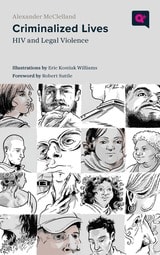
Criminalized Lives
HIV and Legal ViolenceAlexander McClelland
Rutgers University Press, 2024
Canada has been known as a hot spot for HIV criminalization where the act of not disclosing one’s HIV-positive status to sex partners has historically been regarded as a serious criminal offence. Criminalized Lives describes how this approach has disproportionately harmed the poor, Black and Indigenous people, gay men, and women in Canada. In this book, people who have been criminally accused of not disclosing their HIV-positive status, detail the many complexities of disclosure, and the violence that results from being criminalized.
Accompanied by portraits from artist Eric Kostiuk Williams, the profiles examine whether the criminal legal system is really prepared to handle the nuances and ethical dilemmas faced everyday by people living with HIV. By offering personal stories of people who have faced criminalization first-hand, Alexander McClelland questions common assumptions about HIV, the role of punishment, and the violence that results from the criminal legal system’s legacy of categorizing people as either victims or perpetrators.
Note: A regrettable error appears on page 22. The number 240 should be 206 when referring to the number of people prosecuted in relation to allegations of HIV nondisclosure. This will be fixed in future reprints.
Making Rights Real
Activists, Bureaucrats, and the Creation of the Legalistic StateCharles R. Epp
University of Chicago Press, 2009
It’s a common complaint: the United States is overrun by rules and procedures that shackle professional judgment, have no valid purpose, and serve only to appease courts and lawyers. Charles R. Epp argues, however, that few Americans would want to return to an era without these legalistic policies, which in the 1970s helped bring recalcitrant bureaucracies into line with a growing national commitment to civil rights and individual dignity.
Focusing on three disparate policy areas—workplace sexual harassment, playground safety, and police brutality in both the United States and the United Kingdom—Epp explains how activists and professionals used legal liability, lawsuit-generated publicity, and innovative managerial ideas to pursue the implementation of new rights. Together, these strategies resulted in frameworks designed to make institutions accountable through intricate rules, employee training, and managerial oversight. Explaining how these practices became ubiquitous across bureaucratic organizations, Epp casts today’s legalistic state in an entirely new light.
Second-Best Justice
The Virtues of Japanese Private LawJ. Mark Ramseyer
University of Chicago Press, 2015
With Second-Best Justice, J. Mark Ramseyer offers a more compelling, better-grounded explanation: the low rate of lawsuits in Japan results not from distrust of a dysfunctional system but from trust in a system that works—that sorts and resolves disputes in such an overwhelmingly predictable pattern that opposing parties rarely find it worthwhile to push their dispute to trial. Using evidence from tort claims across many domains, Ramseyer reveals a court system designed not to find perfect justice, but to “make do”—to adopt strategies that are mostly right and that thereby resolve disputes quickly and economically.
An eye-opening study of comparative law, Second-Best Justice will force a wholesale rethinking of the differences among alternative legal systems and their broader consequences for social welfare.