Results by title
151 books match the query 'Liberalism' and 7 start with a
A Deeper Freedom
Liberal Democracy as an Everyday MoralityCharles W. Anderson
University of Wisconsin Press, 2002
Today those who believe in liberal democracy must reexamine and reaffirm their commitments. Here, Charles Anderson probes our urgent concerns and questions. Even those who believe that liberal democracy is the best form of government may think that liberal individualism leads to selfishness, permissiveness, and irresponsibility. Many would teach a cultural or religious counter-ethic to offset the excesses of freedom.
Grounding his view in classic philosophic and religious ideals, Anderson argues that a deeper vision of individuality and freedom can lead to both a sound public philosophy and a worthy personal ethic. In the same way that we as humans try to understand our place in nature and the cosmos, Anderson seeks to understand how we, as unique individuals, can understand our place among our fellow humans. Beginning with friendship and love, he extends his inquiry to the relationships of teaching, community, work, and democracy. Anderson shows how the natural desire of free people to find meaning in relationships with one another can lead to depth and fullness both in private and public life.
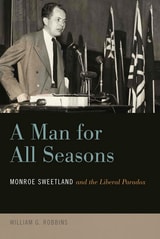
A Man for All Seasons
Monroe Sweetland and the Liberal ParadoxWilliam Robbins
Oregon State University Press, 2015
Historian William G. Robbins illuminates the wrenching transformation of American political culture in A Man for All Seasons: Monroe Sweetland and the Liberal Paradox. Racial and economic inequalities motivated much of Sweetland’s civic life, including his lifelong memberships in the American Civil Liberties Committee, the National Association for the Advancement of Colored People, the Urban League, the Japanese American Citizens League, and the Red Cross, where Sweetland worked repatriating American prisoners of war after Japan’s surrender.
Robbins’ portrait is holistic, exploring Sweetland’s socialist beginnings, inconsistencies in his politics—especially during the Cold War—and his regional legacy. He was the most important person in the resurgence of the modern, liberal Oregon Democratic Party from the late 1940s to the 1960s. He joined the National Education Association in 1964 and became the driving force behind the Bilingual Education Act of 1968 and the fight for the age-18 vote, achieved in the ratification of the 26th amendment in 1971. Monroe Sweetland was a nationally prominent figure, whose fights bequeathed to modern America important legislation that shaped its political landscape.
Afterlives of Modernism
Liberalism, Transnationalism, and Political CritiqueJohn Carlos Rowe
Dartmouth College Press, 2015
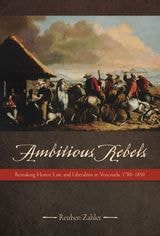
Ambitious Rebels
Remaking Honor, Law, and Liberalism in Venezuela, 1780-1850Reuben Zahler
University of Arizona Press, 2013
In a highly engaging style, Zahler examines gender and class against the backdrop of Venezuelan institutions and culture during the late colonial period through post-independence (known as the “middle period”). His fine-grained analysis shows that liberal ideals permeated the elite and popular classes to a substantial degree while Venezuelan institutions enjoyed impressive levels of success. Showing remarkable ambition, Venezuela’s leaders aspired to transform a colony that adhered to the king, the church, and tradition into a liberal republic with minimal state intervention, a capitalistic economy, freedom of expression and religion, and an elected, representative government.
Subtle but surprisingly profound changes of a liberal nature occurred, as evidenced by evolving standards of honor, appropriate gender roles, class and race relations, official conduct, courtroom evidence, press coverage, economic behavior, and church-state relations. This analysis of the philosophy of the elites and the daily lives of common men and women reveals in particular the unwritten, unofficial norms that lacked legal sanction but still greatly affected political structures.
Relying on extensive archival resources, Zahler focuses on Venezuela but provides a broader perspective on Latin American history. His examination provides a comprehensive look at intellectual exchange across the Atlantic, comparative conditions throughout the Americas, and the tension between traditional norms and new liberal standards in a postcolonial society.
America at Risk
Threats to Liberal Self-Government in an Age of UncertaintyRobert Faulkner and Susan Shell, Editors
University of Michigan Press, 2009
America at Risk gathers original essays by a distinguished and bipartisan group of writers and intellectuals to address a question that matters to Americans of every political persuasion: what are some of the greatest dangers facing America today? The answers, which range from dwindling political participation to rising poverty, and religion to empire, add up to a valuable and timely portrait of a particular moment in the history of American ideas.
While the opinions are many, there is a central theme in the book: the corrosion of the liberal constitutional order that has long guided the country at home and abroad. The authors write about the demonstrably important dangers the United States faces while also breaking the usual academic boundaries: there are chapters on the family, religious polarization, immigration, and the economy, as well as on governmental and partisan issues.
America at Risk is required reading for all Americans alarmed about the future of their country.
Contributors
- Traci Burch
- James W. Ceaser
- Robert Faulkner
- Niall Ferguson
- William A. Galston
- Hugh Heclo
- Pierre Manent
- Harvey C. Mansfield
- Peter Rodriguez
- Kay Lehman Schlozman
- Susan Shell
- Peter Skerry
- James Q. Wilson
- Alan Wolfe
Robert Faulkner is Professor of Political Science at Boston College. Susan Shell is Professor of Political Science at Boston College.
"America at Risk goes well beyond the usual diagnoses of issues debated in public life like immigration, war, and debt, to consider the Republic’s founding principles, and the ways in which they have been displaced by newer thoughts and habits in contemporary America. A critical book for understanding our present condition."
—Francis Fukuyama, Bernard L. Schwartz Professor of International Political Economy, Johns Hopkins School of Advanced International Studies
"In this penetrating book, the nation’s finest social and political thinkers from across the spectrum take a careful and no-holds-barred look at the dangers facing the American political system. The conclusions are more unsettling than reassuring---but that is because they are honest and real."
—Norm Ornstein, Resident Scholar, American Enterprise Institute
"In the midst of overwrought pundits, irate soccer moms, and outraged bloggers, it is difficult to distinguish genuine dangers from false alarms and special pleading. This book enables us to do so, in a way that helps us to actually think about, not just feel anxious about, threats to those features of American society that are worth cherishing. The authors range in ideology and expertise, but they are uniformly judicious, incisive, and informative. This is a fascinating book about issues that the political system usually ignores or exaggerates."
—Jennifer L. Hochschild, Henry LaBarre Jayne Professor of Government and Professor of African and African American Studies, Harvard University
Arthur M. Schlesinger Jr. and the Ideological History of American Liberalism
Stephen P. Depoe
University of Alabama Press, 1994
Arthur M. Schlesinger, Jr., is a historian and political advocate whose ideas and activities have significantly influenced the shape and direction of American liberalism during the past fifty years. A central feature of Schlesinger’s ideological perspective is his belief that American history has been marked by alternating periods of conservative and liberal dominance, which he has termed the “tides of national politics.” Throughout his career, Schlesinger has used the “tides of national politics” to defend the legitimacy and superiority of active liberal government and leadership.
The study investigates how the “tides” concept has functioned in both Schlesinger’s historical scholarship and his partisan political discourse. Depoe also explores the ways in which the “tides” concept has shaped and channeled Schlesinger’s political thought over time, leading him toward certain definitions of situations and away from others. Finally, Depoe offers Schlesinger’s life and work as a case study of the highs and lows of postwar American liberalism. By tracing Schlesinger’s responses to Eisenhower-era conservatism, Kennedy’s New Frontier, and the problems of Vietnam and violence during the 1960s, and the gradual delegitimation of liberalism from the 1970s to the present, this book offers a road map that can guide the reader toward a better understanding of the past, present, and future of liberalism in America.
Authoritarianism
Three Inquiries in Critical TheoryWendy Brown, Peter E. Gordon, and Max Pensky
University of Chicago Press, 2018
In this volume, three distinguished scholars draw on critical theory to address our current predicament. Wendy Brown, Peter E. Gordon, and Max Pensky share a conviction that critical theory retains the power to illuminate the forces producing the current political constellation as well as possible paths away from it. Brown explains how “freedom” has become a rallying cry for manifestly un-emancipatory movements; Gordon dismantles the idea that fascism is rooted in the susceptible psychology of individual citizens and reflects instead on the broader cultural and historical circumstances that lend it force; and Pensky brings together the unlikely pair of Tocqueville and Adorno to explore how democracies can buckle under internal pressure. These incisive essays do not seek to smooth over the irrationality of the contemporary world, and they do not offer the false comforts of an easy return to liberal democratic values. Rather, the three authors draw on their deep engagements with nineteenth–and twentieth–century thought to investigate the historical and political contradictions that have brought about this moment, offering fiery and urgent responses to the demands of the day.