Results by title
1228 books match the query 'Library & Information Science' and 101 start with a

A Basic Music Library
Essential Scores and Sound Recordings, Volume 1: Popular MusicAmerican Library Association, 2022
A Book Sale How-To Guide
More Money, Less StressPat Ditzler
American Library Association, 2012
A Box Full of Tales
Kathy MacMillan
American Library Association, 2008

A Brief History of the Bodleian Library
Mary Clapinson
Bodleian Library Publishing, 2020
How did a library founded over four hundred years ago grow to become the world-renowned institution it is today, home to over thirteen million items? From its foundation by Sir Thomas Bodley in 1598 to the opening of the Weston Library in 2015, this illustrated account shows how the Library’s history has been involved with the British monarchy and political events throughout the centuries. The history of the Library is also a history of collectors and collections, and this book traces the story of major donations and purchases, making use of the Library’s own substantial archives to show how it came to house key items such as early confirmations of the Magna Carta, Shakespeare’s First Folio, and the manuscript of Jane Austen’s earliest writings, among many others.
This revised edition brings the history of the Bodleian Library up to the present moment. Beautifully illustrated with prints, portraits, manuscripts, and archival material, this book is essential reading for anyone interested in the history of libraries and collections.
A Different Kind of Web
New Connections Between Archives and Our UsersKate Theimer
American Library Association, 2011
A Few Good Books
Stephanie L. Maatta
American Library Association, 2010
A History of ALA Policy on Intellectual Freedom
A Supplement to the Intellectual Freedom ManualTrina Magi
American Library Association, 2015
Collecting several key documents and policy statements, this supplement to the tenth edition of the Intellectual Freedom Manual traces a history of ALA's commitment to fighting censorship. Beginning with an introductory essay that chronicles ALA policy making on intellectual freedom, this important resource includes sections discussing such foundational issues as
- library advocacy on social and political issues, from post-World War I disarmament, to Vietnam-era protests, to the call to revisit the field’s rhetoric concerning neutrality;
- the evolution of the Library Bill of Rights, such as the 1978 revision that eliminated its use of sex-linked pronouns and ALA Council actions rescinding the 2018 interpretation on meeting rooms;
- protecting the freedom to read;
- diverse collections and equity, diversity, and inclusion, new to this edition;
- ALA’s complicated history on race, including a 1936 statement opposing discrimination, inaction amidst litigation to desegregate libraries in the 1950s and 1960s, and protests over Florida’s Stand Your Ground Law;
- ALA's Code of Ethics;
- how to respond to challenges and concerns about library resources;
- internet filtering, minors and online activity, and education and information literacy;
- programs and displays;
- policy on governmental intimidation;
- copyright; and
- privacy and confidentiality, including the retention of library usage records.
A Librarian's Guide to an Uncertain Job Market
Jeannette American Library Association
American Library Association, 2011
A Matter of Facts
The Value of Evidence in an Information AgeLaura A. Millar
American Library Association, 2019
The safeguarding of authentic facts is essential, especially in this disruptive Orwellian age, where digital technologies have opened the door to a post-truth world in which “alternative facts” can be so easily accepted as valid. And because facts matter, evidence matters. In this urgent manifesto, archives luminary Millar makes the case that authentic and accurate records, archives, data, and other sources of documentary proof are crucial in supporting and fostering a society that is respectful, democratic, and self-aware. An eye-opening treatise for the general public, an invaluable resource for archives students, and a provocative call-to-arms for information and records professionals, Millar’s book
- explains the concept of evidence and discusses the ways in which records, archives, and data are not just useful tools for our daily existence but also essential sources of evidence both today and in the future;
- includes plentiful examples that illustrate the critical role evidence plays in upholding rights, enforcing responsibilities, tracing family or community stories, and capturing and sharing memories; and
- examines the impact of digital technologies on how records and information are created and used.
With documentary examples ranging from Mesopotamian clay tablets to World War II photographs to today’s Twitter messages and Facebook posts, Millar’s stirring book will encourage readers to understand more fully the importance of their own records and archives, for themselves and for future generations.
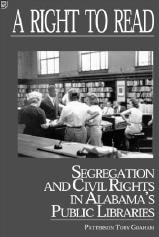
A Right to Read
Segregation and Civil Rights in Alabama's Public Libraries, 1900–1965Patterson Toby Graham
University of Alabama Press, 2006
This original and significant contribution to the historiography of the civil rights movement and education in the South details a dramatic and disturbing chapter in American cultural history.
The tradition of American public libraries is closely tied to the perception that these institutions are open to all without regard to social background. Such was not the case in the segregated South, however, where public libraries barred entry to millions of African Americans and provided tacit support for a culture of white supremacy. A Right to Read is the first book to examine public library segregation from its origins in the late 19th century through its end during the tumultuous years of the 1960s civil rights movement. Graham focuses on Alabama, where African Americans, denied access to white libraries, worked to establish and maintain their own "Negro branches." These libraries-separate but never equal-were always underfunded and inadequately prepared to meet the needs of their constituencies.
By 1960, however, African Americans turned their attention toward desegregating the white public libraries their taxes helped support. They carried out "read-ins" and other protests designed to bring attention and judicial pressure upon the segregationists. Patterson Toby Graham contends that, for librarians, the civil rights movement in their institutions represented a conflict of values that pitted their professional ethics against regional mores. He details how several librarians in Alabama took the dangerous course of opposing segregationists, sometimes with unsettling results.
This groundbreaking work built on primary evidence will have wide cross-disciplinary appeal. Students and scholars of southern and African-American history, civil rights, and social science, as well as academic and public librarians, will appreciate Graham's solid research and astute analysis.
A Slow Approach to Visual Literacy in Higher Education
Lesson Plans for Critical DiscernmentDana Statton Thompson and Stephanie Beene
American Library Association, 2024
- dozens of flexible lesson plans for teaching visual literacy, scaffolded by competency levels: novice, intermediate, and advanced;
- ways to integrate slow looking into the classroom, emphasizing careful observation and the sustained act of looking;
- techniques for showing learners how to select images with intention, as well as carefully determine when and how to share those images;
- reasons why slow creating is essential to understanding and applying visual literacy in the twenty-first century; and
- a look at how increasing access to internet connectivity, generative artificial intelligence (AI), and new ethics for sharing and using information online will affect the future of visual literacy.
A Starter's Guide for Academic Library Leaders
Advice in ConversationAmanda Clay Powers
American Library Association, 2019
The path towards leadership starts with you. But you don’t have to go it alone. For this book, the authors sat down with many of the library leaders they most admire for a series of conversations about the aspects of the job that they find the most fascinating (and challenging). Much like the chats you might have over coffee at a conference or with a mentor, these frank discussions will nourish you with nuts-and-bolts wisdom on a diverse range of academic library management issues. Among the topics and situations broached are
- balancing personal values against the common refrain “you don’t get to be who you want to be in positions like ours”;
- five questions to ask that reveal much about organizational culture and climate;
- creating a culture of change, including why a newly promoted director chose to make the most drastic changes in the first 100 days;
- forming a “dean team” to help frame responses with consideration to institutional culture;
- the value of demystifying the budget for the entire library staff;
- using tools such as a personal “learning journal” to fuel professional development;
- cultivating a personal network by setting up meetings at local libraries during conferences;
- the risks that result from jumping into a situation too fast and boxing yourself into a corner;
- lessons learned from failed initiatives;
- examples of navigating controversies, such as a director’s response to a WPA mural with a racist message; and
- managing facilities, with an example of how injecting a previously ignored library voice into a building project led to a tripling of the space.
Between these covers you’ll find guidance, ideas, and inspiration as you continue your leadership journey.
A Trauma-Informed Approach to Library Services
Rebecca Tolley
American Library Association, 2014
We are only now coming to terms with how common trauma really is; a landmark Kaiser study that surveyed patients receiving physicals found that almost two-thirds had experienced at least one form of abuse, neglect, or other trauma as a child. Though originating in the fields of health and social services, trauma-informed care is a framework that holds great promise for application to library work. Empathetic service, positive patron encounters, and a more trusting workplace are only a few of the benefits that this approach offers. In this important book Tolley, experienced in both academic and public libraries, brings these ideas into the library context. Library administrators, directors, and reference and user services staff will all benefit from learning
- the six key principles of trauma-informed care;
- characteristics of a trusting and transparent library organization, plus discussion questions to promote a sense of psychological safety among library workers;
- how certain language and labels can undermine mutuality, with suggested phrases that will help library staff demonstrate neutrality to patron ideas and views during information requests;
- delivery models that empower patrons;
- advice on balancing free speech on campus with students’ need for safety;
- how appropriate furniture arrangement can help people suffering from PTSD feel safe;
- guidance on creating safe zones for LGBTQIA+ children, teens, and adults; and
- self-assessment tools to support change toward trauma-responsive library services.
A Trauma-Informed Framework for Supporting Patrons
The PLA Workbook of Best PracticesThe Public Library Association Social Worker Task Force
American Library Association, 2022
- delve into what trauma is and how it impacts library work;
- be introduced to a framework for utilizing a trauma-informed lens in your interactions;
- practice exercises to spur personal reflection on common concerns bound up with library work and the policies relating to these issues; and
- gain hand-on tools and techniques, including strategies for de-escalation and guidance on the impacts of involving law-enforcement and banning patrons.
You will also explore various scenarios which provide the opportunity to integrate what you’ve learned and practice responding through a trauma-informed lens, including
- Mental Health Challenges
- Sleeping at the Library
- Strong Personal Odor
- Personal Belongings
- Suspected Intoxication/Under the Influence
- Substance Use
- Threatening Verbal and Nonverbal Behavior
- Unsheltered Teens
- Adult Self-Neglect
- Child Abuse or Assault
- Solicitation or Panhandling
- Stealing
- Child Unattended After Closing
A Year in the Story Room
Ready-to-Use Programs for ChildrenDawn R. Roginski
American Library Association, 2014
A Year of Programs for Millennials and More
Amy Alessio
American Library Association, 2015
A Year of Programs for Teens 2
Amy Alessio
American Library Association, 2011
ALA Filing Rules
American Library Association, 1980
ALA Glossary of Library and Information Science
Michael Levine-Clark
American Library Association, 2013
ALA Guide To Medical & Health Science
American Library Association, 2011
ALA Guide to Economics and Business Reference
American Library Association, 2011
ALA Guide to Sociology and Psychology Reference
Denise Beaubien Bennett
American Library Association, 2011
ALA-APA Salary Survey
Librarian--Public and AcademicAmerican Library Association, 2010
ALSC's Popular Picks for Young Readers
Diane Foote
American Library Association, 2014
Academic Archives
Managing the Next Generation of College and University Archives, Records, and Special CollectionsAaron D. Purcell
American Library Association, 2012
Academic Librarian Burnout
Causes and ResponsesChristina Holm
Assoc of College & Research Libraries, 2022
Academic Librarian Burnout can help librarians develop the agency to challenge the assumptions and practices that have led to so much professional burnout. In five thorough parts, it offers ways to discuss burnout in our work environments, studies burnout’s nature and causes, and provides preventative intervention and mitigation strategies:
- Reframing Burnout
- Conditions that Promote Burnout
- Lived Experiences
- Individual Responses to Burnout
- Organizational Responses to Burnout
Academic Librarian Faculty Status
CLIPP #47Edgar Bailey
Assoc of College & Research Libraries, 2022
Academic Librarian Faculty Status: CLIPP #47 contains a thorough literature review and bibliography, analysis and discussion of survey results, and sample criteria, policies, and guidelines for appointment, promotion, and tenure for librarians with and without faculty status.
No other group of employees in higher education has occupied quite the same ambivalent status on campus as librarians. The debate over granting librarians the same rights and responsibilities as faculty has generated a substantial body of literature over the years. Most of this research has tended to focus on either a mix of institutional sizes or on large universities, with a surprising dearth of studies of smaller institutions. The results of the survey reported in CLIPP #47 fills this gap, as well as offering practical information and sample tenure and promotion documents and policies.
Academic Librarianship
G. Edward Evans
American Library Association, 2018
Ideal for practitioners looking to advance their careers and for use in LIS programs, this "comprehensive overview" (Journal of Access Services) has been thoroughly revised and updated to provide a timely exploration of the characteristics of academic librarianship and its place in the ever-changing environment of higher education. Evans and new coauthor Greenwell guide readers towards understanding what is required to have a successful career in academic librarianship, explaining why academic libraries are distinct from other types of libraries and lending practical insight into their unique political and operational characteristics. The text offers comprehensive coverage of such key issues as
- teaching faculty roles and the status of the academic librarian;
- governance and the growing tension on some campuses between faculty and administration;
- curriculum, with a discussion of the balance between general education requirements and applied courses;
- the student body;
- collections, data management, digitization, and metadata;
- scholarly communication, plus alternative models such as open educational resources (OERs);
- providing quality service, and the role of user experience (UX) in assessment;
- ACRL's Information Literacy Framework;
- funding, including how and where to find detailed higher education expenditure data;
- classrooms, common learning spaces, and other facilities;
- staffing and professional development;
- technology and IT support;
- career development, with advice on preparing a vita and undergoing a successful interview; and
- the future of academic librarianship.
This updated edition enables readers to understand how academic libraries deliver information, offer services, and provide learning spaces in new ways to better meet the needs of today's students, faculty, and other communities of academic library users.
Academic Librarianship
Camila Alire
American Library Association, 2010

Academic Libraries And The Academy Vol 2
Marwin Britto
Assoc of College & Research Libraries, 2018
Academic Libraries And The Academy
Vol 1Marwin Britto
American Library Association, 2018
Academic Libraries and the Academy (2 VOLUME SET)
Strategies and Approaches to Demonstrate Your Value, Impact, and Return on InvestmentMarwin Britto
Assoc of College & Research Libraries, 2018
Academic Libraries for Commuter Students
Research-Based StrategiesMariana Regalado
American Library Association, 2018
Academic Library Impact
Improving Practice AndLynn Silipigni Connaway
Assoc of College & Research Libraries, 2017
Academic Library Job Descriptions
CLIPP #46Kathleen Baril
Assoc of College & Research Libraries, 2021

Academic Library Management
Case StudiesTammy Nickelson Dearie
American Library Association, 2017
Academic Library Mentoring
Fostering Growth and Renewal: Three Volume SetLeila June Rod-Welch
Assoc of College & Research Libraries, 2021
Academic Library Mentoring: Fostering Growth and Renewal presents a cross-section of mentoring thought and practice in college and university libraries, including mentoring definitions, practice fundamentals, models, program development, surveys, and analysis. Across three volumes, it explores library mentoring programs and the lived experiences of library faculty, librarians, library staff members, graduate library and information science students, and library student employees.
Volume 1, Fundamentals and Controversies, details effective mentoring skills and behaviors, mentoring models, dysfunctional mentoring relationships, conflicts of interest in mentoring, and, through a feminist lens, power differentials in mentoring. Chapters on diversity, equity, and inclusion call for library personnel to understand the exclusion some experience in the profession and to implement more inclusive mentoring practices.
Mentoring of Library Faculty and Librarians, Volume 2, explores mentorship skills, models, purposes and issues, and program development. Mentoring purposes include support for the pursuit of tenure and promotion, other career goals, and psychosocial concerns. Issues incorporate understanding and addressing diversity, equity, and inclusion in mentoring. Chapter methodologies include surveys, program assessments, analysis of practices against standards, case studies of mentor and mentee lived experiences, and case studies of libraries and affiliated entities.
In Volume 3, Mentoring of Students and Staff, we hear the voices of library science students and library student employees as they describe their library school and library employment mentoring experiences. Also presented are mentoring programs for recruiting individuals to the profession, practices supporting all library employees regardless of formal employee classification, and methods for enhancing the skills of consortial members. The volume ends with a look to the future of mentoring and organizational development and with a tool any library employee at any career stage can use in forming their own mentoring constellation.
Intentional, effective, committed mentorships can help mentees understand their roles and develop their identities as librarians, library workers, or library science students. Mentorships also help mentees understand and meet performance standards, broaden their skills, shift to new specializations, and discern options for contributing to the larger institution and the profession. Through mentoring, mentors may be invigorated by contributing to the growth of mentees and by encountering ideas and approaches different from their own. Academic Library Mentoring: Fostering Growth and Renewal addresses the many dimensions of contemporary academic library mentoring and how best to engage in inclusive, effective mentoring.
Academic Library Mentoring
Fostering Growth and Renewal: Volume 1: Fundamentals and ControversiesLeila June Rod-Welch
Assoc of College & Research Libraries, 2021
Academic Library Mentoring: Fostering Growth and Renewal presents a cross-section of mentoring thought and practice in college and university libraries, including mentoring definitions, practice fundamentals, models, program development, surveys, and analysis. Across three volumes, it explores library mentoring programs and the lived experiences of library faculty, librarians, library staff members, graduate library and information science students, and library student employees.
Volume 1, Fundamentals and Controversies, details effective mentoring skills and behaviors, mentoring models, dysfunctional mentoring relationships, conflicts of interest in mentoring, and, through a feminist lens, power differentials in mentoring. Chapters on diversity, equity, and inclusion call for library personnel to understand the exclusion some experience in the profession and to implement more inclusive mentoring practices.
Mentoring of Library Faculty and Librarians, Volume 2, explores mentorship skills, models, purposes and issues, and program development. Mentoring purposes include support for the pursuit of tenure and promotion, other career goals, and psychosocial concerns. Issues incorporate understanding and addressing diversity, equity, and inclusion in mentoring. Chapter methodologies include surveys, program assessments, analysis of practices against standards, case studies of mentor and mentee lived experiences, and case studies of libraries and affiliated entities.
In Volume 3, Mentoring of Students and Staff, we hear the voices of library science students and library student employees as they describe their library school and library employment mentoring experiences. Also presented are mentoring programs for recruiting individuals to the profession, practices supporting all library employees regardless of formal employee classification, and methods for enhancing the skills of consortial members. The volume ends with a look to the future of mentoring and organizational development and with a tool any library employee at any career stage can use in forming their own mentoring constellation.
Intentional, effective, committed mentorships can help mentees understand their roles and develop their identities as librarians, library workers, or library science students. Mentorships also help mentees understand and meet performance standards, broaden their skills, shift to new specializations, and discern options for contributing to the larger institution and the profession. Through mentoring, mentors may be invigorated by contributing to the growth of mentees and by encountering ideas and approaches different from their own. Academic Library Mentoring: Fostering Growth and Renewal addresses the many dimensions of contemporary academic library mentoring and how best to engage in inclusive, effective mentoring.
Academic Library Mentoring
Fostering Growth and Renewal: Volume 2: Mentoring of Library Faculty and LibrariansLeila June Rod-Welch
Assoc of College & Research Libraries, 2021
Academic Library Mentoring: Fostering Growth and Renewal presents a cross-section of mentoring thought and practice in college and university libraries, including mentoring definitions, practice fundamentals, models, program development, surveys, and analysis. Across three volumes, it explores library mentoring programs and the lived experiences of library faculty, librarians, library staff members, graduate library and information science students, and library student employees.
Volume 1, Fundamentals and Controversies, details effective mentoring skills and behaviors, mentoring models, dysfunctional mentoring relationships, conflicts of interest in mentoring, and, through a feminist lens, power differentials in mentoring. Chapters on diversity, equity, and inclusion call for library personnel to understand the exclusion some experience in the profession and to implement more inclusive mentoring practices.
Mentoring of Library Faculty and Librarians, Volume 2, explores mentorship skills, models, purposes and issues, and program development. Mentoring purposes include support for the pursuit of tenure and promotion, other career goals, and psychosocial concerns. Issues incorporate understanding and addressing diversity, equity, and inclusion in mentoring. Chapter methodologies include surveys, program assessments, analysis of practices against standards, case studies of mentor and mentee lived experiences, and case studies of libraries and affiliated entities.
In Volume 3, Mentoring of Students and Staff, we hear the voices of library science students and library student employees as they describe their library school and library employment mentoring experiences. Also presented are mentoring programs for recruiting individuals to the profession, practices supporting all library employees regardless of formal employee classification, and methods for enhancing the skills of consortial members. The volume ends with a look to the future of mentoring and organizational development and with a tool any library employee at any career stage can use in forming their own mentoring constellation.
Intentional, effective, committed mentorships can help mentees understand their roles and develop their identities as librarians, library workers, or library science students. Mentorships also help mentees understand and meet performance standards, broaden their skills, shift to new specializations, and discern options for contributing to the larger institution and the profession. Through mentoring, mentors may be invigorated by contributing to the growth of mentees and by encountering ideas and approaches different from their own. Academic Library Mentoring: Fostering Growth and Renewal addresses the many dimensions of contemporary academic library mentoring and how best to engage in inclusive, effective mentoring.
Academic Library Mentoring
Fostering Growth and Renewal: Volume 3: Mentoring of Students and StaffLeila June Rod-Welch
Assoc of College & Research Libraries, 2021
Academic Library Mentoring: Fostering Growth and Renewal presents a cross-section of mentoring thought and practice in college and university libraries, including mentoring definitions, practice fundamentals, models, program development, surveys, and analysis. Across three volumes, it explores library mentoring programs and the lived experiences of library faculty, librarians, library staff members, graduate library and information science students, and library student employees.
Volume 1, Fundamentals and Controversies, details effective mentoring skills and behaviors, mentoring models, dysfunctional mentoring relationships, conflicts of interest in mentoring, and, through a feminist lens, power differentials in mentoring. Chapters on diversity, equity, and inclusion call for library personnel to understand the exclusion some experience in the profession and to implement more inclusive mentoring practices.
Mentoring of Library Faculty and Librarians, Volume 2, explores mentorship skills, models, purposes and issues, and program development. Mentoring purposes include support for the pursuit of tenure and promotion, other career goals, and psychosocial concerns. Issues incorporate understanding and addressing diversity, equity, and inclusion in mentoring. Chapter methodologies include surveys, program assessments, analysis of practices against standards, case studies of mentor and mentee lived experiences, and case studies of libraries and affiliated entities.
In Volume 3, Mentoring of Students and Staff, we hear the voices of library science students and library student employees as they describe their library school and library employment mentoring experiences. Also presented are mentoring programs for recruiting individuals to the profession, practices supporting all library employees regardless of formal employee classification, and methods for enhancing the skills of consortial members. The volume ends with a look to the future of mentoring and organizational development and with a tool any library employee at any career stage can use in forming their own mentoring constellation.
Intentional, effective, committed mentorships can help mentees understand their roles and develop their identities as librarians, library workers, or library science students. Mentorships also help mentees understand and meet performance standards, broaden their skills, shift to new specializations, and discern options for contributing to the larger institution and the profession. Through mentoring, mentors may be invigorated by contributing to the growth of mentees and by encountering ideas and approaches different from their own. Academic Library Mentoring: Fostering Growth and Renewal addresses the many dimensions of contemporary academic library mentoring and how best to engage in inclusive, effective mentoring.
Academic Library Research
Perspectives and Current TrendsMarie L. Radford
Assoc of College & Research Libraries, 2011
Academic Library Research
Perspectives and Current TrendsMarie L. Radford
Assoc of College & Research Libraries, 2011
Academic Library Value
The Impact Starter KitMegan Oakleaf
American Library Association, 2017
Achieving National Board Certification for School Library Media Specialists
A Study GuideGail Dickinson
American Library Association, 2005
Acquisitions
Core Concepts and PracticesJesse Holden
American Library Association, 2016
Action Plan for Outcomes Assessment in Your Library
Peter Hernon
American Library Association, 2002
Adult Programs in the Library
Brett W. Lear
American Library Association, 2013
Adults Just Wanna Have Fun
Programs for Emerging AdultsAudrey Barbakoff
American Library Association, 2016
Advocacy and Awareness for Archivists
Kathleen D. Roe
American Library Association, 2019
Advocacy, Outreach & the Nation’s Academic Libraries
A Call for ActionWilliam C. Welburn
Assoc of College & Research Libraries, 2011