Results by title
2 books match the query 'Lie, John'
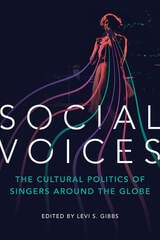
Social Voices
The Cultural Politics of Singers around the GlobeEdited by Levi S. Gibbs
University of Illinois Press, 2023
Around the world and across time, singers and their songs stand at the crossroads of differing politics and perspectives. Levi S. Gibbs edits a collection built around the idea of listening as a political act that produces meaning. Contributors explore a wide range of issues by examining artists like Romani icon Esma Redžepova, Indian legend Lata Mangeshkar, and pop superstar Teresa Teng. Topics include gendered performances and the negotiation of race and class identities; the class-related contradictions exposed by the divide between highbrow and pop culture; links between narratives of overcoming struggle and the distinction between privileged and marginalized identities; singers’ ability to adapt to shifting notions of history, borders, gender, and memory in order to connect with listeners; how the meanings we read into a singer’s life and art build on one another; and technology’s ability to challenge our ideas about what constitutes music.
Cutting-edge and original, Social Voices reveals how singers and their songs equip us to process social change and divergent opinions.
Contributors: Christina D. Abreu, Michael K. Bourdaghs, Kwame Dawes, Nancy Guy, Ruth Hellier, John Lie, Treva B. Lindsey, Eric Lott, Katherine Meizel, Carol A. Muller, Natalie Sarrazin, Anthony Seeger, Carol Silverman, Andrew Simon, Jeff Todd Titon, and Elijah Wald

Two Dreams in One Bed
Empire, Social Life, and the Origins of the North Korean Revolution in ManchuriaHyun Ok Park
Duke University Press, 2005
Drawing on a rich archive of Korean, Japanese, and Chinese sources, Park describes how Koreans negotiated the contradictory demands of national and colonial powers. She demonstrates that the dynamics of global capitalism led the Chinese and Japanese to pursue capitalist expansion while competing for sovereignty. Decentering the nation-state as the primary analytic rubric, her emphasis on the role of global capitalism is a major innovation for understanding nationalism, colonialism, and their immanent links in social space.
Through a regional and temporal comparison of Manchuria from the late nineteenth century until 1945, Park details how national and colonial powers enacted their claims to sovereignty through the regulation of access to land, work, and loans. She shows that among Korean migrants, the complex connections among Chinese laws, Japanese colonial policies, and Korean social practices gave rise to a form of nationalism in tension with global revolution—a nationalism that laid the foundation for what came to be regarded as North Korea’s isolationist politics.