Results by title
6 books match the query 'Life (Biology)'
Beyond Biopolitics
Essays on the Governance of Life and DeathPatricia Ticineto Clough and Craig Willse, eds.
Duke University Press, 2011
Contributors. Ann Anagnost, Una Chung, Patricia Ticineto Clough, Steve Goodman, Sora Y. Han, Stefano Harney, May Joseph, Randy Martin, Brian Massumi, Luciana Parisi, Jasbir Puar, Amit S. Rai, Eugene Thacker, Çağatay Topal, Craig Willse
Entropy Economics
The Living Basis of Value and ProductionJames K. Galbraith and Jing Chen
University of Chicago Press, 2025
Economists dream of equilibrium. It’s time to wake up.
In mainstream economics, markets are ideal if competition is perfect. When supply balances demand, economic maturity is orderly and disturbed only by shocks. These ideas are rooted in doctrines going back thousands of years, yet, as James K. Galbraith and Jing Chen show, they contradict the foundations of our scientific understanding of the physical and biological worlds.
Entropy Economics discards the conventions of equilibrium and presents a new basis for thinking about economic issues, one rooted in life processes—an unequal world of unceasing change in which boundaries, plans, and regulations are essential. Galbraith and Chen’s theory of value is based on scarcity, and it accounts for the power of monopoly. Their theory of production covers increasing and decreasing returns, uncertainty, fixed investments over time, and the impact of rising resource costs. Together, their models illuminate key problems such as trade, finance, energy, climate, conflict, and demography.
Entropy Economics is a thrilling framework for understanding the world as it is and will be keenly relevant to the economic challenges of a world threatened with disorder.
How Life Works
A User’s Guide to the New BiologyPhilip Ball
University of Chicago Press, 2023
“Ball’s marvelous book is both wide-ranging and deep. . . . I could not put it down.”—Siddhartha Mukherjee, author of The Song of the Cell and the Pulitzer Prize–winning The Emperor of All Maladies
A new, cutting-edge vision of biology that revises our understanding of what life itself is, how to enhance it, and what possibilities it offers.
Biology is undergoing a quiet but profound transformation. Several aspects of the standard picture of how life works—the idea of the genome as a blueprint, of genes as instructions for building an organism, of proteins as precisely tailored molecular machines, of cells as entities with fixed identities, and more—have been exposed as incomplete, misleading, or wrong.
In How Life Works, Philip Ball explores the new biology, revealing life to be a far richer, more ingenious affair than we had guessed. Ball explains that there is no unique place to look for an answer to this question: life is a system of many levels—genes, proteins, cells, tissues, and body modules such as the immune system and the nervous system—each with its own rules and principles. How Life Works explains how these levels operate, interface, and work together (most of the time).
With this knowledge come new possibilities. Today we can redesign and reconfigure living systems, tissues, and organisms. We can reprogram cells, for instance, to carry out new tasks and grow into structures not seen in the natural world. As we discover the conditions that dictate the forms into which cells organize themselves, our ability to guide and select the outcomes becomes ever more extraordinary. Some researchers believe that ultimately we will be able to regenerate limbs and organs, and perhaps even create new life forms that evolution has never imagined.
Incorporating the latest research and insights, How Life Works is a sweeping journey into this new frontier of the life sciences, a realm that will reshape our understanding of life as we know it.
In Search of Cell History
The Evolution of Life's Building BlocksFranklin M. Harold
University of Chicago Press, 2014
Written in accessible language and complemented by a glossary for easy reference, this book investigates the full scope of cellular history. Assuming only a basic knowledge of cell biology, Harold examines such pivotal subjects as the relationship between cells and genes; the central role of bioenergetics in the origin of life; the status of the universal tree of life with its three stems and viral outliers; and the controversies surrounding the last universal common ancestor. He also delves deeply into the evolution of cellular organization, the origin of complex cells, and the incorporation of symbiotic organelles, and considers the fossil evidence for the earliest life on earth. In Search of Cell History shows us just how far we have come in understanding cell evolution—and the evolution of life in general—and how far we still have to go.
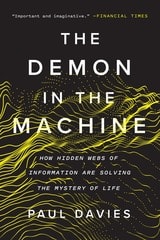
The Demon in the Machine
How Hidden Webs of Information Are Solving the Mystery of LifePaul Davies
University of Chicago Press, 1991
A Financial Times, Sunday Times, and Telegraph Best Science Book of the Year
What is life? For generations, scientists have struggled to make sense of this fundamental question, for life really does look like magic: even a humble bacterium accomplishes things so dazzling that no human engineer can match it. Huge advances in molecular biology over the past few decades have served only to deepen the mystery.
In this penetrating and wide-ranging book, world-renowned physicist and science communicator Paul Davies searches for answers in a field so new and fast-moving that it lacks a name; it is a domain where biology, computing, logic, chemistry, quantum physics, and nanotechnology intersect. At the heart of these diverse fields, Davies explains, is the concept of information: a quantity which has the power to unify biology with physics, transform technology and medicine, and force us to fundamentally reconsider what it means to be alive—even illuminating the age-old question of whether we are alone in the universe.
From life’s murky origins to the microscopic engines that run the cells of our bodies, The Demon in the Machine journeys across an astounding landscape of cutting-edge science. Weaving together cancer and consciousness, two-headed worms and bird navigation, Davies reveals how biological organisms garner and process information to conjure order out of chaos, opening a window onto the secret of life itself.
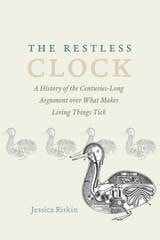
The Restless Clock
A History of the Centuries-Long Argument over What Makes Living Things TickJessica Riskin
University of Chicago Press, 2016
The Restless Clock examines the history of this principle, banning agency, in the life sciences. It also tells the story of dissenters embracing the opposite idea: that agency is essential to nature. The story begins with the automata of early modern Europe, as models for the new science of living things, and traces questions of science and agency through Descartes, Leibniz, Lamarck, and Darwin, among many others. Mechanist science, Jessica Riskin shows, had an associated theology: the argument from design, which found evidence for a designer in the mechanisms of nature. Rejecting such appeals to a supernatural God, the dissenters sought to naturalize agency rather than outsourcing it to a “divine engineer.” Their model cast living things not as passive but as active, self-making machines.
The conflict between passive- and active-mechanist approaches maintains a subterranean life in current science, shaping debates in fields such as evolutionary biology, cognitive science, and artificial intelligence. This history promises not only to inform such debates, but also our sense of the possibilities for what it means to engage in science—and even what it means to be alive.