Results by title
4 books match the query 'Life Stories'
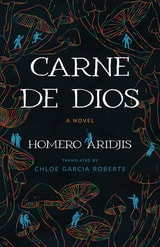
Carne de Dios
A NovelHomero Aridjis; Translated by Chloe Garcia Roberts
University of Arizona Press, 2025
In the remote mountains of Oaxaca, the Beatniks have arrived.
María Sabina, the renowned Mazatec healer, spends her days in the small town of Huautla de Jiménez selling produce at the market and foraging under the new moon for the sacred mushrooms that grow near her home—her Holy Children, Carne de Dios, or Flesh of God. But her life changes forever when an amateur mycologist from New York, with a cameraman in tow, visits her to experience for himself the mushroom ceremony, or velada, he knows only from whispers in anthropological records. When he publishes an unauthorized article about his experience in LIFE Magazine 1957, the stage is set for an explosive encounter between the burgeoning international counterculture and the woman who became an unwilling icon of the psychedelic revolution.
Homero Aridjis’s novel, vividly translated by Chloe Garcia Roberts, tells the story of the motley crew of bohemians, researchers, and holy fools, both real and imagined, who descend on the town of Huautla de Jiménez searching for inspiration, distraction, and salvation in the sacred mushrooms. These seekers melt in and out of a narrative infiltrated by the slipstream logic of dreams. As John Lennon plays jazz on the patio of the Hotel Grande, Juan Rulfo contemplates horror movies, and Allen Ginsberg recites mantras at Philip Lamantia’s wedding, María Sabina’s life is increasingly thrown into turmoil.
Carne de Dios is a masterful and often humorous blend of history, myth, and poetic imagination, captured in a translation that mirrors the hallucinatory beauty of Aridjis’s original Spanish. Aridjis’s intimate portrayal of María Sabina, informed by his personal connection to her, serves as both a tribute to her enduring legacy and a critical reflection on the wave of global interest in mushroom culture still gaining momentum today.
This English translation includes an introduction by the translator and an afterword by the author.
[more]
Inside Separate Worlds
Life Stories of Young Blacks, Jews, and LatinosDavid Schoem, Editor
University of Michigan Press, 1991
Inside Separate Worlds is a compelling collection of autobiographical essays that opens an honest window onto the lives of young Black, Jewish, and Latino students growing up and coming of age in America. Compiled and edited by David Schoem, with deep roots in the University of Michigan’s Program on Intergroup Relations and Conflict, this volume brings together the candid, firsthand voices of students who courageously share their struggles and victories over prejudice, marginalization, and the challenges of forging their own identities.The book is structured around the idea that, though we may live, study, and work side by side, there are “separate worlds” built by boundaries of race, ethnicity, and religion—boundaries reinforced by misunderstanding, silence, and fear. Through classroom dialogue, group writing, and the transformative exercise of sharing their lives on paper, the young authors reveal what it means to navigate family, culture, and self-discovery in communities where difference can be both a source of pride and a barrier to acceptance.Through powerful narratives like Amelia Valdez’s “Surviving in the Barrio,” Max Gordon’s “A History of Survival,” and Lauren Shapiro’s “Bean Soup,” the students chronicle their journeys from the margins to center stage, confronting stereotypes, internal conflicts, and systemic injustices. The essays move beyond pain and confrontation; they celebrate resilience, solidarity, and the search for belonging.Inside Separate Worlds is more than a book of personal stories—it is a call for dialogue, empathy, and change. It challenges readers to look beyond superficial differences, to listen and learn from one another, and to recognize both the unique and shared struggles shaping the multicultural American experience. By turning separation into understanding, these young writers invite us all to help create a more connected and inclusive future.
[more]
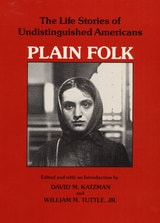
Plain Folk
The Life Stories of Undistinguished AmericansEdited by David M. Katzman and William M. Tuttle, Jr.
University of Illinois Press, 1982
Plain Folk depicts both the ordinary occupations and ethnic and racial diversity of America at the turn of the century. Katzman and Tuttle have drawn upon 75 brief autobiographies or "lifelets" of working-class Americans published between 1902 and 1906 in The Independent magazine. Among the seventeen life stories included here are those of a Lithuanian stockyards worker in Chicago, a Polish sweatshop girl and a Chinese merchant in New York City, a black peon in rural Georgia, and a Swedish farmer in Minnesota. Together they provide an unmediated and seldom-seen view of American life during this period.
[more]
Right Here, Right Now
Life Stories from America's Death RowLynden Harris, editor
Duke University Press, 2021
Upon receiving his execution date, one of the thousands of men living on death row in the United States had an epiphany: “All there ever is, is this moment. You, me, all of us, right here, right now, this minute, that's love.” Right Here, Right Now collects the powerful, first-person stories of dozens of men on death rows across the country. From childhood experiences living with poverty, hunger, and violence to mental illness and police misconduct to coming to terms with their executions, these men outline their struggle to maintain their connection to society and sustain the humanity that incarceration and its daily insults attempt to extinguish. By offering their hopes, dreams, aspirations, fears, failures, and wounds, the men challenge us to reconsider whether our current justice system offers actual justice or simply perpetuates the social injustices that obscure our shared humanity.
[more]