Results by title
4 books match the query 'Life cycles'
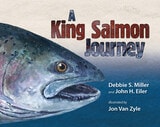
King Salmon Journey
Debbie Miller and John H. Eiler
University of Alaska Press, 2014
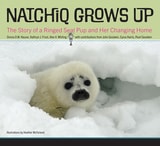
Natchiq Grows Up
The Story of an Alaska Ringed Seal Pup and Her Changing HomeDonna D.W. Hauser
University of Alaska Press, 2023
Beginning in the 1980s, scientists started traveling to northwest Alaska to research the lives of ringed seals, bringing Labrador retrievers who could sniff out seals and their snow cave homes (called lairs) on the sea ice. Decades later, scientists partnered with the Iñupiaq people of
Qikiktaġruk (Kotzebue) to learn more about ringed seals. They relied on a combination of Indigenous Knowledge and scientific techniques to capture and apply tags to understand the movements and behavior of ringed seals.
But the Arctic homes of ringed seals are changing, and the long history of ringed seal science in the Kotzebue Sound proved to be just the beginning of long and cooperative relationships melding science and Indigenous knowledge. During 2018 and 2019, with unprecedented sea ice conditions, Qikiktagrumiut Elders and scientists returned to the ice to measure changes in the habitat available for ringed seal pups in the region.

The Life Cycles of Global Governance
How Institutions Emerge, Evolve, and EndureJulia Gray
University of Michigan Press, 2027
International organizations influence nearly every aspect of global life—from aid and finance to law, security, and development. At a moment when the liberal international order is widely described as being in decline, this volume offers a corrective. International organizations do not simply rise and fall; they are always in motion—adapting, fragmenting, or being repurposed in response to shifting conditions. A life-cycle perspective reveals that what appears as decline may instead reflect transformation. Although they are often treated as fixed landmarks of global politics, institutions rarely follow a linear path from creation to maturity. This interdisciplinary edited volume brings together scholars from law, political science, sociology, and international relations to reveal the life cycles of these institutions: their false starts, early challenges, periods of drift, moments of revitalization, and even their afterlives.
Spanning cases from the 19th century to the present and covering diverse issue areas, the book offers a fresh perspective on why some organizations adapt while others stagnate or disappear. The volume shows how shifting political pressures, bureaucratic agency, and global shocks shape the fortunes of organizations from the UN, WTO, and World Bank to regional bodies and informal networks. By tracing these trajectories across disciplines and domains, The Life Cycles of Global Governance provides an accessible, richly textured account of how global cooperation actually unfolds—and why understanding institutional change is essential in today’s shifting international order.
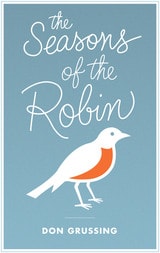
The Seasons of the Robin
By Don Grussing
University of Texas Press, 2009
In a small nest in a large oak tree, the drama begins. A young American Robin breaks open his shell and emerges into a world that will provide the warmth of sunny days and the life-threatening chill of cold, rainy nights; the satisfaction of a full stomach and the danger of sudden predator attacks; and the chance to mature into an adult robin who'll begin the cycle of life all over again come next spring.
In The Seasons of the Robin, Don Grussing tells the uncommon life story of one of the most common birds, the North American Robin. Written as fiction to capture the high drama that goes on unnoticed right outside our windows, the book follows a young male robin through the first year of life. From his perspective, we experience many common episodes of a bird's life—struggling to get out of the egg; awkwardly attempting to master flight; learning to avoid predators; migrating for the first time; returning home; establishing a territory; finding a mate; and beginning the cycle again. This creative approach of presenting natural history through a fictional, yet factually based, story allows us to experience the spine-tingling, nerve-wracking, adrenaline-flowing excitement that is so much a part of the life of every wild thing. As Don Grussing concludes in his preface, "Once you experience the world through a robin's eyes, I hope you'll look at every wild thing with new appreciation and respect for what they accomplish by living."