Results by title
6 books match the query 'Life on other planets'
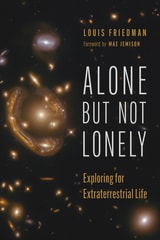
Alone but Not Lonely
Exploring for Extraterrestrial LifeLouis Friedman
University of Arizona Press, 2023
Friedman argues that intelligent life is probably rare in the universe (maybe even uniquely on Earth) but that simple life is likely abundant on millions or billions of planets waiting now to be discovered. He asserts that studying and searching for extraterrestrial life cannot be done by interstellar probes—due to the vastness of space and the comparative brevity of human lifespans—but it can be done remotely by a new technique involving the solar gravity lens that can magnify exoplanets by tens of billions. This technique will allow humankind to explore exoplanets and open up an exciting new field of comparative astrobiology.
Wide-ranging in scope, this book discusses the history of searching for extraterrestrial life, the scientific evidence thereof, and finally his own conclusions on what’s next. Included in the book are three appendices: an explanation of interstellar messaging, a reprint of a debate between Carl Sagan and Ernst Mayr on extraterrestrial intelligence, and an opinion essay on the search for extraterrestrial intelligence.
Encountering Life in the Universe
Ethical Foundations and Social Implications of AstrobiologyEdited by Chris Impey, Anna H. Spitz, and William Stoeger
University of Arizona Press, 2013
Encountering Life in the Universe examines the intersection of scientific research and society to further explore the ethics of how to behave in a universe where much is unknown. Taking contributions from notable experts in several fields, the editors skillfully introduce and develop a broad look at the moral questions facing humans on Earth and beyond.
Major advances in biology, biotechnology, and medicine create an urgency to ethical considerations in those fields. Astrobiology goes on to debate how we might behave as we explore new worlds, or create new life in the laboratory, or interact with extraterrestrial life forms. Stimulated by new technologies for scientific exploration on and off the Earth, astrobiology is establishing itself as a distinct scientific endeavor.
In what way can established philosophies provide guidance for the new frontiers opened by astrobiology research? Can the foundations of ethics and moral philosophy help answer questions about modifying other planets? Or about how to conduct experiments to create life in the lab or about? How to interact with organisms we might discover on another world?
While we wait for the first echo that might indicate life beyond Earth, astobiologists, along with philosophers, theologians, artists, and the general public, are exploring how we might behave—even before we know for sure they are there. Encountering Life in the Universe is a remarkable resource for such philosophical challenges.

Level 7
Mordecai Roshwald; Edited and with a new foreword by David Seed
University of Wisconsin Press, 2004
Level 7 is the diary of Officer X-127, who is assigned to stand guard at the "Push Buttons," a machine devised to activate the atomic destruction of the enemy, in the country’s deepest bomb shelter. Four thousand feet underground, Level 7 has been built to withstand the most devastating attack and to be self-sufficient for five hundred years. Selected according to a psychological profile that assures their willingness to destroy all life on Earth, those who are sent down may never return.
Originally published in 1959, and with over 400,000 copies sold, this powerful dystopian novel remains a horrific vision of where the nuclear arms race may lead, and is an affirmation of human life and love. Level 7 merits comparison to Huxley’s A Brave New World and Orwell’s 1984 and should be considered a must-read by all science fiction fans.

Many Worlds
New Universe Extraterrestrial LifeSteven Dick
Templeton Press, 2000
In Many Worlds, renowned scientists in fields from physics to astronomy discuss the possibility of a cosmic evolutionary process that guides not only our universe, but other planets and universes as well. Physicist and author Paul Davies observes that “if it turns out to be the case that the universe is inherently bio-friendly, then the scientific, theological, and philosophical implications will be extremely significant.”
Many Worlds first focuses on what lessons might be learned from the latest knowledge of the origin and evolution of life. After establishing a well-grounded relationship between science and religion, authors such as Arthur Peacocke and John Leslie evaluate the intricate configuration of events that must occur to create a dynamic and chemically enriched environment capable of not only supporting life, but evolutionary processes as well. The final section addresses the provocative question of extraterrestrial life. What we may find could drastically change our relation to the universe and our creator.
As we reflect on the possibilities that the universe presents, author and contributor Christian de Duve aptly states, “Many myths have had to be abandoned. But mystery remains, more profound and beautiful than ever before, a reality almost inaccessible to our feeble human means.” Is our existence part of a divine scheme ingenuously designed to support life, or is it an extraordinary chain of accidents that culminate in a life-permitting environment? The scientific advancements of the past century cannot help but capture the imagination and inspire renewed hope for the future. This volume will add dimension and insight to these yet unanswered questions.
Science, Society, and the Search for Life in the Universe
Bruce Jakosky
University of Arizona Press, 2006
Astrobiology is the relatively new, but fast growing scientific discipline that involves trying to understand the origin, evolution, and distribution of life within the universe. It is also one of the few scientific disciplines that attracts the public’s intense curiosity and attention. This interest stems largely from the deep personal meaning that the possible existence of extraterrestrial life has for so many. Whether this meaning relates to addressing the “Big Questions” of our existence, the possibility of encountering life on other planets, or the potential impact on our understanding of religion, there is no doubt that the public is firmly vested in finding answers.
In this broadly accessible introduction to the field, Bruce Jakosky looks at the search for life in the universe not only from a scientific perspective, but also from a distinctly social one. In lucid and engaging prose, he addresses topics including the contradiction between the public’s fascination and the meager dialogue that exists between those within the scientific community and those outside of it, and what has become some of the most impassioned political wrangling ever seen in government science funding.
The Pale Blue Data Point
An Earth-Based Perspective on the Search for Alien LifeJon Willis
University of Chicago Press, 2025
“Here is Willis’s fundamental argument: The more we learn about Earth—our one ‘pale blue data point’ for a planet on which life has definitively arisen—the more qualified we will be to recognize signs of life elsewhere. . . . [A] joyful account.”—Steven Poole, The Wall Street Journal
A thrilling tour of Earth that shows the search for extraterrestrial life starts in our own backyard.
Is there life off Earth? Bound by the limitations of spaceflight, a growing number of astrobiologists investigate the question by studying life on our planet. Astronomer and author Jon Willis shows us how it’s done, allowing readers to envision extraterrestrial landscapes by exploring their closest Earth analogs. With Willis, we dive into the Pacific Ocean from the submersible-equipped E/V Nautilus to ponder the uncharted seas of Saturn’s and Jupiter’s moons; search the Australian desert for some of Earth’s oldest fossils and consider the prospects for a Martian fossil hunt; visit mountaintop observatories in Chile to search for the telltale twinkle of extrasolar planets; and eavesdrop on dolphins in the Bahamas to imagine alien minds.
With investigations ranging from meteorite hunting to exoplanet detection, Willis conjures up alien worlds and unthought-of biological possibilities, speculating what life might look like on other planets by extrapolating from what we can see on Earth, our single “pale blue dot”—as Carl Sagan famously called it—or, in Willis’s reframing, scientists’ “pale blue data point.”