Results by title

3 books match the query 'Lifton, Robert Jay'
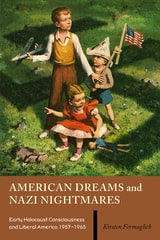
cover of American Dreams and Nazi Nightmares: Early Holocaust Consciousness and Liberal America, 1957-1965

American Dreams and Nazi Nightmares

Early Holocaust Consciousness and Liberal America, 1957-1965

Kirsten Fermaglich

University Press of New England, 2007
To a great extent, Holocaust consciousness in the contemporary United States has become intertwined with American Jewish identity and with support for right-wing Israeli politics -- but this was not always the case. In this illuminating study, Kirsten Fermaglich demonstrates that in the late 1950s and early 1960s, many American Jewish writers and academics viewed the Nazi extermination of European Jewry as a subject of universal interest, with important lessons to be learned for the liberal reform of American politics. Fermaglich analyzes the lives and writings of Stanley M. Elkins, Betty Friedan, Stanley Milgram, and Robert Jay Lifton, four social scientific thinkers whose work was shaped by a liberal perspective. For them, the Holocaust served as a critical frame of reference for a particular issue: Elkins on slavery's legacy, Friedan on the oppressions of domesticity, Milgram on the willingness to obey, and Lifton on war's survivors. In each case, these thinkers were deeply influenced by their Jewish backgrounds, whether by early encounters with antisemitism or by the profound sense that only fate and an ocean had spared them death in Hitler's Europe. Thus, each chose imagery from the concentration camps, albeit utterly devoid of a particular Jewish association, to illuminate themes that advanced liberal politics, including civil rights, the nuclear test ban, feminism, and Vietnam veterans' rights. Rather than being offended by these authors' comparisons between American institutions and Nazi concentration camps, American audiences of all ethnic and religious backgrounds during the late 1950s and early 1960s generally cheered these authors' Nazi imagery and adopted it as part of their own political ideology. Fermaglich demonstrates that liberalism in the United States in the 1960s was more substantially shaped by the Holocaust than we have previously recognized.
[more]
cover of The Protean Self: Human Resilience in an Age of Fragmentation

The Protean Self

Human Resilience in an Age of Fragmentation

Robert Jay Lifton

University of Chicago Press, 1999

"We are becoming fluid and many-sided. Without quite realizing it, we have been evolving a sense of self appropriate to the restlessness and flux of our time. This mode of being differs radically from that of the past, and enables us to engage in continuous exploration and personal experiment. I have named it the 'protean self,' after Proteus, the Greek sea god of many forms."—from The Protean Self
 
[more]
cover of The Web of Violence: From Interpersonal to Global

The Web of Violence

From Interpersonal to Global

Edited by Jennifer Turpin and Lester Kurtz

University of Illinois Press, 1996

Violence is a topic of concern everywhere--in the media, in churches, in the halls of governments. In every land and in every culture violence is considered by most to be taboo, a last resort. Yet under certain conditions, from the level of the family to the level of nations, violence is used as a mechanism of social control. Various rationalizations thus emerge to distinguish between legitimate and illegitimate violence.

The Web of Violence explores the interrelationship among personal, collective, national, and global levels of violence. This unique collection brings together a number of internationally known contributors to address the genesis and manifestations of violence in the search for a remedy for this confounding social problem.

As the global community becomes more intimate, we must better understand the nature of violence. The Web of Violence supports this aim by examining the dangerous human phenomenon from many perspectives, at different levels, and using multiple methodologies.

Contributors: Robert Jay Lifton, Christopher G. Ellison, John P. Bartkowski, Yuan-Horng Chu, Philip Smith, Robert Elias, Birgit Brock-Utne, Riane Eisler, Johan Galtung

[more]