Results by title
6 books match the query 'Lightman, Bernard'
Science Periodicals in Nineteenth-Century Britain
Constructing Scientific CommunitiesEdited by Gowan Dawson, Bernard Lightman, Sally Shuttleworth, and Jonathan R. Topham
University of Chicago Press, 2020
Periodicals played a vital role in the developments in science and medicine that transformed nineteenth-century Britain. Proliferating from a mere handful to many hundreds of titles, they catered to audiences ranging from gentlemanly members of metropolitan societies to working-class participants in local natural history clubs. In addition to disseminating authorized scientific discovery, they fostered a sense of collective identity among their geographically dispersed and often socially disparate readers by facilitating the reciprocal interchange of ideas and information. As such, they offer privileged access into the workings of scientific communities in the period.
The essays in this volume set the historical exploration of the scientific and medical periodicals of the era on a new footing, examining their precise function and role in the making of nineteenth-century science and enhancing our vision of the shifting communities and practices of science in the period. This radical rethinking of the scientific journal offers a new approach to the reconfiguration of the sciences in nineteenth-century Britain and sheds instructive light on contemporary debates about the purpose, practices, and price of scientific journals.
The essays in this volume set the historical exploration of the scientific and medical periodicals of the era on a new footing, examining their precise function and role in the making of nineteenth-century science and enhancing our vision of the shifting communities and practices of science in the period. This radical rethinking of the scientific journal offers a new approach to the reconfiguration of the sciences in nineteenth-century Britain and sheds instructive light on contemporary debates about the purpose, practices, and price of scientific journals.
[more]
Science in the Marketplace
Nineteenth-Century Sites and ExperiencesEdited by Aileen Fyfe and Bernard Lightman
University of Chicago Press, 2007
The nineteenth century was an age of transformation in science, when scientists were rewarded for their startling new discoveries with increased social status and authority. But it was also a time when ordinary people from across the social spectrum were given the opportunity to participate in science, for education, entertainment, or both. In Victorian Britain science could be encountered in myriad forms and in countless locations: in panoramic shows, exhibitions, and galleries; in city museums and country houses; in popular lectures; and even in domestic conversations that revolved around the latest books and periodicals.
Science in the Marketplace reveals this other side of Victorian scientific life by placing the sciences in the wider cultural marketplace, ultimately showing that the creation of new sites and audiences was just as crucial to the growing public interest in science as were the scientists themselves. By focusing attention on the scientific audience, as opposed to the scientific community or self-styled popularizers, Science in the Marketplace ably links larger societal changes—in literacy, in industrial technologies, and in leisure—to the evolution of “popular science.”
[more]

The Dictionary of Nineteenth-Century British Scientists
Edited by Bernard Lightman
University of Chicago Press, 2004
Containing more than 1,200 new entries on both major and minor figures of British science, this four-volume dictionary examines how the theories and practices of scientists were shaped by Victorian beliefs about religion, gender, imperialism, and politics, presenting a rich panorama of the development of science in the nineteenth century.
While the Dictionary of Nineteenth-Century British Scientists covers those working in traditional scientific areas such as physics, astronomy, chemistry, mathematics, and biology, it also acknowledges those working in the human sciences such as anthropology, sociology, psychology, and medicine. In addition, areas often overlooked by historians of science—such as phrenology, mesmerism, spiritualism, scientific illustration, scientific journalism and publishing, instrument making, and government policy—are included here, as are the important roles of neglected "amateurs," such as women and members of the working class. By including those who worked in nontraditional areas and by considering the social and cultural context in which they lived, the dictionary reflects a richer picture of nineteenth-century science than has ever been seen before.
While the Dictionary of Nineteenth-Century British Scientists covers those working in traditional scientific areas such as physics, astronomy, chemistry, mathematics, and biology, it also acknowledges those working in the human sciences such as anthropology, sociology, psychology, and medicine. In addition, areas often overlooked by historians of science—such as phrenology, mesmerism, spiritualism, scientific illustration, scientific journalism and publishing, instrument making, and government policy—are included here, as are the important roles of neglected "amateurs," such as women and members of the working class. By including those who worked in nontraditional areas and by considering the social and cultural context in which they lived, the dictionary reflects a richer picture of nineteenth-century science than has ever been seen before.
[more]
Victorian Popularizers of Science
Designing Nature for New AudiencesBernard Lightman
University of Chicago Press, 2007
The ideas of Charles Darwin and his fellow Victorian scientists have had an abiding effect on the modern world. But at the time The Origin of Species was published in 1859, the British public looked not to practicing scientists but to a growing group of professional writers and journalists to interpret the larger meaning of scientific theories in terms they could understand and in ways they could appreciate. Victorian Popularizers of Science focuses on this important group of men and women who wrote about science for a general audience in the second half of the nineteenth century.
Bernard Lightman examines more than thirty of the most prolific, influential, and interesting popularizers of the day, investigating the dramatic lecturing techniques, vivid illustrations, and accessible literary styles they used to communicate with their audience. By focusing on a forgotten coterie of science writers, their publishers, and their public, Lightman offers new insights into the role of women in scientific inquiry, the market for scientific knowledge, tensions between religion and science, and the complexities of scientific authority in nineteenth-century Britain.
Bernard Lightman examines more than thirty of the most prolific, influential, and interesting popularizers of the day, investigating the dramatic lecturing techniques, vivid illustrations, and accessible literary styles they used to communicate with their audience. By focusing on a forgotten coterie of science writers, their publishers, and their public, Lightman offers new insights into the role of women in scientific inquiry, the market for scientific knowledge, tensions between religion and science, and the complexities of scientific authority in nineteenth-century Britain.
[more]
Victorian Science in Context
Edited by Bernard Lightman
University of Chicago Press, 1997
Victorians were fascinated by the flood of strange new worlds that science was opening to them. Exotic plants and animals poured into London from all corners of the Empire, while revolutionary theories such as the radical idea that humans might be descended from apes drew crowds to heated debates. Men and women of all social classes avidly collected scientific specimens for display in their homes and devoured literature about science and its practitioners.
Victorian Science in Context captures the essence of this fascination, charting the many ways in which science influenced and was influenced by the larger Victorian culture. Contributions from leading scholars in history, literature, and the history of science explore questions such as: What did science mean to the Victorians? For whom was Victorian science written? What ideological messages did it convey? The contributors show how practical concerns interacted with contextual issues to mold Victorian science—which in turn shaped much of the relationship between modern science and culture.
Victorian Science in Context captures the essence of this fascination, charting the many ways in which science influenced and was influenced by the larger Victorian culture. Contributions from leading scholars in history, literature, and the history of science explore questions such as: What did science mean to the Victorians? For whom was Victorian science written? What ideological messages did it convey? The contributors show how practical concerns interacted with contextual issues to mold Victorian science—which in turn shaped much of the relationship between modern science and culture.
[more]
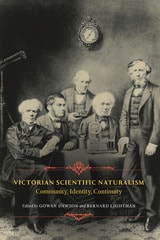
Victorian Scientific Naturalism
Community, Identity, ContinuityEdited by Gowan Dawson and Bernard Lightman
University of Chicago Press, 2014
Victorian Scientific Naturalism examines the secular creeds of the generation of intellectuals who, in the wake of The Origin of Species, wrested cultural authority from the old Anglican establishment while installing themselves as a new professional scientific elite. These scientific naturalists—led by biologists, physicists, and mathematicians such as William Kingdon Clifford, Joseph Dalton Hooker, Thomas Henry Huxley, and John Tyndall—sought to persuade both the state and the public that scientists, not theologians, should be granted cultural authority, since their expertise gave them special insight into society, politics, and even ethics.
In Victorian Scientific Naturalism, Gowan Dawson and Bernard Lightman bring together new essays by leading historians of science and literary critics that recall these scientific naturalists, in light of recent scholarship that has tended to sideline them, and that reevaluate their place in the broader landscape of nineteenth-century Britain. Ranging in topic from daring climbing expeditions in the Alps to the maintenance of aristocratic protocols of conduct at Kew Gardens, these essays offer a series of new perspectives on Victorian scientific naturalism—as well as its subsequent incarnations in the early twentieth century—that together provide an innovative understanding of the movement centering on the issues of community, identity, and continuity.
[more]