Results by title
15 books match the query 'Lima'
A Day in "The Hole"
Risk, Loss, and Excess in Downtown LimaDaniella Gandolfo
University of Chicago Press, 2025
A single day in a semilegal market in Lima, Peru, reveals a social world that defies conventional economic logic.
In the heart of Lima’s historic center, the markets of El Hueco (“The Hole”) and sprawling Mesa Redonda pulse with life, with thousands of vendors selling everything from knockoff electronics to religious icons. In A Day in “The Hole,” anthropologist Daniella Gandolfo immerses readers in a single, tumultuous day—the thirty-fourth anniversary of a vendors’ cooperative—while examining the dynamics that sustain these marketplaces.
Through a blend of cinematic storytelling and incisive anthropological insight, Gandolfo reveals a world with its own unique codes. She inspects how vendors embrace expenditure over profit and instability over order, and moving through the sights and sounds of El Hueco and Mesa Redonda, she finds a dissident economy that is as much about survival as it is about spectacle. Gandolfo redefines how we think about urban economies and the unexpected ways these defiant communities thrive in this textured portrait of Lima’s markets and the people who animate them.
A House of My Own
Social Organization in the Squatter Settlements of Lima, PeruSusan Lobo
University of Arizona Press, 1982
"Whether or not one accepts Susan Lobo's optimistic analysis, her ability to translate the apparent chaos of shanty-town lives into such neat patterns and to help outsiders view life as the inhabitants do are important contributions." —Inter-American Review of Bibliography
"An extremely competent ethnography, simple and straightforward." —Anthropos
"A pleasure to read, a mine of information which will be useful in teaching students to formulate their own hypotheses." —International Journal of Urban & Regional Research
"Very well written and provides a great wealth of the liveliest sort of ethnographic detail." —Latin American Research Review
"Lobo's study of two squatter settlements in Lima provides a solid, well-written, detailed, traditional ethnography of poor families in a Third World urban setting." —Hispanic American Historical Review
"This well-written account . . . has a lot of heart and feeling for the human face of the urban poor." —International Migration Review
Embodying the Sacred
Women Mystics in Seventeenth-Century LimaNancy E. van Deusen
Duke University Press, 2018
Gentleman Troubadours and Andean Pop Stars
Huayno Music, Media Work, and Ethnic Imaginaries in Urban PeruJoshua Tucker
University of Chicago Press, 2013
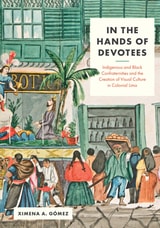
In the Hands of Devotees
Indigenous and Black Confraternities and the Creation of Visual Culture in Colonial LimaXimena A. Gómez
University of Texas Press, 2025
An exploration of how Indigenous and Black communities shaped religious imagery and navigated life in colonial Lima.
Colonial Lima was steeped in Christian devotional imagery. While Spaniards set the norms for these works, it was the city’s Black and Indigenous majority that engaged with them most. As members of lay societies of worshippers called confraternities, subalterns were Lima’s key promoters of religious art, surpassing the colonial hierarchy.
Ximena Gómez argues that, by commissioning and exhibiting sacred images—in chapels and urban processions, adorned with clothing and accessories—Indigenous and Black confraternities created Lima’s visual culture. In one case study, the Indigenous confraternity of the Virgin of Copacabana "invisibly" transforms a sculpture into an object that reflected its multiethnic Andean caretakers. Another case study, that of the confraternity of the Virgin of the Antigua, finds Black worshippers initially united in their interpretation of a Spanish image and later fracturing when some of its members applied a West African interpretive lens. Taking advantage of Lima’s rich documentary record, In the Hands of Devotees centers the ritual practices of Black and Indigenous people and opens possibilities for incorporating subalterns into the history of Lima’s art when limited extant visual evidence has survived.
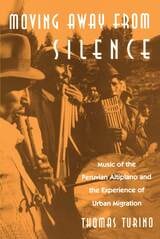
Moving Away from Silence
Music of the Peruvian Altiplano and the Experience of Urban MigrationThomas Turino
University of Chicago Press, 1993
Turino's ethnography is the first large-scale study to concentrate on the pervasive effects of migration on Andean people and their music. Turino uses the musical traditions of Conima, Peru as a unifying thread, tracing them through the varying lives of Conimeos in different locales. He reveals how music both sustains and creates meaning for a people struggling amid the dramatic social upheavals of contemporary Peru.
Moving Away from Silence contains detailed interpretations based on comparative field research of Conimeo musical performance, rehearsals, composition, and festivals in the highlands and Lima. The volume will be of great importance to students of Latin American music and culture as well as ethnomusicological and ethnographic theory and method.
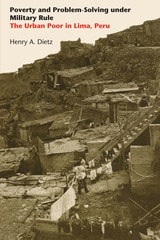
Poverty and Problem-Solving under Military Rule
The Urban Poor in Lima, PeruBy Henry A. Dietz
University of Texas Press, 1980
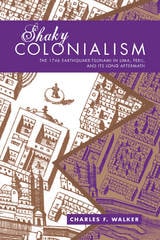
Shaky Colonialism
The 1746 Earthquake-Tsunami in Lima, Peru, and Its Long AftermathCharles F. Walker
Duke University Press, 2008
Through his ambitious rebuilding plan, the Viceroy sought to assert the power of the colonial state over the Church, the upper classes, and other groups. Agreeing with most inhabitants of the fervently Catholic city that the earthquake-tsunami was a manifestation of God’s wrath for Lima’s decadent ways, he hoped to reign in the city’s baroque excesses and to tame the city’s notoriously independent women. To his great surprise, almost everyone objected to his plan, sparking widespread debate about political power and urbanism. Illuminating the shaky foundations of Spanish control in Lima, Walker describes the latent conflicts—about class, race, gender, religion, and the very definition of an ordered society—brought to the fore by the earthquake-tsunami of 1746.
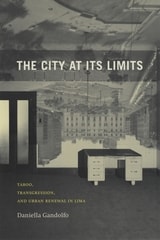
The City at Its Limits
Taboo, Transgression, and Urban Renewal in LimaDaniella Gandolfo
University of Chicago Press, 2009
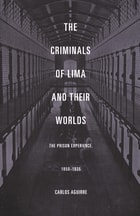
The Criminals of Lima and Their Worlds
The Prison Experience, 1850-1935Carlos Aguirre
Duke University Press, 2005
Drawing on a large collection of prison and administrative records archived at Peru’s Ministry of Justice, Aguirre offers a detailed account of the daily lives of men incarcerated in Lima’s jails. In showing the extent to which the prisoners actively sought to influence prison life, he reveals the dynamic between prisoners and guards as a process of negotiation, accommodation, and resistance. He describes how police and the Peruvian state defined criminality and how their efforts to base a prison system on the latest scientific theories—imported from Europe and the United States—foundered on the shoals of financial constraints, administrative incompetence, corruption, and widespread public indifference. Locating his findings within the political and social mores of Lima society, Aguirre reflects on the connections between punishment, modernization, and authoritarian traditions in Peru.
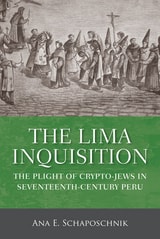
The Lima Inquisition
The Plight of Crypto-Jews in Seventeenth-Century PeruAna E. Schaposchnik
University of Wisconsin Press, 2017
Delving into the records of the tribunal, Schaposchnik brings to light the experiences of individuals on both sides of the process. Some prisoners, she discovers, developed a limited degree of agency as they managed to stall trials or mitigate the most extreme punishments. Training her attention on the accusers, Schaposchnik uncovers the agendas of specific inquisitors in bringing the condemned from the dungeons to the 1639 Auto General de Fe ceremony of public penance and execution. Through this fine-grained study of the tribunal's participants, Schaposchnik finds that the Inquisition sought to discipline and shape culture not so much through frequency of trials or number of sentences as through the potency of individual examples.
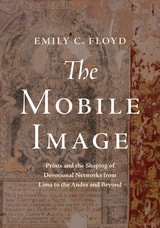
The Mobile Image
Prints and the Shaping of Devotional Networks from Lima to the Andes and BeyondEmily C. Floyd
University of Texas Press, 2025
A study of the production and movement of prints in colonial South America.
Printed images have had a central place in art-historical studies of colonial Spanish America, but scholars have typically focused on imported prints, designed and produced in Europe. The Mobile Image focuses instead on works printed in colonial Lima, generating there a distinctive print culture that served local and regional needs, while also appealing to European print consumers.
Inexpensive, easily transportable, and numerous, Lima’s prints traversed the varied geographies of the Viceroyalty of Peru both as loose sheets and within the protective covers of printed books. In the process, limeño devotional prints encouraged the development of shared regional imaginaries about the sacred Andean landscape, a space marked by miracle-working Virgins, potential saints, and powerful images of Christ. These same prints traveled abroad, where they promoted iconographies developed in Lima and influenced European conceptions of the Andes. Simultaneously, the visual language of limeño prints often challenges conventional approaches to interpreting colonial depictions of race. In analyzing limeño prints, and the identities of their makers, patrons, and consumers, The Mobile Image demonstrates that race is harder to recognize in colonial images than we might think. Unearthing hundreds of forgotten prints, Emily C. Floyd provides a fresh resource for interpreting colonial artworks, troubling established understandings of their aesthetics, and compelling us to reexamine colonial South American material cultures.
The Moral Electricity of Print
Transatlantic Education and the Lima Women's Circuit, 1876-1910Ronald Briggs
Vanderbilt University Press, 2017
Moral electricity—a term coined by American transcendentalists in the 1850s to describe the force of nature that was literacy and education in shaping a greater society. This concept wasn't strictly an American idea, of course, and Ronald Briggs introduces us to one of the greatest examples of this power: the literary scene in Lima, Peru, in the nineteenth century.
As Briggs notes in the introduction to The Moral Electricity of Print, "the ideological glue that holds the American hemisphere together is a hope for the New World as a grand educational project combined with an anxiety about the baleful influence of a politically and morally decadent Old World that dominated literary output through its powerful publishing interests." The very nature of living as a writer and participating in the literary salons of Lima was, by definition, a revolutionary act that gave voice to the formerly colonized and now liberated people. In the actions of this literary community, as men and women worked toward the same educational goals, we see the birth of a truly independent Latin American literature.
The Woman in the Violence
Gender, Poverty, and Resistance in PeruM. Cristina Alcalde
Vanderbilt University Press, 2010
Focusing on the experiences of women who are predominantly poor, nonwhite, rural-to-urban migrants with little or no formal education, The Woman in the Violence addresses a range of serious concerns. What types of violence do women experience at different stages in their lives? Which identities and roles are manifested throughout their lives, and do some of these increase their vulnerability to different forms of violence? What strategies do women employ to gain some power and control in these situations, and how can we conceptualize these strategies?
In examining these questions, The Woman in the Violence contributes to our understanding of violence, gender, race, resistance, and urbanism as it exposes and analyzes systemic violence against women. The everyday forms of resistance these women employ provide significant insight for students, scholars, and health professionals.
Unruly Domestication
Poverty, Family, and Statecraft in Urban PeruKristin Skrabut
University of Texas Press, 2024
2024 Flora Tristán Book Award, Sección Perú, Latin American Studies Association
How the international war on poverty shapes identities, relationships, politics, and urban space in Peru.
Unruly Domestication investigates how Peru’s ongoing, internationally endorsed "war on poverty" shapes politics, intimate identities, and urban space in Lima. Drawing on a decade of embedded, ethnographic research in Lima’s largest and most recently founded “extreme poverty zone,” Kristin Skrabut demonstrates how Peru’s efforts to fight poverty by formalizing property, identity, and family status perpetuate environmentally unsustainable urban sprawl, deepen discrimination against single mothers, and undermine Peruvians’ faith in public officials and in one another. In the process, Skrabut reveals myriad entanglements of poverty, statecraft, and private life, exploring how families are made and unmade through political practices, how gender inequalities are perpetuated through policy, and how Peruvians’ everyday pursuits of state-sanctioned domestic ideals reproduce informality and landscapes of poverty in the urban periphery.
The only full-length ethnography written about Lima’s iconic and policy-inspiring shantytowns in thirty years, Unruly Domestication provides valuable insight into the dynamics of housing and urban development in the Global South, elucidating the most intimate and profound effects of global efforts to do good.