Results by title
6 books match the query 'Lincoln-Douglas Debates, Ill., 1858'
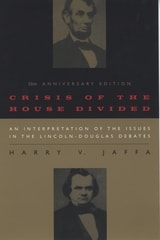
Crisis of the House Divided
An Interpretation of the Issues in the Lincoln-Douglas Debates, 50th Anniversary EditionHarry V. Jaffa
University of Chicago Press, 2009
The definitive account of the Lincoln-Douglas debates and their importance to American history
A lasting classic, Crisis of the House Divided offers an unparalleled account of the Lincoln-Douglas debates. Harry Jaffa provides the definitive analysis of the political principles that guided Lincoln from his reentry into politics in 1854 through his Senate campaign against Douglas in 1858.
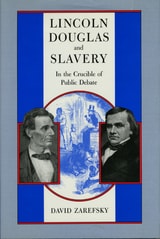
Lincoln, Douglas, and Slavery
In the Crucible of Public DebateDavid Zarefsky
University of Chicago Press, 1990
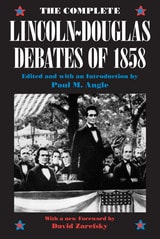
The Complete Lincoln-Douglas Debates of 1858
Abraham Lincoln and Stephen A. Douglas
University of Chicago Press, 1991
Zarefsky analyzes the rhetoric of the speeches, showing how Lincoln and Douglas chose their arguments and initiated a debate that shook the nation. Their eloquent, statesmanlike discussion of the morality of slavery illustrates the masterful use of rhetorical strategies and tactics in the public forum: a form of discourse that has nearly disappeared from the political scene today.
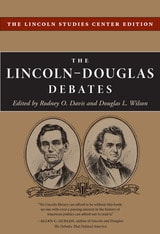
The Lincoln-Douglas Debates
The Lincoln Studies Center EditionEdited by Rodney O. Davis and Douglas L. Wilson
University of Illinois Press, 2014
While the debates between Abraham Lincoln and Stephen A. Douglas are undoubtedly the most celebrated in American history, they may also be the most consequential as well. For the issues so fiercely debated in 1858 were about various interrelated aspects of one momentous, nation-threatening issue: slavery. The contest between Lincoln and Douglas became a testing ground for the viability of conflicting ideals in a nation deeply divided. One of the most colorful and engaging episodes in American history, this series of debates is of enduring interest as an illuminating instance of the ever-recurring dilemma of self-government: what happens when the guiding principle of democracy, "popular sovereignty," confronts a principled stand against a "moral, social, and political evil"? The tragic answer in this case came three years later: civil war.
Important as they are, the Lincoln-Douglas debates have long since ceased to be self-explanatory. This edition is the first to provide a text founded on all known records, rather than following one or another of the partisan and sometimes widely-varying newspaper accounts. Meticulously edited and annotated, it provides numerous aids to help the modern reader understand the debates, including extensive introductory material, commentary, and a glossary. The fullest and most dependable edition of the Lincoln-Douglas debates ever prepared, this edition brings readers as close as possible to the original words of these two remarkable men.
The Shaping of American Liberalism
The Debates over Ratification, Nullification, and SlaveryDavid F. Ericson
University of Chicago Press, 1993
Focusing on three critical debates in American history—the debate between Anti-Federalists and Federalists over the ratification of the Constitution; the debate between the national republicans and the states-rights republicans over the nullification of the tariff; and the Lincoln-Douglas debates over slavery and pluralist democracy—Ericson shows that republicanism, rather than being opposed to liberalism, is in fact an offshoot of it. His descriptions of republicanism and pluralism represent the poles of an evolving tradition of liberal ideas in America: the former championing the claims of the public sphere, general welfare, and civic virtue; the latter protecting the rights of the individual to liberty, property, and privacy.
Republicanism and pluralism are therefore more properly understood as two sets of competing ideas that evolved from common roots. Ericson concludes that although republican themes persist in American politics, the profound transformations brought about by the Civil War made the ascendancy of pluralism virtually inevitable.
This highly original discussion of the relation between liberalism and republicanism—the central concern of much of the recent scholarship in American political thought—will be important reading for those interested in American politics, history, and culture.
When Lincoln Came to Egypt
George W. Smith, with a Foreword by Daniel W. Stowell
Southern Illinois University Press, 2017