642 books match the query 'Linguistics' and 70 start with a

cover of A Barrel of Monkeys: A Compendium of Collective Nouns for Animals

A Barrel of Monkeys

A Compendium of Collective Nouns for Animals

Compiled by Samuel Fanous

Bodleian Library Publishing, 2015

What should we call the wild animals we spot from our windows? A surfeit of skunks? A dray of squirrels? A patient watch of wildlife enthusiasts might even catch sight of a skulk of foxes or a scavenging sloth of bears. The practice of inventing collective nouns for animals is an ancient pastime which derives from medieval hunts, but the list has been augmented in every age—and it remains an entertaining pastime today.

A Barrel of Monkeys brings together more than one hundred collective nouns for animals, from a bloat of hippopotamuses to a caravan of camels, a tower of giraffes, and a leap of leopards. The rivalry between male rhinoceroses becomes especially apt when the rowdy ungulates are characterized as a crash of rhinos.  An ambush of tigers is an apt characterization of the skillful hunters that silently stalk their prey. A blend of wordplay, puns, and alliteration, some of the terms collected here are now commonplace, like a pride of lions. Others aren’t heard much these days, but many—like a dazzle of zebras or a prickle of porcupines—richly deserve a comeback.

With charming illustrations by the eighteenth-century artist and naturalist Thomas Bewick, A Barrel of Monkeys is the perfect follow-up to A Conspiracy of Ravens, the Bodleian Library’s book of bird words. Not even a crash of rhinos can stop readers from smiling at this second collection.
[more]
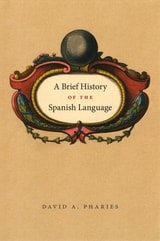
cover of A Brief History of the Spanish Language

A Brief History of the Spanish Language

David A. Pharies

University of Chicago Press, 2007

Spanish is the fourth most widely spoken language in the world and a language of ever-increasing importance in the United States. In what will likely become the introduction to the history of the Spanish language, David Pharies clearly and concisely charts the evolution of Spanish from its Indo-European roots to its present form. An internationally recognized expert on the history and development of this language, Pharies brings to his subject a precise sense of what students of Spanish linguistics need to know.

After introductory chapters on what it means to study the history of a language, the concept of linguistic change, and the nature of language families, Pharies traces the development of Spanish from its Latin roots, all with the minimum amount of technical language possible.  In the core sections of the book, readers are treated to an engaging and remarkably succinct presentation of the genealogy and development of the language, including accounts of the structures and peculiarities of Latin, the historical and cultural events that deeply influenced the shaping of the language, the nature of Medieval Spanish, the language myths that have become attached to Spanish, and the development of the language beyond the Iberian Peninsula, especially in the Americas. Focusing on the most important facets of the language’s evolution, this compact work makes the history of Spanish accessible to anyone with a knowledge of Spanish and a readiness to grasp basic linguistic concepts.

Available in both English and Spanish editions, A Brief History of the Spanish Language provides a truly outstanding introduction to the exciting story of one of the world’s great languages.
 
[more]
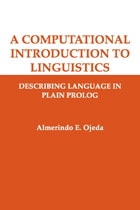
cover of A Computational Introduction to Linguistics: Describing Language in Plain Prolog

A Computational Introduction to Linguistics

Describing Language in Plain Prolog

Almerindo E. Ojeda

CSLI, 2013

In this book, Almerindo E. Ojeda offers a unique perspective on linguistics by discussing developing computer programs that will assign particular sounds to particular meanings and, conversely, particular meanings to particular sounds. Since these assignments are to operate efficiently over unbounded domains of sound and sense, they can begin to model the two fundamental modalities of human language—speaking and hearing. The computational approach adopted in this book is motivated by our struggle with one of the key problems of contemporary linguistics—figuring out how it is that language emerges from the brain.

[more]
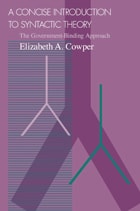
cover of A Concise Introduction to Syntactic Theory: The Government-Binding Approach

A Concise Introduction to Syntactic Theory

The Government-Binding Approach

Elizabeth A. Cowper

University of Chicago Press, 1992

This textbook is intended to give students a quick start in using theory to address syntactic questions. At each stage, Cowper is careful to introduce a theoretical apparatus that is no more complex than is required to deal with the phenomenon under consideration. Comprehensive and up-to-date, this accessible volume will also provide an excellent refresher for linguists returning to the study of Government-Binding theory.

"Cowper exhibits the analytical devices of current principles-and-parameters approaches, takes readers carefully through the central elements of grammatical theory (including very recent work), and ushers them selectively into the technical literature. . . . A serious introduction for those who want to know the nuts and bolts of syntactic theory and to see why linguists are so excited these days."—David Lightfoot, University of Maryland

"An excellent short introduction to the Government and Binding model of syntactic theory. . . . Cowper's work succeeds in teaching syntactic argumentation and in showing the conceptual reasons behind specific proposals in modern syntactic theory."—Jaklin Kornfilt, Syracuse University
[more]
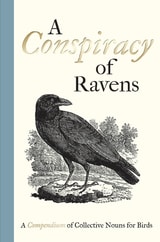
cover of A Conspiracy of Ravens: A Compendium of Collective Nouns for Birds

A Conspiracy of Ravens

A Compendium of Collective Nouns for Birds

Compiled by Samuel Fanous

Bodleian Library Publishing, 2014

A charm of goldfinches. An ostentation of peacocks. A murder of crows. The English language brims with witty words for flocks of birds! Thought to have originated from hunting manuals, the practice of inventing collective nouns for birds has since evolved into a sport all its own, with new words striving to perfectly capture the essence of each bird.
           
A Conspiracy of Ravens presents readers with a compendium of collective bird nouns from the distant and not-so-distant past. Some of the nouns are portentous, like a tiding of magpies. Others, like a murmuration of starlings or a chattering of choughs, convey sound. Still more reflect with literary flourish the beauty of the bird: what could be more celebratory than a crown of kingfishers or an exaltation of larks? Featuring songbirds, aquatic birds, garden favorites, and birds of prey, this book collects more than one hundred of the best and most imaginative expressions and illustrates them with charming woodcuts by the eighteenth-century artist and naturalist Thomas Bewick.
           
A beautiful and entertaining read, A Conspiracy of Ravens will delight bird-lovers and word-lovers in equal measure.
[more]
cover of A Constructional Approach to Resultatives

A Constructional Approach to Resultatives

Hans C. Boas

CSLI, 2003
Providing a unified solution within the frameworks of Construction Grammar and Frame Semantics, Hans Boas develops an account of resultative constructions in English by grouping them in two classes: conventionalized and non-conventionalized. The usage-based model used here proposes that each particular sense of a verb constitutes a conventionalized mini-construction, which is crucial information for the licensing of arguments. In contrast, verbs in non-conventionalized resultative constructions can acquire a novel meaning and thereby a new syntactic frame. English and German resultatives are compared to illustrate the distinct lexical polysemy networks of English and German verbs.
[more]
cover of A Contested Caribbean Indigeneity: Language, Social Practice, and Identity within Puerto Rican Taíno Activism

A Contested Caribbean Indigeneity

Language, Social Practice, and Identity within Puerto Rican Taíno Activism

Sherina Feliciano-Santos

Rutgers University Press, 2021
A Contested Caribbean Indigeneity is an in-depth analysis of the debates surrounding Taíno/Boricua activism in Puerto Rico and the Caribbean diaspora in New York City. Drawing on in-depth ethnographic research, media analysis, and historical documents, the book explores the varied experiences and motivations of Taíno/Boricua activists as well as the alternative fonts of authority they draw on to claim what is commonly thought to be an extinct ethnic category. It explores the historical and interactional challenges involved in claiming membership in, what for many Puerto Ricans, is an impossible affiliation. In focusing on Taíno/Boricua activism, the books aims to identify a critical space from which to analyze and decolonize ethnoracial ideologies of Puerto Ricanness, issues of class and education, Puerto Rican nationalisms and colonialisms, as well as important questions regarding narrative, historical memory, and belonging.
[more]
cover of A Descriptive Approach to Language-Theoretic Complexity

A Descriptive Approach to Language-Theoretic Complexity

James Rogers

CSLI, 1998
Early formal specifications of natural language syntax were quite closely connected to the notion of abstract machines for computing them. This provided a very natural means of gauging the relative difficulty of processing various constructions, as well as offering some insight into the abstract properties of the human language faculty. More recently, this approach has been superseded by one in which languages are specified in terms of systems of constraints on the structure of their sentences. This has made complexity results difficult to obtain. This book introduces a way of obtaining such results. It presents a natural and quite general means of expressing constraints on the structure of trees and shows that the languages that can be specified by systems of such constraints are exactly those computable by a particular standard class of abstract machines. Thus the difficulty of processing a construction can be reduced to the difficulty of expressing the constraints that specify it. The technique is demonstrated by applying it to a fairly complete treatment of English within the framework of Government and Binding theory, with the result of showing that its complexity is much less than has heretofore been assumed.
[more]
cover of A Dictionary of Ch'orti' Mayan-Spanish-English

A Dictionary of Ch'orti' Mayan-Spanish-English

Kerry Hull

University of Utah Press, 2016

Of extant languages, Ch’orti’ Mayan is the closest to ancient the Maya hieroglyphic script, but it is a language that is decreasing in usage. In southern Guatemala where it is spoken, many children no longer learn it, as Spanish dominates most experiences. From linguistic and anthropological data gathered over many years, Kerry Hull has created the largest and most complete Ch’orti’ Mayan dictionary to date. With nearly 9,000 entries, this trilingual dictionary of Ch’orti’, Spanish, and English preserves ancient words and concepts that were vital to this culture in the past.

Each entry contains examples of Ch’orti’ sentences along with their translations. Each term is defined grammatically and linked to a grammatical index. Variations due to age and region are noted. Additionally, extensive cultural and linguistic annotations accompany many entries, providing detailed looks into Ch’orti’ daily life, mythology, flora and fauna, healing, ritual, and food. Hull worked closely with native speakers, including traditional ritual specialists, and presents that work here in a way that is easily accessible to scholars and laypersons alike. 
[more]
cover of A Dictionary of Language

A Dictionary of Language

David Crystal

University of Chicago Press, 2001
No ordinary dictionary, David Crystal's Dictionary of Language includes not only descriptions of hundreds of languages literally from A to Z (Abkhaz to Zyryan) and definitions of literary and grammatical concepts, but also explanations of terms used in linguistics, language teaching, and speech pathology. If you are wondering how many people speak Macedonian, Malay, or Makua, or if you're curious about various theories of the origins of language, or if you were always unsure of the difference between structuralism, semiotics, and sociolinguistics, this superbly authoritative dictionary will answer all of your questions and hundred of others.


[more]
cover of A Dictionary of Selected Synonyms in the Principal Indo-European Languages

A Dictionary of Selected Synonyms in the Principal Indo-European Languages

Carl Darling Buck

University of Chicago Press, 1988
Originally published in 1949 and appearing now for the first time in a paperbound edition, Buck's Dictionary remains an indispensable tool for diachronic analysis of the Indo-European languages. Arranged according to the meaning of words, the work contains more than 1,000 groupings of synonyms from the principal Indo-European languages. Buck first tabulates the words describing a particular concept and then discusses their etymological and semantic history, tracing changes in meaning of the root words as well as presenting cases indicating which of the older forms have been replaced by expressions of colloquial or foreign origin.
[more]
cover of A Gateway to Sindarin: A Grammar of an Elvish Language from JRR Tolkien's Lord of the Rings

A Gateway to Sindarin

A Grammar of an Elvish Language from JRR Tolkien's Lord of the Rings

David Salo

University of Utah Press, 2004

From the 1910s to the 1970s, author and linguist J. R. R. Tolkien worked at creating plausibly realistic languages to be used by the creatures and characters in his novels. Like his other languages, Sindarin was a new invention, not based on any existing or artificial language. By the time of his death, he had established fairly complete descriptions of two languages, the "elvish" tongues Quenya and Sindarin. He was able to compose poetic and prose texts in both, and he also constructed a lengthy sequence of changes for both from an ancestral "proto-language," comparable to the development of historical languages and capable of analysis with the techniques of historical linguistics.

In A Gateway to Sindarin, David Salo has created a volume that is a serious look at an entertaining topic. Salo covers the grammar, morphology, and history of the language. Supplemental material includes a vocabulary, Sindarin names, a glossary of terms, and an annotated list of works relevant to Sindarin. What emerges is an homage to Tolkien's scholarly philological efforts.
[more]
cover of A Grammar Writer's Cookbook

A Grammar Writer's Cookbook

Edited by Miriam Butt, Tracy Holloway King, María-Eugenia Niño, and Frédérique S

CSLI, 1999
A Grammar Writer's Cookbook is an introduction to the issues involved in the writing and design of computational grammars, reporting on experiences and analyses within the ParGram parallel grammar development project. Using the Lexical Functional Grammar (LFG) framework, this project implemented grammars for German, French, and English to cover parallel corpora.
[more]
cover of A Grammar and Dictionary of the Timucua Language

A Grammar and Dictionary of the Timucua Language

Julian Granberry

University of Alabama Press, 1993

Preserving the voice of a vanished people through language, history, and scholarship.

Taken from the surviving contemporary documentary sources, Julian Granberry's volume describes the grammar and lexicon for the extinct 17th-century Timucua language of Central and North Florida and traces the origins of the 17th-century Timucua speakers and their language. Originally privately published in 1987, with limited circulation, this is the only available publication on the Timucuan language. It provides full grammatical analysis and complete lexical data, and it synthesizes both linguistic and archaeological data in order to provide a coherent picture of the Timucua peoples. Granberry traces the probable historical origins of Timucua speakers to a central Amazonian homeland at approximately 2,500 B.C. and proposes that Timucua speakers were responsible for introducing ceramic wares into North America.
[more]
cover of A Grammar of Akajeru: Fragments of a Traditional North Andamanese Dialect

A Grammar of Akajeru

Fragments of a Traditional North Andamanese Dialect

Raoul Zamponi and Bernard Comrie

University College London, 2021

A definitive guide to an almost extinct North Andamanese language.
 
Originally spoken across the northern Andamanese Islands in the Bay of Bengal, the Akajeru language is spoken today by only three people. A Grammar of Akajeru describes this unique grammatical system as it was reported at the turn of the twentieth century. Based primarily on research conducted by Victorian anthropologists Alfred R. Radcliffe-Brown and Edward Horace Man, this book offers a linguistic analysis of all extant Akajeru material as well as the scant documentation of adjacent dialects Akabo and Akakhora. This volume includes a grammatical sketch of Akajeru, an English-Akajeru lexicon, and a comparison between Akajeru and present-day Andamanese.
 
[more]
cover of A Grammar of Gaddi

A Grammar of Gaddi

Preeti Kumari, Shreya Mehta, Anjali Nair, Anusuya Nayak, Yangchen Roy, and Vyom Sharma

University College London, 2026

The first comprehensive descriptive grammar of the understudied Indo-Aryan Pahari language, Gaddi.

A Grammar of Gaddi is the first long-form descriptive grammar of the Pahari Indo-Aryan language, Gaddi (also called Bharmauri), spoken by the Gaddi people, a traditionally pastoral community in India. The volume presents a meticulous linguistic analysis of Gaddi, showcasing its phonemic inventory, phonotactics, syllable structure, and its phonological and morpho-phonological processes.
[more]
cover of A Grammar of Khowar: Descriptive and Comparative Analysis

A Grammar of Khowar

Descriptive and Comparative Analysis

Elena Bashir

University College London, 2025

A pioneering linguistic study documenting Khowar’s complex structure and historic oral tradition, shaped by centuries of cultural exchange in northern Pakistan.

Grammar of Khowar is the first comprehensive English-language study of Khowar, a unique Indo-Aryan language spoken in northern Pakistan. Drawing on over thirty years of field research, Elena Bashir provides a detailed snapshot of the language at a critical moment in its evolution, as increasing cultural and economic pressures accelerate linguistic change.

The book presents Khowar’s phonology, morphology, and syntax, alongside an in-depth analysis of how its grammatical structures shape the way speakers conceptualize the world. Rife with original example sentences—many sourced from oral texts recorded in multiple villages—this work preserves linguistic data that might otherwise be lost. A special appendix includes a thirty-page sample text in Khowar’s Perso-Arabic script, followed by a romanized transcription and English translation, offering an invaluable resource for scholars.

A critical contribution to South Asian linguistics, this book underscores the urgency of studying and preserving endangered mountain languages before they fade from use.
 
[more]
cover of A Grammar of Mam, A Mayan Language

A Grammar of Mam, A Mayan Language

By Nora C. England

University of Texas Press, 1983

This is the first full-length reference grammar of Mam, a Mayan language spoken today by over 400,000 people in the western highlands of Guatemala and the state of Chiapas, Mexico. The result of over three years of extensive fieldwork in Guatemala, A Grammar of Mam, a Mayan Language is based on the dialect of Mam spoken by 12,000 people in San Ildefonso Ixtahuacan in the department of Huehuetenango, Guatemala.

England organizes A Grammar of Mam according to two complementary principles: to analyze Mam following basically traditional levels of grammatical description and to present material in such a way that the background information necessary for understanding each topic of discussion shall have been previously provided. Accordingly, England's analysis of the sound system and morphophonemic processes of Mam is followed by a description of the characteristics of root, inflectional, and derivational morphology. Chapters on phrase structure precede two chapters on sentence-level syntax.

A Grammar of Mam is of particular interest in analyzing a Mayan language that is both syntactically and morphologically ergative and that is innovative in the direction of strengthening the ergative system. Indeed at all levels of linguistic organization Mam is innovative, and for this reason it is uniquely interesting both historically and theoretically.
[more]
cover of A Historical Grammar of the Maya Language of Yucatan: 1557-2000

A Historical Grammar of the Maya Language of Yucatan

1557-2000

Victoria R. Bricker

University of Utah Press, 2018
Victoria Bricker’s painstaking work is based on almost one thousand provenienced notarial documents and letters written by native speakers of Yucatec Maya from colonial times to the modern day. Because the documents are dated and also specify the town where they were written, Bricker was able to determine when and where grammatical changes first appeared in the language and the trajectory of their movement across the Yucatan peninsula. This exemplary grammar of Yucatec Maya includes examples and careful explanations of the phonological, morphological, and syntactic structures of the language. Bricker’s research is distinguished in its treatment of seemingly aberrant spellings of Maya words as clues to the way they were actually pronounced at different times in the past. Her chapters include topics seldom covered, such as deictic particles, affects, and reduplication. Of special interest is a poetic form of reduplication composed of couplets (or triplets) found in documents from each of the centuries, indicating the continuity of this genre from the Colonial to the Modern version of this language.
 
[more]
cover of A History of Language

A History of Language

Steven Roger Fischer

Reaktion Books, 2018
This second edition of Steven Roger Fischer’s fascinating book charts the history of communication from a time before human language was conceived of to the media explosion of the present day. Fischer begins by describing the modes of communication used by whales, birds, insects, and nonhuman primates, suggesting these are the first contexts in which the concept of “language” might be applied. He then moves from the early abilities of Homo erectus to the spread of languages worldwide, analyzing the effect of the development of writing along the way. With the advent of the science of linguistics in the nineteenth century, the nature of human languages first came to be studied and understood. Fischer follows the evolution of linguists’ insights and the relationship of language to social change into the mid-1900s. Taking into account the rise of pidgin, Creole, jargon, and slang, he goes on to raise provocative questions about literature’s—and literacy’s—relationship to language. Finally, touching on the effects of radio, television, propaganda, and advertising, Fischer looks to the future, asking how electronic media are daily reshaping the world’s languages and suggesting a radical reinterpretation of what language really is.
[more]
cover of A Key into the Language of America: The Tomaquag Museum Edition

A Key into the Language of America

The Tomaquag Museum Edition

Roger Williams

Westholme Publishing, 2019

A New Edition of One of the Most Important Cultural Artifacts of European and Indigenous American Contact
Roger Williams’s Key into the Language of America, first published in 1643, is one of the most important artifacts of early Indigenous American culture. In it, Williams recorded the day-to-day experience of the Narragansett people of Rhode Island in their own words, the first documentation of an American Indian language in English. Williams’s Key can be read at many levels because of its historical, literary, political, and religious significance. Its greatest value, though, is its intimate portrait of the Narragansett and their linguistic neighbors in the early years of European colonial settlement, before disease, dislocation, warfare—in particular, King Philip’s War—and colonial interference had diminished their population and power in the region. An extraordinary achievement, Williams’s Key gives us a contemporary account of Narragansett family life, of their sociability and skill in business, their dress, foodways, and the farming, fishing, and hunting that formed the basis of their sustenance practices. 
This new Tomaquag Museum edition includes for the first time cultural commentary provided by the Narragansett Tribe as well as modern linguistic information provided by a leading authority in the study of American Indian languages. 
The Tomaquag Museum, located in Exeter, Rhode Island, is an Indigenous nonprofit organization dedicated to sharing the culture, arts, and history of the Narragansett and other tribal communities of southern New England.
[more]
cover of A Leonard Bloomfield Anthology

A Leonard Bloomfield Anthology

Leonard Bloomfield

University of Chicago Press, 1987

In the centenary year of Leonard Bloomfield's birth, this abridgment makes available a representative selection of the writings of this central figure in the history of linguistics.

"Hockett has achieved his purpose—to reveal Bloomfield's way of working, the general principles that guided his work, and last, but by no means least, to indicate how Bloomfield's interests and attitudes changed with the passing years."—Harry Hoijer, Language
[more]
cover of A Lexical Approach to Italian Cliticization

A Lexical Approach to Italian Cliticization

Paola Monachesi

CSLI, 1999
This volume examines the behavior of clitics both in Italian and in certain southern Italian dialects in order to show that, even within a single language, clitics exhibit different properties. Monachesi argues against the existence of a special class 'clitics' whose elements exhibit variable behavior. Instead, she decomposes and assimilates their properties to those of well established categories. Motivations are thus provided for treating Italian object clitics as affixes. It is shown that both their morphosyntactic and their phonological behavior argue in favor of this assumption. Under this view, a lexicalist analysis is proposed which takes into account the phonological, morphological, and syntactic properties of Italian clitics.
[more]
cover of A Natural History of Negation

A Natural History of Negation

Laurence R. Horn

CSLI, 1989
This book offers a unique synthesis of past and current work on the structure, meaning, and use of negation and negative expressions, a topic that has engaged thinkers from Aristotle and the Buddha to Freud and Chomsky. Horn's masterful study melds a review of scholarship in philosophy, psychology, and linguistics with original research, providing a full picture of negation in natural language and thought; this new edition adds a comprehensive preface and bibliography, surveying research since the book's original publication.
[more]
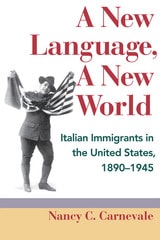
cover of A New Language, A New World: Italian Immigrants in the United States, 1890-1945

A New Language, A New World

Italian Immigrants in the United States, 1890-1945

Nancy C. Carnevale

University of Illinois Press, 2012
An examination of Italian immigrants and their children in the early twentieth century, A New Language, A New World is the first full-length historical case study of one immigrant group's experience with language in America. Incorporating the interdisciplinary literature on language within a historical framework, Nancy C. Carnevale illustrates the complexity of the topic of language in American immigrant life. By looking at language from the perspectives of both immigrants and the dominant culture as well as their interaction, this book reveals the role of language in the formation of ethnic identity and the often coercive context within which immigrants must negotiate this process.
[more]
cover of A Paradigm for Program Semantics

A Paradigm for Program Semantics

Chris Brink and Ingrid Rewitsky

CSLI, 2001
This book provides a synthesis of four versions of program semantic—srelational semantics, predicate transformer semantics, information systems, and domain theory—showing, through an exhaustive case study analysis, that it is possible to do back-and-forth translation from any of these versions of program semantics into any of the others, and demonstrating that while there are many variations of each, in principle they may be thought of as intertranslatable.
[more]
cover of A Sourcebook for Ancient Greek: Grammar, Poetry, and Prose

A Sourcebook for Ancient Greek

Grammar, Poetry, and Prose

John Tomarchio

Catholic University of America Press, 2022
This book was designed for students transitioning from the study of Greek grammar to translation of texts. It was developed in classroom use for classroom use, in the context of an integrated Great Books program in liberal arts and sciences. It is meant for students not only of Classics, but more, for students of Humanities interested in direct engagement of primary sources. Each Greek text offered for translation was chosen for its theoretical interest as well as the interest of its Greek. The selections of Greek literature offered in this Sourcebook are wide-ranging. The indisputable standard of excellence for classicists is of course the Attic dialect of Athens in its glory. However, this Sourcebook is meant for students of liberal arts and sciences whose interests range far more widely. Thus, it does not hesitate to extend not only backward to the archaic Greek of Homer, but also forward to the koine Greek of the Alexandrian and Roman empires. Greek works were chosen for being seminal to Western thinking today, chosen to give students of Western arts and sciences introductions to its Greek sources Naturally, Greek grammar is taught to the newcomer analytically and sequentially, but the continuing student needs to synthesize these distended enumerations of elements and principles. Accordingly, grammatical synopses are not appended as reference tables but placed front and center as objects of study. The grammar tables offer synoptic views of integral parts of Greek grammar to show the form and logic of the whole part of speech or part of a sentence. On the basis of these tables, detailed grammatical notes and commentary appended to Greek selections that follow are tailored for continuing students.
[more]
cover of A Sourcebook for Classical Logic

A Sourcebook for Classical Logic

John Tomarchio

Catholic University of America Press, 2023
This Sourcebook offers a brief sequence in classical Logic befitting an unspecialized study for students of liberal arts and sciences. The sequence is made up of select texts of the Aristotelian Organon, mostly the opening chapters of each treatise, in the traditional order, where Aristotle lays out the primary elements of reasoning. Study aids accompany these primary texts, providing students with mnemonics and diagrams developed for classroom use in the great books programs St. John’s College. The culmination of this Aristotelian Logic sequence is selections from the Posterior Analytics where Aristotle offers an account of the demonstrative reasoning of theoretical sciences. The interest of this Sourcebook, as of Aristotelian Logic, is search for such knowledge. This Aristotelian sequence is preceded by a sequence of readings in Medieval grammatica speculativa, or philosophy of language. This propaedeutic sequence begins with an ancient source to which that metaphysically minded ‘grammar’ recurred, namely Augustine’s De magistro, or On the Teacher. It is a dialogue between Augustine and his son about the triadic relation of the spoken word to the word thought and the thing thought about. This aporetic dialectic between Augustine and his son proves effective in awakening students to the theoretical stakes of Logic. Similarly, from later theological inquiries into language for purposes of scriptural interpretation more general theories of language emerged. The theoretical uses thus made of Aristotelian Logic by the Jewish theologian Maimonides and the Catholic Thomas Aquinas whet student appetite for the technical matter of the Organon sequence to follow.
[more]
cover of A Sourcebook for Classical Rhetoric

A Sourcebook for Classical Rhetoric

John Tomarchio

Catholic University of America Press, 2023
This Sourcebook is intended for students of liberal arts and great books. It treats such books as primary sources for inquiring into the nature of human speech because they clarify the terms and stakes of perennial questions thinking human beings ask themselves about persuasive speaking. By crystallizing viable claims about the nature of what we confront in politics and society—live claims for us to confront in our own, with the stakes of that confrontation being live as well—they originate a dialectic with one another and with us their readers. Cicero called rhetoric a liberal art necessary for every citizen of a free republic. In the polities of ancient Greece and Rome, rhetoric was politically potent because oratory was the regular means of political decision. Words were decisive, often a matter of life and death, not merely for individuals but for peoples. In human milieux where human speech is so politically decisive, reflection upon its nature became keen. The selections of this sourcebook have been arranged in three sequences. The first two sequences comprise philosophical dialogues on the ends of rhetoric. Selections from Plato’s Gorgias, Phaedrus, and Apology examine the rhetorician or teacher of rhetoric, and then Cicero’s De oratore offers us a dialectic among practitioners about its practice. The philosophical dialogues on the art’s intended ends and causative effects provide the theoretical and ethical context for examining its means. These philosophical dialogues are thus propaedeutic to the third sequence, which focusses on the art itself with selections from Aristotle’s treatise On Rhetoric, paired with orations from Thucydides’ History of the Peloponnesian War.
[more]
cover of A Sourcebook for English Lyric Poetry

A Sourcebook for English Lyric Poetry

John Tomarchio

Catholic University of America Press, 2023
This Sourcebook is not a survey of English lyric poems but rather a florilegium. It singles out great poems of the last five centuries worthy of study in liberal education—in Great Books programs, Core curricula, and the Humanities generally. The poems were selected not as representative of the author’s time or oeuvre, but rather as addressed to the reader and the reader’s time by virtue of their representing the nature of things. That is what makes a poem great and worthy of inquiry, in John Tomarchio’s judgement. The capacities, needs, and interests of students of such great poetry were the principles of selection. To arrange the great poems selected Tomarchio looked to their meters as a formal measure intrinsic to them, rather than to epochal divisions. The paradigmatic example of this is the classical English sonnet. Many an English poet has submitted themselves to the self-discipline of this poetic form born in the classical period of English poetry in Tudor England. But what of such historical context? When Robert Frost chooses to write a sonnet in the 20th century, why associate it more with the free verse of e.e. cummings than of the quincentenary sonnet tradition his chosen form invokes for context? The Sourcebook arranges poems according to five such metrical modes, however along with an Index by poet as well . Tomarchio’s enumeration of poetic modes does not presume to be either exhaustive or normative, but rather interpretative of poetic practices and hopefully more elucidative than historical considerations. Further, as understanding great poetry’s means deepens interpretation of ends, the Sourcebook begins with a propaedeutic “grammar” that introduces students to such devices of poetic art as meter, rhyme, and trope.
[more]
cover of A Tohono O'odham Grammar

A Tohono O'odham Grammar

Ofelia Zepeda

University of Arizona Press, 1983
This first pedagogical grammar of the Papago language features twenty chapters on grammatical constructions and five sample dialogs—plus abbreviations, symbols, summary of grammatical elements, and two glossaries. Classroom-tested for teaching both native and non-native speakers, the text also offers linguists an overview of the Papago language not available elsewhere.
[more]
cover of A War of Words in the Discourse of Trade: The Rhetorical Constitution of Metaphor

A War of Words in the Discourse of Trade

The Rhetorical Constitution of Metaphor

Philip Eubanks

Southern Illinois University Press, 2000

This study by Phillip Eubanks challenges traditional accounts of metaphor and significantly expands theories of "conceptual" metaphor by examining Trade Is War metaphor as it occurs in concrete discourse.

Although scholarly interest in metaphor as an aesthetic, linguistic, and cognitive phenomenon has long endured, Eubanks is among the first to consider metaphor in its sociohistorical role. Questioning major accounts of metaphor from Aristotle to the present, Eubanks argues that metaphor is not just influenced by but actually is constituted by its concrete operation.

Far-reaching in its implications for our understanding of metaphor, Eubanks’s premise enables us to see metaphor as a sweeping rhetorical entity even as it accounts for the more localized operations of metaphor of interest to linguists, philosophers of language, and cognitive scientists. Providing a new model of metaphoric functioning, Eubanks reconsiders the most promising account of metaphor to date, the notion of "conceptual metaphor.”

Eubanks focuses on the conceptual metaphor Trade Is War—a metaphor found wherever people discuss business and commerce—to develop his rhetorical model of metaphor. He analyzes Trade Is War as it occurs in the print news media, on television discussion shows, in academic works, in popular nonfiction and novels, in historic economic commentary, and in focus group talk. While these examples do reveal a rich variety in the make-up of Trade Is War, much more than mere variety is at stake.

Trade Is War is implicated in an extended and rhetorically complex conversation with other metaphors and literal concepts: trade is peace, Trade Is a Game, Trade Is Friendship, Trade is a Journey, and Markets Are Containers. The recognition and analysis of this constituting conversation furthers a reevaluation theory. What also emerges, however, is a valuable portrait of the discourse of trade itself, a discourse that depends importantly upon a responsive interchange of metaphors.

[more]
cover of Aazheyaadizi: Worldview, Language, and the Logics of Decolonization

Aazheyaadizi

Worldview, Language, and the Logics of Decolonization

Mark D. Freeland

Michigan State University Press, 2020

Many of the English translations of Indigenous languages that we commonly use today have been handed down from colonial missionaries whose intent was to fundamentally alter or destroy prior Indigenous knowledge and praxis. In this text, author Mark D. Freeland develops a theory of worldview that provides an interrelated logical mooring to shed light on the issues around translating Indigenous languages in and out of colonial languages. In tandem with other linguistic and narrative methods, this theory of worldview can be employed to help root out the reproduction of colonial culture in Indigenous languages and can be a useful addition to the repertoire of tools needed to return to life-giving relationships with our environment. These issues of decolonization are highlighted in the trajectory of treaty language associated with relationships to land and their present-day importance. This book uses the 1836 Treaty of Washington and its contemporary manifestation in Great Lakes fishing rights and the State of Michigan’s 2007 Inland Consent Decree as a means of identifying the role of worldview in deciphering the logics embedded in Anishinaabe thought associated with these relationships to land. A fascinating study for students of Indigenous and linguistic disciplines, this book deftly demonstrates the significance of worldview theory in relation to the logics of decolonization of Indigenous thought and praxis.
[more]
cover of African American English Speakers and Their Participation in Local Sound Changes: A Comparative Study, Volume 84

African American English Speakers and Their Participation in Local Sound Changes

A Comparative Study, Volume 84

Erik R. Thomas

Duke University Press, 0
This volume examines variation in vowel configurations in African American English as spoken by members of seven U.S. communities, including Roanoke Island, North Carolina; Pittsburgh, Pennsylvania; and several parishes in rural Louisiana. The contributors argue that African American English exhibits considerable diversity, disproving the commonly held view that it is a uniform national dialect. Although some features of African American English are universal, others vary by region. In each community, African Americans adopted variants from local vernaculars. The study finds the most assimilation in the oldest communities in the rural South, where multiple races have lived together for centuries.
[more]
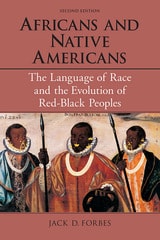
cover of Africans and Native Americans: The Language of Race and the Evolution of Red-Black Peoples

Africans and Native Americans

The Language of Race and the Evolution of Red-Black Peoples

Jack D. Forbes

University of Illinois Press, 1993
Jack D. Forbes's monumental Africans and Native Americans has become a canonical text in the study of relations between the two groups. Forbes explores key issues relating to the evolution of racial terminology and European colonialists' perceptions of color, analyzing the development of color classification systems and the specific evolution of key terms such as black, mulatto, and mestizo--terms that no longer carry their original meanings. Forbes also presents strong evidence that Native American and African contacts began in Europe, Africa, and the Caribbean.
[more]
cover of After Rhetoric: The Study of Discourse Beyond Language and Culture

After Rhetoric

The Study of Discourse Beyond Language and Culture

Stephen R. Yarbrough

Southern Illinois University Press, 1999

Aware that categorical thinking imposes restrictions on the ways we communicate, Stephen R. Yarbrough proposes discourse studies as an alternative to rhetoric and philosophy, both of which are structuralistic systems of inquiry.

Discourse studies, Yarbrough argues, does not support the idea that languages, cultures, or conceptual schemes in general adequately describe linguistic competence. He asserts that a belief in languages and cultures "feeds a false dichotomy: either we share the same codes and conventions, achieving community but risking exclusivism, or we proliferate differences, achieving choice and freedom but risking fragmentation and incoherence." Discourse studies, he demonstrates, works around this dichotomy.

Drawing on philosopher Donald Davidson, Yarbrough establishes the idea that community can be a consequence of communication but is not a prerequisite for it. By disassociating our thinking from conceptual schemes, we can avoid the problems that come with believing in an abstract structure that predates any utterance.

Yarbrough also draws on Mikhail Bakhtin's dialogism to define how utterances operate in life and to show how utterances are involved with power and how power relates to understanding. His discussion of Michel Meyer's problematology treats the questions implied by a statement as the meaning of the statement.

Yarbrough introduces readers to a credible theoretical framework for focusing on discourse rather than on conceptual schemes that surround it and to the potential advantages of our using this approach in daily life.
[more]
cover of Algebraic Semantics in Language and Philosophy

Algebraic Semantics in Language and Philosophy

Godehard Link

CSLI, 1997
The philosophical approach of this volume is mainly structuralist, using logical tools to investigate the formal structure of various kinds of objects in our world, as characterised by language and as systematised by philosophy. This volume mainly analyses the structural properties of collections or pluralities (with applications to the philosophy of set theory), homogeneous objects like water, and the semantics and philosophy of events. This book thereby complements algebraic work that has been done on other philosophical entities, i.e. propositions, properties, relations, or situations. Located in the triangle of language, logic and philosophy, this volume is unique in combining the resources of different ¹elds in an interdisciplinary enterprise. Half of the fourteen chapters of this volume are original papers, complementing the collection of the author's previously published essays on the subject.
[more]
cover of Algebras, Diagrams and Decisions in Language, Logic and Computation

Algebras, Diagrams and Decisions in Language, Logic and Computation

Edited by Kees Vermeulen and Ann Copestake

CSLI, 2002
This exemplary volume shows how the shared interests of three different research areas can lead to significant and fruitful exchanges: six papers each very accessibly present an exciting contribution to the study and uses of algebras, diagrams, and decisions, ranging from indispensable overview papers about shared formal members to inspirational applications of formal tools to specific problems. Contributors include Pieter Adriaans, Sergei Artemov, Steven Givant, Edward Keenan, Almerindo Ojeda, Patrick Scotto di Luzio, and Edward Stabler.
[more]
cover of Amazonian Linguistics: Studies in Lowland South American Languages

Amazonian Linguistics

Studies in Lowland South American Languages

Edited by Doris L. Payne

University of Texas Press, 1990

Lowland South American languages have been among the least studied ln the world. Consequently, their previous contribution to linguistic theory and language universals has been small. However, as this volume demonstrates, tremendous diversity and significance are found in the languages of this region.

These nineteen essays, originally presented at a conference on Amazonian languages held at the University of Oregon, offer new information on the Tupian, Cariban, Jivaroan, Nambiquaran, Arawakan, Tucanoan, and Makuan languages and new analyses of previously recalcitrant Tupí-Guaraní verb agreement systems.

The studies are descriptive, but typological and theoretical implications are consistently considered. Authors invariably indicate where previous claims must be adjusted based on the new information presented. This is true in the areas of nonlinear phonological theory, verb agreement systems and ergativity, grammatical relations and incorporation, and the uniqueness of Amazonian noun classification systems. The studies also contribute to the now extensive interest in grammatical change.
[more]
cover of Ambiguity in Language Learning: Computational and Cognitive Models

Ambiguity in Language Learning

Computational and Cognitive Models

Hinrich Schütze

CSLI, 1997

This volume is concerned with how ambiguity and ambiguity resolution are learned, that is, with the acquisition of the different representations of ambiguous linguistic forms and the knowledge necessary for selecting among them in context. Schütze concentrates on how the acquisition of ambiguity is possible in principle and demonstrates that particular types of algorithms and learning architectures (such as unsupervised clustering and neural networks) can succeed at the task. Three types of lexical ambiguity are treated: ambiguity in syntactic categorisation, semantic categorisation, and verbal subcategorisation. The volume presents three different models of ambiguity acquisition: Tag Space, Word Space, and Subcat Learner, and addresses the importance of ambiguity in linguistic representation and its relevance for linguistic innateness.
[more]
cover of American Regional Dialects: A Word Geography

American Regional Dialects

A Word Geography

Craig M. Carver

University of Michigan Press, 1987

This text describes the dialect areas of the United States. Focusing on some 2,000 dialect expressions, it traces cultural and historical forces that have shaped these speech regions and given them their characteristic vocabularies. The author not only explains the genesis and character of the dialects, but also explores the geographical and etymological origins of many unique words and phrases in the various dialects. Nearly 100 maps help define the dialect boundaries and individual isoglosses.
[more]
cover of Amy, Wendy, and Beth: Learning Language in South Baltimore

Amy, Wendy, and Beth

Learning Language in South Baltimore

By Peggy J. Miller

University of Texas Press, 1982

Amy, Wendy, and Beth, the 1980 recipient of the New York Academy of Sciences Edward Sapir Award, is a lively in-depth study of how three young children from an urban working-class community learned language under everyday conditions. It is a sensitive portrayal of the children and their families and offers an innovative approach to the study of language development and social class.

A major conclusion of the study is that the linguistic abilities of working-class children are consistent with previous cross-cultural accounts of the development of communicational skills and, as such, lend no support to past claims that children from the lower classes are linguistically deprived. Instead, Amy, Wendy, and Beth emerge as able and enthusiastic language learners; their families, as caring and competent partners in the language socialization process.

Sound scholarship and original findings about a hitherto neglected population of children lend special value to this work not only for scholars in psychology, linguistics, and anthropology, but for educators and policymakers as well.

[more]
cover of An Acoustic Analysis of Vowel Variation in New World English, Volume 76

An Acoustic Analysis of Vowel Variation in New World English, Volume 76

Erik R. Thomas, ed.

Duke University Press, 0

An Acoustic Analysis of Vowel Variation in New World English examines acoustical variations in vowel configurations in a wide variety of dialects of English found in the Western Hemisphere.
While the work opens with an introduction on the methods and aims of the study, the following chapter immediately moves to a detailed discussion of distinctive vowel sounds called phonemes, characterizing each variant of sound listed within the cited reference literature. The remaining chapters provide explanatory descriptions of the variants of each dialect, reviewing past research specific to that dialect. While the United States English, Canadian English, and Caribbean varieties are featured in various chapters throughout the work, individual chapters are devoted to African-American, Mexican-American, and Native American English, emphasizing not only ethnic variation but delving into the historical development of each dialect.
This monograph is an essential reference on vowel variation for all sociolinguists, phoneticians, phonologists, creolists, and historical linguists.
[more]
cover of An Essay on Contraction

An Essay on Contraction

André Fuhrmann

CSLI, 1996

Subject: Philosophy; Belief and Doubt; Logic
[more]
cover of An Essay on Negation: For a Linguistic Anthropology

An Essay on Negation

For a Linguistic Anthropology

Paolo Virno

Seagull Books, 2018

A vital addition to Seagull’s growing Italian List that focuses on leftist Italian thought, bringing famous as well as little-known yet crucial voices into the English language.

As speaking animals, we continuously make use of an unassuming grammatical particle, without suspecting that what is at work in its inconspicuousness is a powerful apparatus, which orchestrates language, signification, and the world at large. What particle might this be? The word not.

In Essay on Negation, Paolo Virno argues that the importance of the not is perhaps comparable only to that of money—that is, the universality of exchange. Negation is what separates verbal thought from silent cognitive operations, such as feelings and mental images. Speaking about what is not happening here and now, or about properties that are not referable to a given object, the human animal deactivates its original neuronal empathy, which is prelinguistic; it distances itself from the prescriptions of its own instinctual endowment and accesses a higher sociality, negotiated and unstable, which establishes the public sphere. In fact, the speaking animal soon learns that the negative statement does not amount to the linguistic double of unpleasant realities or destructive emotions: while it rejects them, negation also names them and thus includes them in social life. Virno sees negation as a crucial effect of civilization, one that is, however, also always exposed to further regressions. Taking his cue from a humble word, the author is capable of unfolding the unexpected phenomenology of the negating consciousness.
[more]
cover of An Introduction to the Indo-European Languages

An Introduction to the Indo-European Languages

Philip Baldi

Southern Illinois University Press, 1983

This comprehensive linguistic survey of the Indo-European groups synthesizes the vast amount of information contained in the spe­cialized handbooks of the individual stocks.

The text begins with an introduction to the concept of the Indo-European language family, the history of its discovery, and the techniques of analysis. The introduction also gives a structural sketch of Proto-Indo-European, the parent language from which the others are descended. Baldi then devotes a chapter to each of the 11 major branches of Indo-European (Italic, Celtic, Indo-Iranian, Greek, Armenian, Albanian, Baltic, Slavic, Germanic, Tocharian, and Anatolian).

Each chapter provides an outline of the external history of the branch, its people, di­alects, and other relevant history. This out­line is followed by a structural sketch of the most important language or languages of the branch (e.g., Old Irish for Celtic, Sanskrit and Avestan for Indo-Iranian, Latin and Osco-Umbrian for Italic). The sketch also contains the phonology, morphology, and syntax of each language. There is lastly a sample text of each language containing both interlinear and free translation. In those branches where there are special issues (e.g., the relation of Italic to Celtic and Baltic to Slavic, or the problem of archaism in Hittite), additional discussions of these issues are pro­vided. Baldi’s final chapter gives a brief out­line of the “minor” Indo-European lan­guages such as Illyrian, Thracian, Raetic, and Phrygian. Adding further to the usefulness of the book are extensive bibliographies, an up-to-date map showing the geographical dis­tribution of the Indo-European languages throughout the world, and a detailed family tree diagram of the members of each sub­group within the Indo-European language family and their interrelationships.

[more]
cover of An Irish-Speaking Island: State, Religion, Community, and the Linguistic Landscape in Ireland, 1770–1870

An Irish-Speaking Island

State, Religion, Community, and the Linguistic Landscape in Ireland, 1770–1870

Nicholas M. Wolf

University of Wisconsin Press, 2014

After 1770, Ireland experienced the establishment of modern forms of Irish Catholicism, new engagement by the public with the political process, and the growth of the modern state, represented by new legal and educational systems. An Irish-Speaking Island investigates the role in these developments of the population who spoke Irish in their daily lives—whether as a first or second language—and links the history of language contact and bilingualism with the broader history of Ireland in the eighteenth and nineteenth centuries.
            As late as 1840, Ireland had as many as four million Irish speakers—a significant proportion of the total population—who could be found in every county of the island and in all social classes and religious persuasions. Their impact on the modern history of Ireland and the United Kingdom cannot be captured by a simple conclusion that they became anglicized. Rather, Nicholas M. Wolf explores the complex ways in which the transition from Irish to English placed a premium on adaptive bilingualism and shaped beliefs and behavior in the domestic sphere, religious life, and oral culture within the community. An Irish-Speaking Island will interest not only historians but also scholars of linguistics, folklore, politics, literature, and religion.

Winner, Michael J. Durkan Prize for Books on Language and Culture, American Conference for Irish Studies

Winner, Donald Murphy Prize for Distinguished First Books, American Conference for Irish Studies
[more]
cover of An Other Tongue: Nation and Ethnicity in the Linguistic Borderlands

An Other Tongue

Nation and Ethnicity in the Linguistic Borderlands

Alfred Arteaga

Duke University Press, 1994

As our millennium draws to a close, we find ourselves in the midst of great and rapid global changes with nations and political systems dissolving all around us and the world becoming one of shifting identities--of peoples unified and divided by such distinctions as nationality, ethnicity, race, religion, and colonial status. The articulation and construction of these distinctions, the very language of difference, is the subject of An Other Tongue. This collection of essays by a group of distinguished scholars, including Norma Alarcón, Gayatri Spivak, Tzvetan Todorov, and Gerald Vizenor, explores the interconnections between language and identity.
The Chicanos, the U.S./Mexico borderland polyglots whose sense of history, nationality, and race is as mixed as their language, are the book's prime example. But the authors recognize that border zones, like diasporas and post-colonial relations, occur globally, and their discussion of hybrid or mestizo identities ranges from the United States to the Caribbean to South Asia to Ireland. Drawing on personal experience, readings of poetry and fiction, and cultural theory, the authors detail the politics of being human through the mediation of language. What does "shadow" mean to the Native American Indian, or diaspora to the East Indian immigrant? How does British colonialism yet affect Irish and Indian nationalist literary production? Why is the split between Eastern and Western European language use necessarily schizophrenic? So much of our sense of difference today is constructed as we speak, and An Other Tongue speaks with eloquence to this phenomenon and will be of great interest to those concerned with the discourse of post-colonial studies, critical theory, and the remapping of world literature.

Contributors. Norma Alarcón, Alfred Arteaga, Juan Bruce-Novoa, Cordelia Chávez Candelaria, Michael G. Cooke, Edmundo Desnoes, Eugene C. Eoyang, David Lloyd, Lydie Moudileno, Jean-Luc Nancy, Tejaswini Niranjana, Ada Savin, Gayatri Chakravorty Spivak, Michael Smith, Tzvetan Todorov, Luis A. Torres, Gerald Vizenor

[more]
cover of Anaphora and Conceptual Structure

Anaphora and Conceptual Structure

Karen van Hoek

University of Chicago Press, 1997

Karen van Hoek presents a cogent analysis of the classic problem of constraints on pronominal anaphora within the framework of Cognitive Grammar. Van Hoek proceeds from the position that grammatical structure can be characterized in terms of semantic and phonological representations, without autonomous syntactic structures or principles such as tree structures or c-command. She argues that constraints on anaphora can be explained in terms of semantic interactions between nominals and the contexts in which they are embedded.

Integrating the results of previous work, Van Hoek develops a model in which some nominals function as "conceptual reference points" that dominate over stretches defined by the semantic relations among elements. When a full noun is in the domain of a reference point, coreference is ruled out, since the speaker would be sending contradictory messages about the salience of the noun's referent.

With profound implications for the nature of syntax, this book will interest theoretical linguists of all persuasions.

[more]
cover of Angalkut/Shamans in Yup'ik Oral Tradition

Angalkut/Shamans in Yup'ik Oral Tradition

Ann Fienup-Riordan

University of Alaska Press, 2025

Angalkut/Shamans in Yup’ik Oral Tradition collects over thirty years’ worth of shaman stories, told as part of gatherings organized by Calista Education and Culture to document Yup’ik traditional knowledge. These conversations highlight the critical role angalkut played in Yup’ik life—healing the sick, interpreting dreams and unusual experiences, requesting future abundance through masked dances and other ceremonies, protecting the lives of young children, and dealing with the dead.
 
The book begins with an English introduction that places Yup’ik oral traditions in the context of shamanism in Alaska and other parts of the Arctic. Then first-person accounts presented in the original Yup’ik with accompanying English translations discuss the importance of shamans and shamanism in general, good and bad shamans, and shamans as healers. Narratives from Nelson Island, Canineq, Kuskokwim River, Akulmiut, and Yukon River describe shamans as healers, shaman journeys and performances, shamans and masked dances requesting abundance, shamans and the dead, malicious shamans, shaman confrontations, becoming a shaman, and those who have shaman abilities today. A detailed glossary and references are also included.
 
Today, not only are these angalkut gone, but so are those who witnessed and participated in their activities. Angalkut/Shamans in Yup’ik Oral Tradition is the first book devoted exclusively to Yup’ik angalkut; never before has the variety of angalkut roles been profiled in publication, including the richness of elders’ recollections of these individuals and their roles. There is great value in the stories they left behind. This fine-grained presentation of unique, bilingual first-person narratives is an essential resource for scholars and students interested in Yup’ik heritage, Yugtun language, shaman ethnography, and Alaska Native oral traditions.
 
[more]