Results by title
4 books match the query 'Lions'
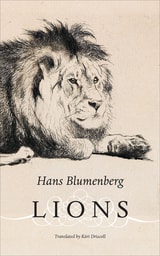
Lions
Hans Blumenberg
Seagull Books, 2020
Each of these short texts, sparkling with erudition and humor, is devoted to a peculiar leonine presence—or, in many cases, absence—in literature, art, philosophy, religion, and politics. From Ecclesiastes to the New Testament Apocrypha, Dürer to Henri Rousseau, Aesop and La Fontaine to Rilke and Thomas Mann, the extraordinary breadth of Blumenberg’s knowledge and intellectual curiosity is on full display. Lions has much to offer readers, both those already familiar with Blumenberg’s oeuvre and newcomers looking for an introduction to the thought of one of Germany’s most important postwar philosophers.
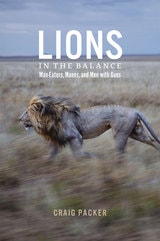
Lions in the Balance
Man-Eaters, Manes, and Men with GunsCraig Packer
University of Chicago Press, 2015
Monsters take many forms: from man-eating lions to the people who hunt them, from armed robbers to that midnight knock at the door of a cheap hotel room in Dar es Salaam. And celebrated biologist Craig Packer has faced them all. Head on.
With Lions in the Balance, Packer takes us back into the complex, tooth-and-claw world of the African lion, offering revealing insights into both the lives of one of the most iconic and dangerous animals on earth and the very real risks of protecting them. A sequel to his prize-winning Into Africa—which gave many readers their first experience of fieldwork in Africa, of cooperative lions on dusty savannas, and political kidnappings on the shores of Lake Tanganyika—this new diary-based chronicle of cutting-edge research and heartbreaking corruption will both alarm and entertain. Packer’s story offers a look into the future of the lion, one in which the politics of conservation will require survival strategies far more creative and powerful than those practiced anywhere in the world today.
Packer is sure to infuriate millionaires, politicians, aid agencies, and conservationists alike as he minces no words about the problems he encounters. But with a narrative stretching from far flung parts of Africa to the corridors of power in Washington, DC, and marked by Packer’s signature humor and incredible candor, Lions in the Balance is a tale of courage against impossible odds, a masterly blend of science, adventure, and storytelling, and an urgent call to action that will captivate a new generation of readers.
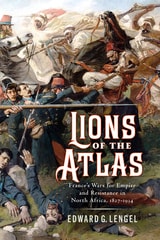
Lions of the Atlas
France's Wars for Empire and Resistance in North Africa, 1827–1934Edward G. Lengel
Westholme Publishing, 2026
France’s century-long wars of conquest in Algeria, Morocco, and Tunisia remain both understudied and symbolic of European imperialism. Launched to provide political legitimacy for the House of Bourbon during unstable times, these wars of empire ironically ended by generating nationalist sentiments that undermined French imperial aspirations, although France was successful on the battlefield after tremendous effort. The controversy both at the time and today about France’s North African ambitions has overshadowed the significant history of this conflict. Fought across some of the world’s most unforgiving, yet spectacular, terrain, these wars featured innovative military campaigns, epic battles, inspiring resistance leaders, and countless episodes of remarkable courage. Profoundly relevant, the French North African wars had a major global impact, influencing the development of military organization, tactics, and technology in the American Civil War, both world wars, and even modern Middle Eastern conflicts. Yet it is the human element that is most compelling. Based on extensive primary source research, Lions of the Atlas: France’s Wars for Empire and Resistance in North Africa, 1827–1934 is the first-ever comprehensive study, in any language, of these pivotal wars and those who fought them.
Beginning with the French naval blockade and amphibious invasion of Algeria in 1827–1830, the book tells the story of the large-scale campaigns and huge set-piece battles that ensued over the following several decades, across the highest peaks of the Atlas Mountains, in hills and valleys, along and over rivers, through scorching deserts, and even in fierce urban combat in town and city streets. Engagements include two unforgettable campaigns to capture the mountain fortress at Constantine, bold and devastating forays by Algerian cavalrymen and mountain warriors, and the pivotal 1844 Battle of Isly. The story continues with the French invasion of Tunisia in 1881, and then the thirty-year French campaign for the subjugation of Morocco, concluding with the Rif War of the 1920s that shocked the world. The narrative features charismatic resistance leaders such as Algeria’s Emir Abd-el-Kader, legendary military units such as the colorful Zouaves and the Foreign Legion, and changes in military technology, including the use of aircraft and armored vehicles. A major contribution to our understanding of one of the world’s most storied regions, Lions of the Atlas provides gripping and insightful reading while presenting the complex history of war and resistance in North Africa.
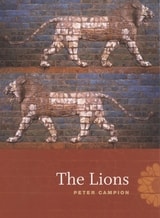
The Lions
Peter Campion
University of Chicago Press, 2009
Big Avalanche Ravine
Just the warning light on a blue crane.
Just mountains. Just the mist that skimmed
them both and bled to silver rain
lashing the condominiums.
But there it sank on me. This urge
to carve a life from the long expanse.
To hold some ground against the surge
of sheer material. It was a tense
and persistent and metallic shiver.
And it stayed, that tremor, small and stark
as the noise of the hidden river
fluming its edge against the dark.
In his second collection of poems, Peter Campion writes about the struggle of making a life in America, about the urge “to carve a space” for love and family from out of the vast sweep of modern life. Coursing between the political and personal with astonishing ease, Campion writes at one moment of his disturbing connection to the public political structure, symbolized by Robert McNamara (who makes a startling appearance in the title poem), then in the next, of a haunting reverie beneath a magnolia tree, representing his impulse to escape the culture altogether. He moves through various forms just as effortlessly, as confident in rhymed quatrains as in slender, tensed free verse. In The Lions, Campion achieves a fusion of narrative structure and lyric intensity that proves him to be one of the very best poets of his generation.
Praise for Other People
“Campion is a poet who knows that what a poet sees is nothing without a mixture of formal prowess and emotional insight.”—David Biespiel, The Oregonian