Results by title
3 books match the query 'Liquor laws'

Drinkers, Drivers, and Bartenders
Balancing Private Choices and Public AccountabilityFrank A. Sloan, Emily M. Stout, Kathryn Whetten-Goldstein, and Lan Liang
University of Chicago Press, 2000
According to the United States Public Health Service, over 100,000 deaths a year are attributable to alcohol, including 20,000 highway fatalities. In response, legislatures have enacted various forms of regulation intended both to reduce alcohol consumption and to curb its harmful effects. This groundbreaking study focuses on one such form of regulation, the liability imposed on alcohol servers and social hosts by tort law. Basing their analysis on important new data from their extensive research and in-depth interviews with actors on all sides of the issue, the authors conclude that, despite their relative unpopularity, tort laws are very effective in reducing accidents—even more than criminal sanctions.
Extraordinary in scope and exacting in detail, Drinkers, Drivers, and Bartenders: Balancing Private Choices and Public Accountability links alcohol problems, deterrence, and serving practices in a way no other work has been able to do and is certain to become a crucial reference point for researchers and policymakers alike.
Extraordinary in scope and exacting in detail, Drinkers, Drivers, and Bartenders: Balancing Private Choices and Public Accountability links alcohol problems, deterrence, and serving practices in a way no other work has been able to do and is certain to become a crucial reference point for researchers and policymakers alike.
[more]
Federal Criminal Law Doctrines
The Forgotten Influence of National ProhibitionKenneth M. Murchison
Duke University Press, 1994
This book offers a close look at the development of legal thought during the era of prohibition and documents the impact of prohibition on law as an intellectual discipline. Kenneth M. Murchison examines changes in federal criminal law doctrines from 1918 to 1933 in light of recent historical scholarship on prohibition and its impact on American society. He identifies these federal doctrinal developments as an important but ignored legacy of prohibition and describes how these changes continue to effect contemporary law.
In this detailed examination, Murchison considers a portion of the Supreme Court’s work prior to the New Deal crisis, a period insufficiently considered until now. Among the developments he discusses are those relating to the defense of entrapment, the Fourth Amendment’s protection against unreasonable search and seizure, the Fifth Amendment’s prohibition against double jeopardy, property forfeitures, and the jury trial guarantees for criminal proceedings. His analysis reveals a court less rigid, less consistently divided along modern ideological lines, and more tolerant of governmental authority than traditional wisdom would suggest. Thus, Murchison offers a framework for a revisionist view of the Supreme Court’s activities during this period.
Exploring an important connection between the Eighteenth Amendment, the Volstead Act, and the development of federal criminal law, this book documents what was arguably the nation’s first criminal law revolution at the federal level. Explaining the modern origins of doctrines that still inform federal criminal law, Murchison also provides a case study of how legal doctrine responds to changing social conditions. Federal Criminal Law Doctrines will add immeasurably to the work of historians and legal scholars alike.
[more]
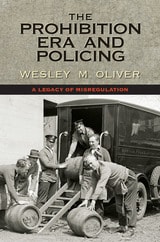
The Prohibition Era and Policing
A Legacy of MisregulationWesley M. Oliver
Vanderbilt University Press, 2018
Legal precedents created during Prohibition have lingered, leaving search-and-seizure law much better defined than limits on police use of force, interrogation practices, or eyewitness identification protocols. An unlawful trunk search is thus guarded against more thoroughly than an unnecessary shooting or a wrongful conviction.
Intrusive searches for alcohol during Prohibition destroyed middle-class Americans' faith in police and ushered in a new basis for controlling police conduct. State courts in the 1920s began to exclude perfectly reliable evidence obtained in an illegal search. Then, as Prohibition drew to a close, a presidential commission awakened the public to torture in interrogation rooms, prompting courts to exclude coerced confessions irrespective of whether the technique had produced a reliable statement.
Prohibition's scheme lingered long past the Roaring '20s. Racial tensions and police brutality were bigger concerns in the 1960s than illegal searches, yet when the Supreme Court imposed limits on officers' conduct in 1961, searches alone were regulated. Interrogation law during the 1960s, fundamentally reshaped by the Miranda ruling, ensured that suspects who invoked their rights would not be subject to coercive tactics, but did nothing to ensure reliable confessions by those who were questioned. Explicitly recognizing that its decisions excluding evidence had not been well-received, the Court in the 1970s refused to exclude identifications merely because they were made in suggestive lineups. Perhaps a larger project awaits—refocusing our rules of criminal procedure on those concerns from which Prohibition distracted us: conviction accuracy and the use of force by police.
[more]