Results by title
5 books match the query 'Literary Modernism'

Eardrums
Literary Modernism as Sonic WarfareTyler Whitney
Northwestern University Press, 2019
In this innovative study, Tyler Whitney demonstrates how a transformation and militarization of the civilian soundscape in the late nineteenth and early twentieth centuries left indelible traces on the literature that defined the period. Both formally and thematically, the modernist aesthetics of Franz Kafka, Robert Musil, Detlev von Liliencron, and Peter Altenberg drew on this blurring of martial and civilian soundscapes in traumatic and performative repetitions of war. At the same time, Richard Huelsenbeck assaulted audiences in Zurich with his “sound poems,” which combined references to World War I, colonialism, and violent encounters in urban spaces with nonsensical utterances and linguistic detritus—all accompanied by the relentless beating of a drum on the stage of the Cabaret Voltaire.
Eardrums is the first book-length study to explore the relationship between acoustical modernity and German modernism, charting a literary and cultural history written in and around the eardrum. The result is not only a new way of understanding the sonic impulses behind key literary texts from the period. It also outlines an entirely new approach to the study of literature as as the interaction of text and sonic practice, voice and noise, which will be of interest to scholars across literary studies, media theory, sound studies, and the history of science.
Eardrums is the first book-length study to explore the relationship between acoustical modernity and German modernism, charting a literary and cultural history written in and around the eardrum. The result is not only a new way of understanding the sonic impulses behind key literary texts from the period. It also outlines an entirely new approach to the study of literature as as the interaction of text and sonic practice, voice and noise, which will be of interest to scholars across literary studies, media theory, sound studies, and the history of science.
[more]
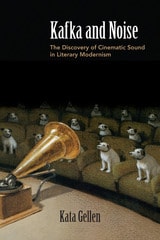
Kafka and Noise
The Discovery of Cinematic Sound in Literary ModernismKata Gellen
Northwestern University Press, 2019
A series of disruptive, unnerving sounds haunts the fictional writings of Franz Kafka. These include the painful squeak in Gregor Samsa's voice, the indeterminate whistling of Josefine the singer, the relentless noise in "The Burrow," and telephonic disturbances in The Castle. In Kafka and Noise, Kata Gellen applies concepts and vocabulary from film theory to Kafka's works in order to account for these unsettling sounds. Rather than try to decode these noises, Gellen explores the complex role they play in Kafka's larger project.
Kafka and Noise offers a method for pursuing intermedial research in the humanities—namely, via the productive "misapplication" of theoretical tools, which exposes the contours, conditions, and expressive possibilities of the media in question. This book will be of interest to scholars of modernism, literature, cinema, and sound, as well as to anyone wishing to explore how artistic and technological media shape our experience of the world and the possibilities for representing it.
Kafka and Noise offers a method for pursuing intermedial research in the humanities—namely, via the productive "misapplication" of theoretical tools, which exposes the contours, conditions, and expressive possibilities of the media in question. This book will be of interest to scholars of modernism, literature, cinema, and sound, as well as to anyone wishing to explore how artistic and technological media shape our experience of the world and the possibilities for representing it.
[more]
Literary Modernism and the Transformation of the Work
James F. Knapp
Northwestern University Press, 1988
Literary Modernism and the Transformation of Work probes the relationship between the aesthetic structures of modernism and its political and philosophical shape. James F. Knapp explores modernism's engagement with and reaction to the theories and discourse of scientific management that were reshaping the workplace in the early twentieth century, and in so doing, he traces "the ways in which a socially dominant discourse of knowledge is reproduced—and challenged—through a series of texts that range from the marginal to the most fully canonized."
[more]
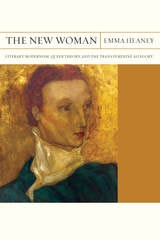
The New Woman
Literary Modernism, Queer Theory, and the Trans Feminine AllegoryEmma Heaney
Northwestern University Press, 2017
The New Woman: Literary Modernism, Queer Theory, and the Trans Feminine Allegory traces the use of the trans feminine as an allegorical figure, from the practice's origins in nineteenth-century sexology through writings in the fields of psychoanalysis, Modernist fiction, and contemporary Queer Theory.
The book is the first to identify the process by which medical sources simplified the diversity of trans feminine experience into a single diagnostic narrative. It then demonstrates that this medical figure became an archetype for the "sexual anarchy" of the Modernist period in works by Aldous Huxley, James Joyce, Djuna Barnes, T. S. Eliot, and Jean Genet.
Thus illuminating the trans feminine's Modernist provenance, the book examines foundational works of Queer Theory that resuscitated the trans feminine allegory at the end of the twentieth century. Insightful and seminal, The New Woman debunks the pervasive reflex beginning in the 1990s to connect trans experience to a late twentieth-century collapse of sexual differences by revealing the Modernist roots of that very formulation.
[more]

The Vanishing Subject
Early Psychology and Literary ModernismJudith Ryan
University of Chicago Press, 1991
Is thinking personal? Or should we not rather say, "it thinks," just as we say, "it rains"? In the late nineteenth century a number of psychologies emerged that began to divorce consciousness from the notion of a personal self. They asked whether subject and object are truly distinct, whether consciousness is unified or composed of disparate elements, what grounds exist for regarding today's "self" as continuous with yesterday's. If the American pragmatist William James declared himself, on balance, in favor of a "real and verifiable personal identity which we feel," his Austrian counterpart, the empiricist Ernst Mach, propounded the view that "the self is unsalvageable."
The Vanishing Subject is the first comprehensive study of the impact of these pre-Freudian debates on modernist literature. In lucid and engaging prose, Ryan traces a complex set of filiations between writers and thinkers over a sixty-year period and restores a lost element in the genesis and development of modernism. From writers who see the "self" as nothing more or less than a bundle of sensory impressions, Ryan moves to others who hesitate between empiricist and Freudian views of subjectivity and consciousness, and to those who wish to salvage the self from its apparent disintegration. Finally, she looks at a group of writers who abandon not only the dualisms of subject and object, but dualistic thinking altogether.
Literary impressionism, stream-of-consciousness and point-of-view narration, and the question of epiphany in literature acquire a new aspect when seen in the context of the "psychologies without the self." Rilke's development of a position akin to phenomenology, Henry and Alice James's relation to their psychologist brother, Kafka's place in the modernist movements, Joyce's rewriting of Pater, Proust's engagement with contemporary thought, Woolf's presentation of consciousness, and Musil's projection of a utopian counter-reality are problems familiar to readers and critics: The Vanishing Subject radically revises the way we see them.
[more]