Results by title
6 books match the query 'Literature and photography'
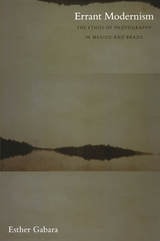
Errant Modernism
The Ethos of Photography in Mexico and BrazilEsther Gabara
Duke University Press, 2008
Gabara argues that Brazilian and Mexican modernists deliberately made photography err: they made this privileged medium of modern representation simultaneously wander and work against its apparent perfection. They flouted the conventions of mainstream modernism so that their aesthetics registered an ethical dimension. Their photographic modernism strayed, dragging along the baggage of modernity lived in a postcolonial site. Through their “errant modernism,” avant-garde writers and photographers critiqued the colonial history of Latin America and its twentieth-century formations.
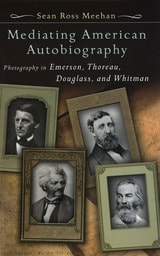
Mediating American Autobiography
Photography in Emerson, Thoreau, Douglass, and WhitmanSean Ross Meehan
University of Missouri Press, 2008
The emergence of photography in the mid-nineteenth century transformed ideas about how the self and nature could be pictured. Although the autobiographical potential of photography seems self-evident today, Sean Meehan takes us back to the birth of the medium when some of America’s preeminent authors began to think about photography’s implications for the representation of identity and the nature of autobiographical writing.
Both photography and autobiography involve a tension between disclosing and concealing their means of production: a chemical process for one, the writing process for the other. Meehan examines how four major authors—Ralph Waldo Emerson, Henry David Thoreau, Frederick Douglass, and Walt Whitman—were well aware of this tension and explored it in their work. By examining the implications of early photography in their writings, he shows how each engaged the new visual medium, how photography mediated their conceptions of self-representation, and how their appropriation of photographic thinking created a new kind of autobiography.
Examining the metonymic nature of photography, Meehan explores how the new medium influenced conceptions of visual and verbal representation. He intertwines these four writers’ reflections on photography—in Emerson’s Representative Men, Thoreau’s journals, Douglass’s narratives of slavery, and Whitman’s Specimen Days—with theories of photography as expounded by its inventors and observers, from Louis Daguerre and William Talbot in Europe to Oliver Wendell Holmes and Marcus Root in America.
As the first book to focus on the emergence of this new visual medium during the American Renaissance, Mediating American Autobiography shows us what photography means for American literature in general and for the genre most closely linked to it in particular. Because the engagement of these writers with photography has been neglected in previous scholarship, Meehan’s work provocatively bridges the study of two media and illuminates an important aspect of American thought and culture at the dawn of the technological era.
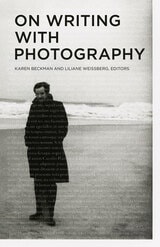
On Writing with Photography
Karen Beckman
University of Minnesota Press, 2013
From James Agee to W. G. Sebald, there has been an explosion of modern documentary narratives and fiction combining text and photography in complex and fascinating ways. However, these contemporary experiments are part of a tradition that stretches back to the early years of photography. Writers have been integrating photographs into their work for as long as photographs have existed, producing rich, multilayered creations; and photographers have always made images that incorporate, respond to, or function as writing. On Writing with Photography explores what happens to texts—and images—when they are brought together.
From the mid-nineteenth century to the present, this collection addresses a wide range of genres and media, including graphic novels, children’s books, photo-essays, films, diaries, newspapers, and art installations. Examining the works of Herman Melville, Don DeLillo, Claude McKay, Man Ray, Dare Wright, Guy Debord, Zhang Ailing, and Roland Barthes, among others, the essays trace the relationship between photographs and “reality” and describe the imaginary worlds constructed by both, discussing how this production can turn into testimony of personal and collective history, memory and trauma, gender and sexuality, and ethnicity.
Together, these essays help explain how writers and photographers—past and present—have served as powerful creative resources for each other.
Contributors: Stuart Burrows, Brown U; Roderick Coover, Temple U; Adrian Daub, Stanford U; Marcy J. Dinius, DePaul U; Marianne Hirsch, Columbia U; Daniel H. Magilow, U of Tennessee, Knoxville; Janine Mileaf; Tyrus Miller, U of California, Santa Cruz; Leah Rosenberg, U of Florida; Xiaojue Wang, U of Pennsylvania.
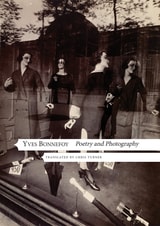
Poetry and Photography
Yves Bonnefoy
Seagull Books, 2017
Bonnefoy's compact essay focuses on one of the disturbing effects of the earliest photographs: their introduction of a notion of non-being—if not, indeed, nothingness—into the world of images. But it also foregrounds a tale which seems to have picked up figuratively on this effect and examined its dangers with a sense of horror: Guy de Maupassant’s extraordinary short story “The Night,” one of the nightmarish works of his last period of conscious creation.
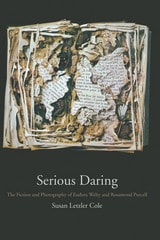
Serious Daring
The Fiction and Photography of Eudora Welty and Rosamond PurcellSusan Letzler Cole
University of Arkansas Press, 2016
Serious Daring is the story of the complementary journeys of two American women artists, celebrated fiction writer Eudora Welty and internationally acclaimed photographer Rosamond Purcell, each of whom initially practiced, but then turned from, the art form ultimately pursued by the other.
For both Welty and Purcell, the art realized is full of the art seemingly abandoned. Welty’s short stories and novels use images of photographs, photographers, and photography. Purcell photographed books, texts, and writing.
Both women make compelling art out of the seeming tension between literary and visual cultures. Purcell wrote a memoir in which photographs became endnotes. Welty re-emerged as a photographer through the publication of four volumes of what she called her “snapshots,” magnificent black-and-white photographs of small-town Mississippi and New York City life.
Serious Daring is a fascinating look at how the road not taken can stubbornly accompany the chosen path, how what is seemingly left behind can become a haunting and vital presence in life and art.
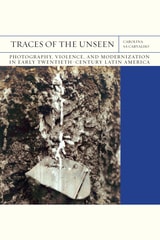
Traces of the Unseen
Photography, Violence, and Modernization in Early Twentieth-Century Latin AmericaCarolina Sá Carvalho
Northwestern University Press, 2023
Winner of the 2024 Roberto Reis Book Award
Winner of the LASA Environment Section Best Book of 2023
Winner of the LASA Amazonian Studies Section Best Book of 2024
Co-Winner of the LASA Book Award for the Visual Culture Studies 2024
A richly illustrated examination of photography as a technology for documenting, creating, and understanding the processes of modernization in turn-of-the-century Brazil and the Amazon
Photography at the turn of the twentieth century was not only a product of modernity but also an increasingly available medium to chronicle the processes of modernization. Traces of the Unseen: Photography, Violence, and Modernization in Early Twentieth-Century Latin America situates photography’s role in documenting the destruction wrought by infrastructure development and extractive capitalist expansion in the Amazon and outside the Brazilian metropole. Combining formal analysis of individual photographs with their inclusion in larger multimedia assemblages, Carolina Sá Carvalho explores how this visual evidence of violence was framed, captioned, cropped, and circulated. As she explains, this photographic creation and circulation generated a pedagogy of the gaze with which increasingly connected urban audiences were taught what and how to see: viewers learned to interpret the traces of violence captured in these images within the larger context of modernization.
Traces of the Unseen draws on works by Flavio de Barros, Euclides da Cunha, Roger Casement, Claude Lévi-Strauss, and Mario de Andrade to situate an unruly photographic body at the center of modernity, in all its disputed meanings. Moreover, Sá Carvalho locates historically specific practices of seeing within the geopolitical peripheries of capitalism. What emerges is a consideration of photography as a technology through which modern aspirations, moral inclinations, imagined futures, and lost pasts were represented, critiqued, and mourned.