Results by title

7 books match the query 'Literature and revolutions'
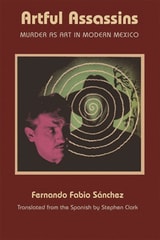
cover of Artful Assassins: Murder as Art in Modern Mexico

Artful Assassins

Murder as Art in Modern Mexico

Fernando Fabio Sanchez

Vanderbilt University Press, 2010

Violence as a way of life, and murder as a political tool. This philosophy is nothing new to Mexico, most recently demonstrated in the wave of assassination and indiscriminate killing brought on by the drug war gripping the country. In Artful Assassins, author and scholar Fernando Fabio Sanchez unveils the long record of violence inspiring artistic expression in Mexico, focusing on its use and portrayal in film and literature. Sanchez is uniquely positioned to explore this topic, through his work as a novelist and poet in Mexico before entering academia in the United States.


Sanchez argues that the seemingly hopeless cycle of violence experienced by Mexico in the 20th century, as reflected in its "crime genre," reveals a broader intrinsic cultural and political failure that suggests grave implications for the current state of crisis. Tracing the development of a national Mexican identity from the 1910 Mexican Revolution onward, Sanchez focuses on the indelible presence of violence and crime underlying the major works that contributed to a larger communal narrative.


Artful Assassins ultimately offers a panoramic overview of the evolution of Mexican arts and letters, as well as nationalism, by claiming murder and assassination as literary and cinematic motifs. The collapse of post-revolutionary political unity was presaged all along in Mexican culture, Sanchez argues. It need only to have been sought in the art of the nation.
[more]
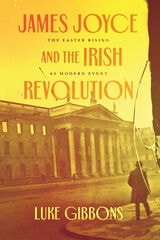
cover of James Joyce and the Irish Revolution: The Easter Rising as Modern Event

James Joyce and the Irish Revolution

The Easter Rising as Modern Event

Luke Gibbons

University of Chicago Press, 2023

A provocative history of Ulysses and the Easter Rising as harbingers of decolonization.
 
When revolutionaries seized Dublin during the 1916 Easter Rising, they looked back to unrequited pasts to point the way toward radical futures—transforming the Celtic Twilight into the electric light of modern Dublin in James Joyce’s Ulysses. For Luke Gibbons, the short-lived rebellion converted the Irish renaissance into the beginning of a global decolonial movement. James Joyce and the Irish Revolution maps connections between modernists and radicals, tracing not only Joyce’s projection of Ireland onto the world stage, but also how revolutionary leaders like Ernie O’Malley turned to Ulysses to make sense of their shattered worlds. Coinciding with the centenary of both Ulysses and Irish independence, this book challenges received narratives about the rebellion and the novel that left Ireland changed, changed utterly.
[more]
cover of Literature and Politics in the Central American Revolutions

Literature and Politics in the Central American Revolutions

By John Beverley and Marc Zimmerman

University of Texas Press, 1990

“This book began in what seemed like a counterfactual intuition . . . that what had been happening in Nicaraguan poetry was essential to the victory of the Nicaraguan Revolution,” write John Beverley and Marc Zimmerman. “In our own postmodern North American culture, we are long past thinking of literature as mattering much at all in the ‘real’ world, so how could this be?” This study sets out to answer that question by showing how literature has been an agent of the revolutionary process in Nicaragua, El Salvador, and Guatemala.

The book begins by discussing theory about the relationship between literature, ideology, and politics, and charts the development of a regional system of political poetry beginning in the late nineteenth century and culminating in late twentieth-century writers. In this context, Ernesto Cardenal of Nicaragua, Roque Dalton of El Salvador, and Otto René Castillo of Guatemala are among the poets who receive detailed attention.
[more]
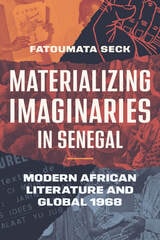
cover of Materializing Imaginaries in Senegal: Modern African Literature and Global 1968

Materializing Imaginaries in Senegal

Modern African Literature and Global 1968

Fatoumata Seck

Duke University Press, 2026
In Materializing Imaginaries in Senegal, Fatoumata Seck shows how cultural revolutionary projects in Senegal and beyond in the 1960s shaped African literature, cinema, and intellectual thought throughout the latter half of the twentieth century. She charts an intellectual and literary history that positions Global 1968 as a defining moment in modern African literature, analyzing the literature of this period through the prism of creative dissidence, revolutionary fervor, and cultural experimentation. Seck examines the role of African students and intellectuals in forging a decolonizing aesthetics underpinned by the Pan-African and internationalist solidarities of the 1960s. She traces the presence of these revolutionary projects in African letters, illuminating how revolutionary imaginaries sediment and remain as latent possibilities, while also reframing the emergence and reception of works by figures such as Léopold Sédar Senghor, Cheikh Anta Diop, David Mandessi Diop, Aminata Sow Fall, Ousmane Sembène, Awa Thiam, Djibril Diop Mambéty, Ken Bugul, Boubacar Boris Diop, and others. In so doing, Seck demonstrates that unfulfilled revolutions do not prevent the materialization of revolutionary imaginaries.
[more]
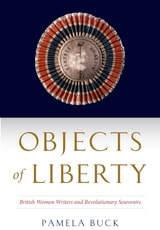
cover of Objects of Liberty: British Women Writers and Revolutionary Souvenirs

Objects of Liberty

British Women Writers and Revolutionary Souvenirs

Pamela Buck

University of Delaware Press, 2024
Objects of Liberty explores the prevalence of souvenirs in British women’s writing during the French Revolution and Napoleonic era. It argues that women writers employed the material and memorial object of the souvenir to circulate revolutionary ideas and engage in the masculine realm of political debate. While souvenir collecting was a standard practice of privileged men on the eighteenth-century Grand Tour, women began to partake in this endeavor as political events in France heightened interest in travel to the Continent. Looking at travel accounts by Helen Maria Williams, Mary Wollstonecraft, Catherine and Martha Wilmot, Charlotte Eaton, and Mary Shelley, this study reveals how they used souvenirs to affect political thought in Britain and contribute to conversations about individual and national identity. At a time when gendered beliefs precluded women from full citizenship, they used souvenirs to redefine themselves as legitimate political actors. Objects of Liberty is a story about the ways that women established political power and agency through material culture.


[more]
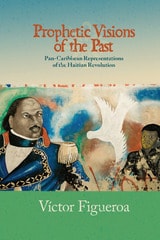
cover of Prophetic Visions of the Past: Pan-Caribbean Representations of the Haitian Revolution

Prophetic Visions of the Past

Pan-Caribbean Representations of the Haitian Revolution

Víctor Figueroa

The Ohio State University Press, 2015

In Prophetic Visions of the Past: Pan-Caribbean Representations of the Haitian Revolution, Víctor Figueroa examines how the Haitian Revolution has been represented in twentieth-century literary works from across the Caribbean. Building on the scholarship of key thinkers of the Latin American “decolonial turn” such as Enrique Dussel, Aníbal Quijano, Walter Mignolo, and Nelson Maldonado-Torres, Figueroa argues that examining how Haiti’s neighbors tell the story of the Revolution illuminates its role as a fundamental turning point in both the development and radical questioning of the modern/colonial world system.
 
Prophetic Visions of the Past includes chapters on literary texts from a wide array of languages, histories, and perspectives. Figueroa addresses work by Alejo Carpentier (Cuba), C. L. R. James (Trinidad), Luis Palés Matos (Puerto Rico), Aimé Césaire (Martinique), Derek Walcott (Saint Lucia), Edouard Glissant (Martinique), and Manuel Zapata Olivella (Colombia). While underscoring each writer’s unique position, Figueroa also addresses their shared geographical, historical, and sociopolitical preoccupations, which are closely linked to the region’s prolonged experience of colonial interventions. Ultimately, these analyses probe how, for the larger Caribbean region, the Haitian Revolution continues to reflect the tension between inspiring revolutionary hopes and an awareness of ongoing colonial objectification and exploitation.

 
[more]
cover of The Frankenstein of 1790 and Other Lost Chapters from Revolutionary France

The Frankenstein of 1790 and Other Lost Chapters from Revolutionary France

Julia V. Douthwaite

University of Chicago Press, 2012

The French Revolution brings to mind violent mobs, the guillotine, and Madame Defarge, but it was also a publishing revolution: more than 1,200 novels were published between 1789 and 1804, when Napoleon declared the Revolution at an end. In this book, Julia V. Douthwaite explores how the works within this enormous corpus announced the new shapes of literature to come and reveals that vestiges of these stories can be found in novels by the likes of Mary Shelley, E. T. A. Hoffmann, Honoré de Balzac, Charles Dickens, Gustave Flaubert, and L. Frank Baum.
 
Deploying political history, archival research, and textual analysis with eye-opening results, Douthwaite focuses on five major events between 1789 and 1794—first in newspapers, then in fiction—and shows how the symbolic stories generated by Louis XVI, Robespierre, the market women who stormed Versailles, and others were transformed into new tales with ongoing appeal. She uncovers a 1790 story of an automaton-builder named Frankénsteïn, links Baum to the suffrage campaign going back to 1789, and discovers a royalist anthem’s power to undo Balzac’s Père Goriot. Bringing to light the missing links between the ancien régime and modernity, The Frankenstein of 1790 and Other Lost Chapters from Revolutionary France is an ambitious account of a remarkable politico-literary moment and its aftermath.
[more]