Results by title
4 books match the query 'Little Faith'
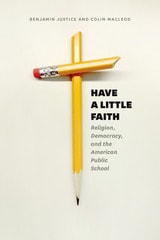
Have a Little Faith
Religion, Democracy, and the American Public SchoolBenjamin Justice and Colin Macleod
University of Chicago Press, 2016
From Bible readings and school prayer to teaching evolution and cultivating religious tolerance, Justice and Macleod consider the key issues and colorful characters that have shaped the way American schools have attempted to negotiate religious pluralism in a politically legitimate fashion. While schools and educational policies have not always advanced tolerance and understanding, Justice and Macleod point to the many efforts Americans have made to find a place for religion in public schools that both acknowledges the importance of faith to so many citizens and respects democratic ideals that insist upon a reasonable separation of church and state. Finally, they apply the lessons of history and political philosophy to an analysis of three critical areas of religious controversy in public education today: student-led religious observances in extracurricular activities, the tensions between freedom of expression and the need for inclusive environments, and the shift from democratic control of schools to loosely regulated charter and voucher programs.
Altogether Justice and Macleod show how the interpretation of educational history through the lens of contemporary democratic theory offers both a richer understanding of past disputes and new ways of addressing contemporary challenges.
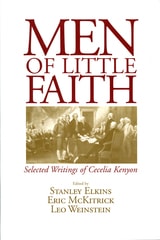
Men of Little Faith
Selected Writings of Cecelia KenyonStanley Elkins
University of Massachusetts Press, 2003
By bringing Kenyon's key writings together in a single volume, the editors have sought not only to reaffirm the importance of her contributions to scholarship but also to reveal the subtlety and imagination of her mind at work. Whether assessing the limitations of Charles Beard's "An Economic Interpretation of the Constitution," analyzing the enigma of Alexander Hamilton (whom she memorably describes as "the Rousseau of the Right"), or evaluating what was truly radical about America's revolution, Kenyon's insights remain as fresh as they are shrewd.
As the editors point out in their foreword to the book, Kenyon had an extraordinary talent for opening up to scrutiny subjects whose significance had previously been overlooked. Although her originality may not have been fully appreciated at first, her writings had an undeniable impact on subsequent work in her field. Eminent scholars such as Bernard Bailyn, Gordon S. Wood, and John Pocock all drew on Kenyon's ideas in their own groundbreaking studies of the Revolutionary era, and today the pivotal importance of her essays is widely recognized by a new generation of historians.
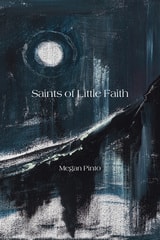
Saints of Little Faith
Megan Pinto
Four Way Books, 2024
The energies animating Saints of Little Faith, Megan Pinto’s electrifying debut in poetry, are a forceful quiet, a loud stillness, the caesura between a lightning strike and the sound of thunder. Everywhere, the speaker sees the numinous power of language, the incipience of things to come, even a kind of catastrophic grace in desolation and destruction — as if within the terrain of her own obsession, she recognizes the familiar, ever-changing seasons. Fierce and intimate, this poet’s meditative transformations engage with South Asian experiences of addiction, domestic violence, and mental illness, refusing to ignore narratives treated as unspeakable and overlooked by the English canon. Mapping the collision of abuse, psychosis, and rage, Pinto sees beyond them, buoyed by an inscrutable but abiding faith in the holiness of life itself, in a cold God nevertheless capable of gentleness. Once, “desire was an arrow, but now desire / is the field.” Pinto presides over this expanse, deciding, “I have three choices: to drift through life / anesthetized, to soften. . .” In that unspoken “or,” the merciful lacuna of that ellipsis, reside the lyrical mystery and medicine that feed this astonishing collection and strengthen resolve, both ours and the speaker’s: “The lake looks frozen, but it is not.”
Saints of Little Faith
Megan Pinto
Four Way Books, 2024
The energies animating Saints of Little Faith, Megan Pinto’s electrifying debut in poetry, are a forceful quiet, a loud stillness, the caesura between a lightning strike and the sound of thunder. Everywhere, the speaker sees the numinous power of language, the incipience of things to come, even a kind of catastrophic grace in desolation and destruction — as if within the terrain of her own obsession, she recognizes the familiar, ever-changing seasons. Fierce and intimate, this poet’s meditative transformations engage with South Asian experiences of addiction, domestic violence, and mental illness, refusing to ignore narratives treated as unspeakable and overlooked by the English canon. Mapping the collision of abuse, psychosis, and rage, Pinto sees beyond them, buoyed by an inscrutable but abiding faith in the holiness of life itself, in a cold God nevertheless capable of gentleness. Once, “desire was an arrow, but now desire / is the field.” Pinto presides over this expanse, deciding, “I have three choices: to drift through life / anesthetized, to soften. . .” In that unspoken “or,” the merciful lacuna of that ellipsis, reside the lyrical mystery and medicine that feed this astonishing collection and strengthen resolve, both ours and the speaker’s: “The lake looks frozen, but it is not.”