Results by title
23 books match the query 'Live'
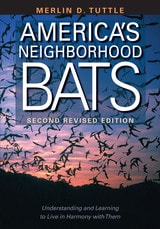
America's Neighborhood Bats
Understanding and Learning to Live in Harmony with ThemBy Merlin D. Tuttle
University of Texas Press, 2005
Since its first publication in 1988, America's Neighborhood Bats has changed the way we look at bats by underscoring their harmless and beneficial nature. In this second revised edition, Merlin Tuttle offers bat aficionados the most up-to-date bat facts, including a wealth of new information on bat house design and current threats to bat survival.
Connected
Or What It Means To Live In The Network SocietySteven Shaviro
University of Minnesota Press, 2003
Don't Forget to Live
Goethe and the Tradition of Spiritual ExercisesPierre Hadot
University of Chicago Press, 2023
With a foreword by Arnold I. Davidson and Daniele Lorenzini.
In his final book, renowned philosopher Pierre Hadot explores Goethe’s relationship with ancient spiritual exercises—transformative acts of intellect, imagination, or will. Goethe sought both an intense experience of the present moment as well as a kind of cosmic consciousness, both of which are rooted in ancient philosophical practices. These practices shaped Goethe’s audacious contrast to the traditional maxim memento mori (Don’t forget that you will die) with the aim of transforming our ordinary consciousness. Ultimately, Hadot reveals how Goethe cultivated a deep love for life that brings to the forefront a new maxim: Don’t forget to live.
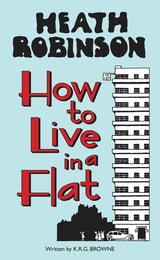
Heath Robinson
How to Live in a FlatW. Heath Robinson
Bodleian Library Publishing, 2015
How to Live in a Flat brings together a series of patently Robinsonesque space-saving solutions for city dwellers looking to make the most of modest square footage. Some of the solutions involve furniture made to serve multiple—and often opposing—purposes, like a combination bath-and-writing desk for businessmen. Others reimagine the workings of entire apartment complexes, including one cutaway explaining the use of the communal bath.
A side-splittingly funny collection from the man whose “absurd, beautiful drawings” H. G. Wells claimed “give me a peculiar pleasure of the mind like nothing else in the world,” this book make a perfect gift for anyone looking to have a laugh at our complicated and increasingly mechanical modern life.
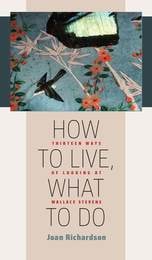
How to Live, What to Do
Thirteen Ways of Looking at Wallace StevensJoan Richardson
University of Iowa Press, 2018
How to Live, What to Do is an indispensable introduction to and guide through the work of a poet equal in power and sensibility to Shakespeare and Milton. Like them, Stevens shaped a new language, fashioning an instrument adequate to describing a completely changed environment of fact, extending perception through his poems to align what Emerson called our “axis of vision” with the universe as it came to be understood during his lifetime, 1879–1955, a span shared with Albert Einstein. Projecting his own imagination into spacetime as “a priest of the invisible,” persistently cultivating his cosmic consciousness through reading, keeping abreast of the latest discoveries of Einstein, Max Planck, Niels Bohr, Louis de Broglie, and others, Stevens pushed the boundaries of language into the exotic territories of relativity and quantum mechanics while at the same time honoring the continuing human need for belief in some larger order. His work records how to live, what to do in this strange new world of experience, seeing what was always seen but never seen before.
Joan Richardson, author of the standard two-volume critical biography of Stevens and coeditor with Frank Kermode of the Library of America edition of the Collected Poetry and Prose, offers concise, lucid captures of Stevens’s development and achievement. Over the ten years of researching her Stevens biography, Richardson read all that he read, as well as his complete correspondence, journals, and notebooks. She weaves the details drawn from this deep involvement into the background of American cultural history of the period. This fabric is further enlivened by her preparation in philosophy and the sciences, creating in these thirteen panels a contemporary version of a medieval tapestry sequence, with Stevens in the place of the unicorn, as it were, holding our attention and eliciting, as necessary angel, individual solutions to the riddles of our existence on this planet spinning and hissing around its cooling star at 18.5 miles per second.

How to Live
A memoir-in-essaysKelle Groom
Tupelo Press, 2023
—Joan Wickersham
I Live in the Country & other dirty poems
Arielle Greenberg
Four Way Books, 2020
Learning to Live with Crime
American Crime Narrative in the Neoconservative TurnChristopher P. Wilson
The Ohio State University Press, 2010
Since the mid-1960s, the war on crime has reshaped public attitudes about state authority, criminal behavior, and the responsibilities of citizenship. But how have American writers grappled with these changes? What happens when a journalist approaches the workings of organized crime not through its legendary Godfathers but through a workaday, low-level figure who informs on his mob? Why is it that interrogation scenes have become so central to prime-time police dramas of late? What is behind writers’ recent fascination with “cold case” homicides, with private security, or with prisons?
In Learning to Live with Crime, Christopher P. Wilson examines this war on crime and how it has made its way into cultural representation and public consciousness. Under the sway of neoconservative approaches to criminal justice and public safety, Americans have been urged to see crime as an inevitable risk of modern living and to accept ever more aggressive approaches to policing, private security, and punishment. The idea has been not simply to fight crime but to manage its risks; to inculcate personal vigilance in citizens; and to incorporate criminals’ knowledge through informants and intelligence gathering. At its most scandalous, this study suggests, contemporary law enforcement has even come to mimic crime’s own operations.
Learning to Live with the Past
Krishna Kumar
Seagull Books, 2023
How does education shape political rivalry and hostility? The Partition of the Indian subcontinent in 1947—the violence that followed it, and its living legacy of rival nationalisms—has made a deep and pervasive impact on education in both India and Pakistan. In Learning to Live with the Past, educationist Krishna Kumar dwells on the complex terrain every history teacher has to navigate: how to make the past come alive without running the risk of creating a desire to lose this “pastness.”
Substantiating this question with a wealth of experiences gained from his extensive research on history textbooks, as well as his interactions with students and teachers in both countries, Kumar explores the integral function the discipline of history plays in the project of nation-building. To help children learn to live with the past, Kumar amplifies the need for spaces that create possibilities for inquiries into a “longer” common heritage shared by South Asia without necessarily denying a national narrative or encouraging an urge to undo the past.
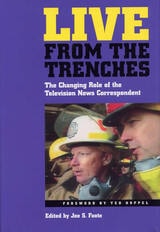
Live From the Trenches
The Changing Role of the Television News CorrespondentEdited by Joe S. Foote. Foreword by Ted Koppel
Southern Illinois University Press, 1998
From Edward R. Murrow to "Sixty Minutes" and CNN, the television news correspondent has become a fixture of American journalism in the latter half of the twentieth century. The correspondent's role has changed, however, as centralized control, changing technology, "infotainment," and profit margin have influenced the way that television networks operate and television news is reported.
In spite of the flood of literature dealing with the American television networks, the evening anchors, and prime-time personalities, little has been written about the "the foot soldier of network news." Live from the Trenches fills that gap, providing the first examination of television news correspondents and their work, with much of the analysis coming from the correspondents themselves.
The correspondents:
Jim Bittermann, a former ABC Paris correspondent, has been the CNN Paris correspondent since 1996. He received a National News Emmy for his coverage of the 1988 Sudan famine.
Chris Bury, correspondent for "Nightline" since 1993, has covered foreign and domestic stories from Waco to Whitewater.
Michael Murrie, after a dozen years in television news at KSDK in St. Louis, is an associate professor and director of the Telecommunications Master's Program for the Department of Radio-Television at Southern Illinois University at Carbondale.
Roger O'Neil, NBC News Denver bureau chief and correspondent since 1983, was the lead reporter for NBC during the Oklahoma City bombing trial of Timothy McVeigh.
Walter C. Rodgers, bureau chief and correspondent in Jerusalem, joined CNN in 1993 as the Berlin correspondent. Prior to joining CNN, he worked for ABC for twelve years.
Marlene Sanders broke barriers for women throughout her career and has won three Emmies. As a correspondent at ABC News in 1964, she was the first woman to anchor a prime-time network newscast.
George Strait is the primary ABC News correspondent for medical and health news. Among his many awards are the Alfred I. duPont Award and Gold Medal Award from the National Association of Black Journalists.
Ed Turner is CNN's first editor-at-large. Based in Washington, he represents the CNN News Group globally.
Garrick Utley joined CNN in 1997 after thirty years covering more than seventy countries for ABC.

Live and Be Well
A Celebration of Yiddish Culture in AmericaVicki Gold Levi
Rutgers University Press, 2000
Like a warm family album, this lively book heralds and documents the rich and vibrant traditions of Yiddish-speaking immigrants and their children in “the golden land,” from the first arrivals to the Second World War.
Meet the famous, the infamous, and the unknown—from hotelier Jenny Grossinger to mobster Jake “Greasy Thumb” Guzik to Moses Solomon, the would-be “Jewish Babe Ruth;” from anarchist Emma Goldman to entertainer Eddie Cantor.
Share the struggles and the triumphs of the labor unions, of Yiddish playwrights and poets. Enter the sweatshops of New York’s Lower East Side and the first Jewish settlements in Los Angeles and Chicago. Taste pastrami from Canter’s Deli in Los Angeles, knishes from Yonah Shimmel’s in New York City, and the famous “smookmit” of the Montreal ghetto.
Lavishly illustrated with photos, cartoons, theater posters, and song sheets, here is a book to delight and inform. It is a joyous celebration of life.
Live and Remember
Valentin Rasputin
Northwestern University Press, 1992

Live from Atlantic City
The Miss America Pageant Before, After, and In Spite of TelevisionA. R. Riverol
University of Wisconsin Press, 1992
A. R. Riverol takes the reader to times and places where no television camera has focused. Drawing upon (and sometimes debating with) primary and secondary sources, the author paints a vivid picture of life in Atlantic City during pageant week—whether that week be in 1944 or 1984. More than just chronicling events, the author also presents two opposing perspectives on the pageant: the pageant as celebration and idealization of American womanhood and the pageant as sexist, exploitative anachronism.
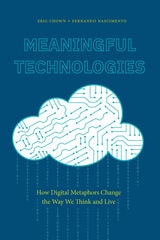
Meaningful Technologies
How Digital Metaphors Change the Way We Think and LiveEric Chown and Fernando Nascimento
Lever Press, 2022
As smartphones mediate more of our activities, they are changing our relationship with meaning. To a teenager, for example a “conversation” is just as likely to refer to an exchange of text messages as it is a face-to-face discussion. Meanwhile, Facebook has redefined what friendship means, Snapchat what a memory means, etc. The kinds of changes smartphones bring are happening at rapid pace: TikTok reached a billion users in just over three years, whereas it took the telephone 75 years to reach a tenth of that number of people. Meaningful Technologies: How Digital Metaphors Change the Way We Think and Live by Eric Chown and Fernando Nascimento offers systematic reconsideration of the ways in which digital technologies impact our lives both individually and collectively.
Metaphors aren’t just a clever way to describe technology, they are also changing the way we think. When we click on a picture of a shopping cart it connects a complex set of technologies to represent a simple idea that we’re all familiar with. A heart icon under a photo is understood as an easy way to express appreciation. We aren’t required to understand how technology works, just how we interact with it. The ambiguity of metaphors, and the complexity of technology can also hide important realities about what is being described. “The cloud,” for example, actually consists of very real data centers, which consume huge amounts of natural resources to keep running. Meanwhile, pressing that heart icon on a photo is a signal to the artificial intelligences running in your app that you want to see more things like that photo and that it should adjust what it knows about you accordingly.
There is a constant feedback loop between us and the digital technologies we use. We are constantly using them and they are changing us through their usage. Meaningful Technologies focuses on this loop from the perspectives of hermeneutic philosophy and cognitive science. Through the former, the authors examine meaning and how it changes over time. Through the latter, they gain understanding of how this feedback loop impacts individuals, especially in terms of learning and attention. Chown and Nascimento argue that, on the one hand, apps have a kind of agency never before possible in a technology, but also that, armed with a critical framework for examining such apps, we can regain some of our own agency. This book will appeal to scholars of digital media digital and computational studies, and those interested in issues related to ethical impacts of digital technologies.

News from Where I Live
PoemsMartin Lammon
University of Arkansas Press, 1998
Winner of the eighth annual Arkansas Poetry Award, Martin Lammon writes poems that deal fearlessly and directly with their subjects. Tenderness, complexity, compassion, reverence, and condemnation are all within his range.
Writing of love, he can speak broadly and universally of the heart, yet in the same poem, he can intricately describe a woman’s hand, a fire on a beach, or the hollows around a lover’s eye. Even when he works in the voice of a suicide, his precision can be devastating, as in these lines: “When you lie beside me under stars, each needlepoint / of light pricks my bare arms.”
With equal ease, Lammon travels across miles, cultures, and time, writing of kilns and potters in Japan, long-dead Eskimos in Alaska, or Blue Hole Cave in Pennsylvania.
Full of grace and candor, these poems pursue the stories that shimmer behind the day’s headlines, seeking the spirit at stake in the “lives beside [our] own whose secrets are worth loving.”
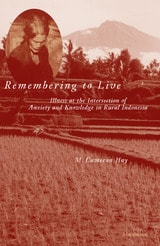
Remembering to Live
Illness at the Intersection of Anxiety and Knowledge in Rural IndonesiaM. Cameron Hay
University of Michigan Press, 2004
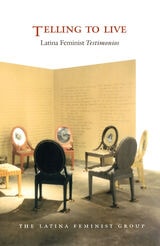
Telling to Live
Latina Feminist TestimoniosLatina Feminist Group
Duke University Press, 2001
The complex and rich tapestry of narratives that comprises this book introduces us to an intergenerational group of Latina women who negotiate their place in U.S. society at the cusp of the twenty-first century. These are the stories of women who struggled to reach the echelons of higher education, often against great odds, and constructed relationships of sustenance and creativity along the way. The stories, poetry, memoirs, and reflections of this diverse group of Puerto Rican, Chicana, Native American, Mexican, Cuban, Dominican, Sephardic, mixed-heritage, and Central American women provide new perspectives on feminist theorizing, perspectives located in the borderlands of Latino cultures.
This often heart wrenching, sometimes playful, yet always insightful collection will interest those who wish to understand the challenges U.S. society poses for women of complex cultural heritages who strive to carve out their own spaces in the ivory tower.
Contributors. Luz del Alba Acevedo, Norma Alarcón, Celia Alvarez, Ruth Behar, Rina Benmayor, Norma E. Cantú, Daisy Cocco De Filippis, Gloria Holguín Cuádraz, Liza Fiol-Matta, Yvette Flores-Ortiz, Inés Hernández-Avila, Aurora Levins Morales, Clara Lomas, Iris Ofelia López, Mirtha N. Quintanales, Eliana Rivero, Caridad Souza, Patricia Zavella
The Renewal of Generosity
Illness, Medicine, and How to LiveArthur W. Frank
University of Chicago Press, 2004
The Renewal of Generosity evokes medicine as the face-to-face encounter that comes before and after diagnostics, pharmaceuticals, and surgeries. Frank calls upon the Roman emperor Marcus Aurelius, philosopher Emmanuel Levinas, and literary critic Mikhail Bakhtin to reflect on stories of ill people, doctors, and nurses who transform demoralized medicine into caring relationships. He presents their stories as a source of consolation for both ill and professional alike and as an impetus to changing medical systems. Frank shows how generosity is being renewed through dialogue that is more than the exchange of information. Dialogue is an ethic and an ideal for people on both sides of the medical encounter who want to offer more to those they meet and who want their own lives enriched in the process.
The Renewal of Generosity views illness and medical work with grace and compassion, making an invaluable contribution to expanding our vision of suffering and healing.

The Spiritual Formation of Seminarians
Learning to Live in Intimate and Unceasing Union with GodJames Keating
Catholic University of America Press, 2025

The Weather and a Place to Live
Photographs of the Suburban WestSteven B. Smith
Duke University Press, 2005
The power of these photographs lies in part in Smith’s unusual knowledge of the places he portrays. Raised in Utah, Smith has worked on construction crews, and he was a contractor in California after living on the East Coast for a few years. When he moved to Los Angeles in 1991, he writes, “I was so astounded by what I saw happening to the landscape as it was being developed that I started photographing it immediately. The landscapes I saw were scraped bare, re-sculpted, sealed, and then covered so as not to erode away before the building process could be completed.”
Smith’s photographs offer a disturbing vision of the future of our planet, where the desire for home ownership is pitted against the costs of development in epic proportions. These altered landscapes force us to consider the consequences of human design battling natural forces across great expanses, a fragile balancing act and a contorted equation in which nature becomes both inspiration and invisible adversary. Smith’s elegant photographs of this constructed universe confront us with the beauty of images as images, yet push us to reflect on the devastation possible in the simple act of choosing a place to live.

To Live and Die in America
Class, Power, Health and HealthcareRobert Chernomas and Ian Hudson
Pluto Press, 2013
To Live and Die in America details how the United States has among the worst indicators of health in the industrialised world and at the same time spends significantly more on its health care system than any other industrial nation.
Robert Chernomas and Ian Hudson explain this contradictory phenomenon as the product of the unique brand of capitalism that has developed in the US. It is this particular form of capitalism that created both the social and economic conditions that largely influence health outcomes and the inefficient, unpopular and inaccessible health care system that is incapable of dealing with them.
The authors argue that improving health in America requires a change in the conditions in which people live and work as well as a restructured health care system.
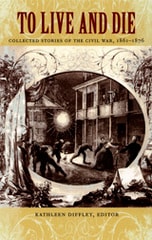
To Live and Die
Collected Stories of the Civil War, 1861–1876Kathleen Diffley, ed.
Duke University Press, 2002
The authors, who include Louisa May Alcott and Mark Twain, depict the horrors of the battlefield, the suffering in prison camps and field hospitals, and the privations of the home front. In these pages, bushwhackers carry the war to out-of-the-way homesteads, spies work households from the inside, journeying paymasters rely on the kindness of border women, and soldiers turn out to be girls. The stories are populated with nurses, officers, speculators, preachers, slaves, and black troops, and they take place in cities, along the frontier, and on battlefields from Shiloh to Gettysburg.
The book opens with a prewar vigilante attack on the Underground Railroad and a Kansas parson in Henry King’s “The Cabin at Pharoah’s Ford” and concludes with an ex-slave recalling the loss of her remaining son in Twain’s “A True Story.” In between are stories written by both women and men that were published in magazines from the South and West as well as the culturally dominant Northeast. Wartime wood engravings highlight the text. Kathleen Diffley’s introduction provides literary and historical background, and her commentary introduces readers to magazine authors as well as the deepening disruptions of a country at war.
Just as they did for nineteenth-century readers, these stories will bring the war home to contemporary readers, giving shape to a crisis that rocked the nation then and continues to haunt it now.
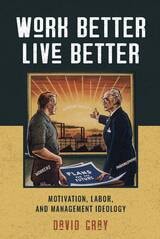
Work Better, Live Better
Motivation, Labor, and Management IdeologyDavid A. Gray
University of Massachusetts Press, 2020
In the United States, a strong work ethic has long been upheld as a necessity, and tributes to motivation abound—from the motivational posters that line the walls of the workplace to the self-help gurus who draw in millions of viewers online. Americans are repeatedly told they can achieve financial success and personal well-being by adopting a motivated attitude toward work. But where did this obsession come from? And whose interests does it serve?
Work Better, Live Better traces the rise of motivational rhetoric in the workplace across the expanse of two world wars, the Great Depression, and the Cold War. Beginning in the early twentieth century, managers recognized that force and coercion—the traditional tools of workplace discipline—inflamed industrial tensions, so they sought more subtle means of enlisting workers' cooperation. David Gray demonstrates how this “motivational project” became a highly orchestrated affair as managers and their allies deployed films, posters, and other media, and drew on the ideas of industrial psychologists and advertising specialists to advance their quests for power at the expense of worker and union interests.