Results by title
5 books match the query 'Livingstone, David N.'

Geographies of Nineteenth-Century Science
Edited by David N. Livingstone and Charles W. J. Withers
University of Chicago Press, 2011
In Geographies of Nineteenth-Century Science, David N. Livingstone and Charles W. J. Withers gather essays that deftly navigate the spaces of science in this significant period and reveal how each is embedded in wider systems of meaning, authority, and identity. Chapters from a distinguished range of contributors explore the places of creation, the paths of knowledge transmission and reception, and the import of exchange networks at various scales. Studies range from the inspection of the places of London science, which show how different scientific sites operated different moral and epistemic economies, to the scrutiny of the ways in which the museum space of the Smithsonian Institution and the expansive space of the American West produced science and framed geographical understanding. This volume makes clear that the science of this era varied in its constitution and reputation in relation to place and personnel, in its nature by virtue of its different epistemic practices, in its audiences, and in the ways in which it was put to work.
Geography and Enlightenment
Edited by David N. Livingstone and Charles W. J. Withers
University of Chicago Press, 1999
The first set of chapters charts the intellectual and geographical contexts in which Enlightenment ideas began to form, including both the sites in which knowledge was created and discussed and the different means used to investigate the globe. Detailed explorations of maps created during this period show how these new ways of representing the world and its peoples influenced conceptions of the nature and progress of human societies, while studies of the travels of people and ideas reveal the influence of far-flung places on Enlightenment science and scientific credibility. The final set of chapters emphasizes the role of particular local contexts in Enlightenment thought.
Contributors are Michael T. Bravo, Paul Carter, Denis Cosgrove, Stephen Daniels, Matthew Edney, Anne Marie Claire Godlewska, Peter Gould, Michael Heffernan, David N. Livingstone, Dorinda Outram, Chris Philo, Roy Porter, Nicolaas Rupke, Susanne Seymour, Charles Watkins, and Charles W. J. Withers.
Geography and Revolution
Edited by David N. Livingstone and Charles W. J. Withers
University of Chicago Press, 2005
David N. Livingstone and Charles W. J. Withers assemble a set of essays that are themselves revolutionary in uncovering not only the geography of revolutions but the role of geography in revolutions. Here, scientific revolutions—Copernican, Newtonian, and Darwinian—ordinarily thought of as placeless, are revealed to be rooted in specific sites and spaces. Technical revolutions—the advent of print, time-keeping, and photography—emerge as inventions that transformed the world's order without homogenizing it. Political revolutions—in France, England, Germany, and the United States—are notable for their debates on the nature of political institutions and national identity.
Gathering insight from geographers, historians, and historians of science, Geography and Revolution is an invitation to take the where as seriously as the who and the when in examining the nature, shape, and location of revolutions.
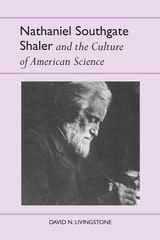
Nathaniel Southgate Shaler and the Culture of American Science
David N. Livingstone
University of Alabama Press, 1987
An influential American scientist and educator.
Nathaniel Southgate Shaler and the Culture of American Science is the first book-length study of the man who served a Harvard’s Professor of Geology and Paleontology during the Darwinian era. Shaler was a student of Louis Agassiz and went on to a successful, multifaceted career as a geologist, geographer, educator, humanist, and poet. Livingstone employs a thematic approach to chart Shaler’s career against the broader intellectual currents of America’s Gilded Age. After tracing Shaler’s life story from his boyhood in Kentucky through his student years at Harvard, his service with the Geological Survey, and eventually his years as Dean of Harvard’s Lawrence Scientific School, the author examines Shaler’s evolutionary vision and portrays his strategic efforts to reconcile the nineteenth century’s scientific and religious world views.
Livingstone assesses Shaler’s prolific writings, including those on race, which demonstrate a typical concern to provide a “scientific” perspective on the political questions of immigration restriction and eugenic control. IN addition, the book explores his efforts to interweave geography and history, particularly in relation to the American frontier; and his contributions to geology and geomorphology. The portrait of Shaler is completed with a review of his educational thinking and his role in establishing the American Summer School and in furthering scientific and technological education.
Nathaniel Southgate Shaler emerges from Livingstone’s work as a distinctive figure in the development of the new scientific culture, a figure who provides a focal point for assessing the impact of evolutionary naturalism on late-nineteenth-century American thought.

Putting Science in Its Place
Geographies of Scientific KnowledgeDavid N. Livingstone
University of Chicago Press, 2003
Putting Science in Its Place establishes the fundamental importance of geography in both the generation and the consumption of scientific knowledge, using historical examples of the many places where science has been practiced. Livingstone first turns his attention to some of the specific sites where science has been made—the laboratory, museum, and botanical garden, to name some of the more conventional locales, but also places like the coffeehouse and cathedral, ship's deck and asylum, even the human body itself. In each case, he reveals just how the space of inquiry has conditioned the investigations carried out there. He then describes how, on a regional scale, provincial cultures have shaped scientific endeavor and how, in turn, scientific practices have been instrumental in forming local identities. Widening his inquiry, Livingstone points gently to the fundamental instability of scientific meaning, based on case studies of how scientific theories have been received in different locales. Putting Science in Its Place powerfully concludes by examining the remarkable mobility of science and the seemingly effortless way it moves around the globe.
From the reception of Darwin in the land of the Maori to the giraffe that walked from Marseilles to Paris, Livingstone shows that place does matter, even in the world of science.