Results by title
3 books match the query 'Lloyd, David'
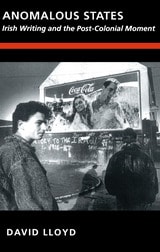
Anomalous States
Irish Writing and the Post-Colonial MomentDavid Lloyd
Duke University Press, 1993
Beginning with Heaney and Beckett, Lloyd shows how in these authors the question of identity connects with the dominance of conservative cultural nationalism and argues for the need to understand Irish culture in relation to the wider experience of colonized societies. A central essay reads Yeats's later works as a profound questioning of the founding of the state. Final essays examine the gradual formation of the state and nation as one element in a cultural process that involves conflict between popular cultural forms and emerging political economies of nationalism and the colonial state. Modern Ireland is thus seen as the product of a continuing process in which, Lloyd argues, the passage to national independence that defines Ireland's post-colonial status is no more than a moment in its continuing history.
Anomalous States makes an important contribution to the growing body of work that connects cultural theory with post-colonial historiography, literary analysis, and issues in contemporary politics. It will interest a wide readership in literary studies, cultural studies, anthropology, and history.
Rage, Shame and Dread
David Lloyd
Seagull Books, 2026
A radical rethinking of dark emotion as critical responses to capitalism, colonial violence, and authoritarian power.
Rage, Shame and Dread is a bold and unsettling exploration of three emotions that resist consolation, correction, or easy political use. In this triptych of essays, David Lloyd dwells with rage, shame, and dread not as states to be managed or redeemed, but as objectless, intransitive forces that interrupt social life and expose its underlying wrongness.
Reading rage as “sheer manifestation,” shame as a catastrophic rupture of self-relation, and dread as anticipation without an object, Lloyd traces how these unpromising emotions emerge from—and register—the violences of capitalism, colonialism, racialization, and authoritarian power. Drawing on Walter Benjamin, Sigmund Freud, Jacques Derrida, Frantz Fanon, Aimé Césaire, Joseph Conrad, Oscar Wilde, and Søren Kierkegaard, the book moves between philosophy, literature, and political theory to challenge therapeutic and liberal accounts that treat these feelings as errors to be corrected or tools for socialization.
Rather than pathologizing these states, Lloyd reads them as signals of damaged social relations and as thresholds to alternative forms of life-in-common. At once philosophically rigorous and politically urgent, Rage, Shame and Dread offers a radical rethinking of feeling as a site of critique, resistance, and collective possibility.
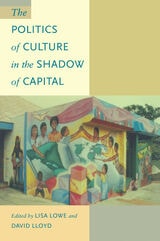
The Politics of Culture in the Shadow of Capital
Lisa Lowe and David Lloyd, eds.
Duke University Press, 1997
Reworking Marxist critique, these essays on Asia, Latin America, the Caribbean, North America, and Europe advance a new understanding of "cultural politics" within the context of transnational neocolonial capitalism. This perspective contributes to an overall critique of traditional approaches to modernity, development, and linear liberal narratives of culture, history, and democratic institutions. It also frames a set of alternative social practices that allows for connections to be made between feminist politics among immigrant women in Britain, women of color in the United States, and Muslim women in Iran, Egypt, Pakistan, and Canada; the work of subaltern studies in India, the Philippines, and Mexico; and antiracist social movements in North and South America, the Caribbean, and Europe. These connections displace modes of opposition traditionally defined in relation to the modern state and enable a rethinking of political practice in the era of global capitalism.
Contributors. Tani E. Barlow, Nandi Bhatia, Dipesh Chakrabarty, Chungmoo Choi, Clara Connolly, Angela Davis, Arturo Escobar, Grant Farred, Homa Hoodfar, Reynaldo C. Ileto, George Lipsitz, David Lloyd, Lisa Lowe, Martin F. Manalansan IV, Aihwa Ong, Pragna Patel, José Rabasa, Maria Josefina Saldaña-Portillo, Jaqueline Urla