Results by title

6 books match the query 'Logics'

cover of Aazheyaadizi: Worldview, Language, and the Logics of Decolonization

Aazheyaadizi

Worldview, Language, and the Logics of Decolonization

Mark D. Freeland

Michigan State University Press, 2020
Many of the English translations of Indigenous languages that we commonly use today have been handed down from colonial missionaries whose intent was to fundamentally alter or destroy prior Indigenous knowledge and praxis. In this text, author Mark D. Freeland develops a theory of worldview that provides an interrelated logical mooring to shed light on the issues around translating Indigenous languages in and out of colonial languages. In tandem with other linguistic and narrative methods, this theory of worldview can be employed to help root out the reproduction of colonial culture in Indigenous languages and can be a useful addition to the repertoire of tools needed to return to life-giving relationships with our environment. These issues of decolonization are highlighted in the trajectory of treaty language associated with relationships to land and their present-day importance. This book uses the 1836 Treaty of Washington and its contemporary manifestation in Great Lakes fishing rights and the State of Michigan’s 2007 Inland Consent Decree as a means of identifying the role of worldview in deciphering the logics embedded in Anishinaabe thought associated with these relationships to land. A fascinating study for students of Indigenous and linguistic disciplines, this book deftly demonstrates the significance of worldview theory in relation to the logics of decolonization of Indigenous thought and praxis.
[more]
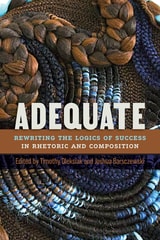
cover of Adequate: Rewriting the Logics of Success in Rhetoric and Composition

Adequate

Rewriting the Logics of Success in Rhetoric and Composition

Timothy Oleksiak

Utah State University Press, 2025

Adequate: Rewriting the Logics of Success in Rhetoric and Composition proposes a fresh approach to teaching rhetoric and composition—a field awash with unrealistic labor expectations and untenable and often unattainable requirements for both the educator and the educated—that takes “success” and “failure” out of the equation and advocates for the concept of adequacy over that of perfection.
 
Fourteen essays from established scholars, ranging from deeply personal, to darkly humorous, to impassioned and blunt, offer theoretical and pragmatic resources for responding to unjust labor extraction and the discipline’s demands that teachers do it all. Drawing on an array of intellectual traditions including labor studies, feminist rhetoric, disability studies, Jewish rhetoric, and theories of writing program administrations, authors assert the reasonable position of being enough and thriving outside of work in the face of growing demands for professional excellence and even perfection.
 
Adequate reimagines what the concept of adequacy holds for the future of academic work. An invaluable resource for scholars, graduate students, and advanced undergraduate students in the rhetoric and composition field, this volume covers the realities of teaching rhetoric and composition in the modern college environment, as well as potential paths forward for educators in need of a better work-life balance.
 
[more]
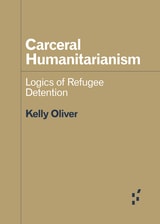
cover of Carceral Humanitarianism: Logics of Refugee Detention

Carceral Humanitarianism

Logics of Refugee Detention

Kelly Oliver

University of Minnesota Press, 2017

Coopted by military operations, humanitarianism has never been neutral. Rather than welcoming refugees, host countries assess the relative risks of taking them in versus turning them away, using a risk-benefit analysis that often reduces refugees to collateral damage in proxy wars fought in the war on terrorism. Carceral Humanitarianism testifies that humanitarian aid and human rights discourse are always political and partisan.

Forerunners is a thought-in-process series of breakthrough digital works. Written between fresh ideas and finished books, Forerunners draws on scholarly work initiated in notable blogs, social media, conference plenaries, journal articles, and the synergy of academic exchange. This is gray literature publishing: where intense thinking, change, and speculation take place in scholarship.
[more]
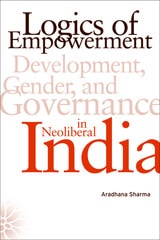
cover of Logics of Empowerment: Development, Gender, and Governance in Neoliberal India

Logics of Empowerment

Development, Gender, and Governance in Neoliberal India

Aradhana Sharma

University of Minnesota Press, 2008

A critical look at the globally dominant development strategy of “empowerment”

Celebratory news features about India’s thriving middle class tell only part of the story of the country’s recent economic rise, frequently glossing over the 300 million Indians who live on the margins and struggle to survive under economic liberalization. How do those cast out of their country’s successes perceive and respond to their position and mobilize against disempowerment?

In Logics of Empowerment, Aradhana Sharma takes up these questions, focusing on the work of an innovative women’s program called Mahila Samakhya that is part governmental and part nongovernmental and strives to empower those rural Indian women who have been pushed aside. She details the awkward ideological articulations and paradoxical outcomes of this unique activist-cum-government organizational structure and usage of empowerment. Bringing much-needed specificity to the study of neoliberalism, Logics of Empowerment fosters a deeper understanding of development and politics in contemporary India.
[more]
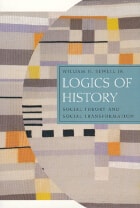
cover of Logics of History: Social Theory and Social Transformation

Logics of History

Social Theory and Social Transformation

William H. Sewell Jr.

University of Chicago Press, 2005

While social scientists and historians have been exchanging ideas for a long time, they have never developed a proper dialogue about social theory. William H. Sewell Jr. observes that on questions of theory the communication has been mostly one way: from social science to history. Logics of History argues that both history and the social sciences have something crucial to offer each other. While historians do not think of themselves as theorists, they know something social scientists do not: how to think about the temporalities of social life. On the other hand, while social scientists’ treatments of temporality are usually clumsy, their theoretical sophistication and penchant for structural accounts of social life could offer much to historians.

Renowned for his work at the crossroads of history, sociology, political science, and anthropology, Sewell argues that only by combining a more sophisticated understanding of historical time with a concern for larger theoretical questions can a satisfying social theory emerge. In Logics of History, he reveals the shape such an engagement could take, some of the topics it could illuminate, and how it might affect both sides of the disciplinary divide.
[more]
cover of Logics of Time and Computation

Logics of Time and Computation

Robert Goldblatt

CSLI, 1992

"This is a short but excellent introduction to modal, temporal, and dynamic logic....It manages to cover, in highly readable style, the basic completeness, decidability, and expressability results in a variety of logics of the three kinds considered." -Rohit Parikh, reviewing the first edition in the Journal of Symbolic Logic. Now revised and significantly expanded, this textbook introduces modal logic and examines the relevance of modal systems for theoretical computer science. Golblatt sets out a basic theory of normal modal and temporal propositional logics, including issues such as completeness proofs, decidability, first-order defiability, and canonicity. The basic theory is then applied to logics of discrete, dense, and continuous time; to the temporal logic of concurrent programs involving the connectives henceforth, next , anduntil; and to the dynamic logic of regular programs. New material for the second edition extends the temporal logic of concurrency to branching time, studying a system of Computational Tree Logic that formalizes reasoning about behavior. Dynamic logic is also extended to the case of concurrency, intorducing a connective for the parallel execution of commands. A seperate section is devoted to the quantificational dynamic logic. Numerous excercises are included for use in the classroom. Robert Goldblatt is a professor of pure mathematics at the Victoria University of Wellington, New Zealand. Center for the Study of Language and Information- Lecture Notes, Number 7
[more]