Results by title
5 books match the query 'Logos'
Essays on Gogol
Logos and the Russian WordSusanne Fusso and Priscilla Meyer
Northwestern University Press, 1994
These fourteen essays reflect the increasingly interdisciplinary character of Russian literature research in general and of the study of Gogol in particular, focusing on specific works, Gogol's own character, and the various approaches to aesthetic, religious, and philosophical issues raised by his writing.
[more]
Logos and Revelation
Ibn 'Arabi, Meister Eckhart, and Mystical HermeneuticsRobert J. Dobie
Catholic University of America Press, 2010
Logos and Revelation looks closely at the writings of two of the most prominent medieval mystical writers: the Muslim, Ibn 'Arabi (1165-1240) and the Christian Meister Eckhart (1260-1328).
[more]
Teacher of the Logos
Essays on Origen's Rediscovered Last WorkJoseph W. Trigg
Catholic University of America Press, 2025
In 2012 Marina Molin Pradel, an archivist at the Bavarian State Library discovered that CMG 314, a long-neglected Byzantine manuscript , contained twenty-nine homilies by Origen, the most important and most talented genius of early Christianity. He delivered these homilies around 259 CE, shortly before arrest and torture during the Decian persecution would put an end to his work. Thus, along with the Contra Celsum, Origen’s lengthy defense of Christianity, written after 248, when that persecution was clearly impending, they enable readers to appreciate Origen’s fully-developed thought.
Except for the four of these homilies that had been translated into Latin in the fifth century, scholars of Origen thought that all the homilies on the Psalms had been lost. In 2015 Lorenzo Perrone of the University of Bologna, an eminent Origen scholar, assisted by a team including Dr. Pradel, produced a magnificent critical edition of the text.
In 2017 the editors of this volume organized a colloquium in Washington, DC, generously hosted by the program in Early Christian Studies. The authors of this volume, a group of American and Canadian scholars, invited Professor Perrone to address the discovery of the homilies and his edition, and to join their discussion of their interpretation. This volume represents the group’s energetic investigations and discussion over the two days of the conference. The essays address Origen’s use of language, his philosophical interests, his relationship with Judaism, and his scholarly patrimony in the next century.
[more]
The Middle Included
Logos in AristotleAygün, Ömer
Northwestern University Press, 2016
The Middle Included is the first comprehensive account of the Ancient Greek word logos in Aristotelian philosophy. Logos means many things in the Aristotelian corpus: essential formula, proportion, reason, and language. Surveying these meanings in Aristotle’s logic, physics, and ethics, Ömer Aygün persuasively demonstrates that these divers meanings of logos all refer to a basic sense of “gathering” or “inclusiveness.” In this sense, logos functions as a counterpart to a formal version of the principles of non-contradiction and of the excluded middle in his corpus. Aygün thus shifts Aristotle’s traditional image from that of the father of formal logic, classificatory thinking, and exclusion to a more nuanced image of him as a thinker of inclusion.
The Middle Included also explores human language in Aristotelian philosophy. After an account of acoustic phenomena and animal communication, Aygün argues that human language for Aristotle is the ability to understand and relay both first-hand experiences and non-first-hand experiences. This definition is key to understanding many core human experiences such as science, history, news media, education, sophistry, and indeed philosophy itself. Logos is thus never associated with any other animal nor with anything divine—it remains strictly and rigorously secular, humane, and yet full of the wonder.
The Middle Included also explores human language in Aristotelian philosophy. After an account of acoustic phenomena and animal communication, Aygün argues that human language for Aristotle is the ability to understand and relay both first-hand experiences and non-first-hand experiences. This definition is key to understanding many core human experiences such as science, history, news media, education, sophistry, and indeed philosophy itself. Logos is thus never associated with any other animal nor with anything divine—it remains strictly and rigorously secular, humane, and yet full of the wonder.
[more]
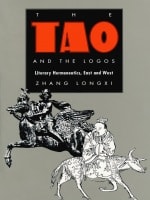
The Tao and the Logos
Literary Hermeneutics, East and WestLongxi Zhang
Duke University Press, 1992
Questions of the nature of understanding and interpretation—hermeneutics—are fundamental in human life, though historically Westerners have tended to consider these questions within a purely Western context. In this comparative study, Zhang Longxi investigates the metaphorical nature of poetic language, highlighting the central figures of reality and meaning in both Eastern and Western thought: the Tao and the Logos. The author develops a powerful cross-cultural and interdisciplinary hermeneutic analysis that relates individual works of literature not only to their respective cultures, but to a combined worldview where East meets West.
Zhang's book brings together philosophy and literature, theory and practical criticism, the Western and the non-Western in defining common ground on which East and West may come to a mutual understanding. He provides commentary on the rich traditions of poetry and poetics in ancient China; equally illuminating are Zhang's astute analyses of Western poets such as Rilke, Shakespeare, and Mallarmé and his critical engagement with the work of Foucault, Derrida, and de Man, among others.
Wide-ranging and learned, this definitive work in East-West comparative poetics and the hermeneutic tradition will be of interest to specialists in comparative literature, philosophy, literary theory, poetry and poetics, and Chinese literature and history.
[more]