Results by title

4 books match the query 'Lomnitz, Claudio'

cover of A Political Theology of Negative Sovereignty

A Political Theology of Negative Sovereignty

Claudio Lomnitz

Duke University Press, 2027

Claudio Lomnitz excavates the metaphysical foundations of violence in contemporary Mexico by exploring the theological imaginaries that emerge from the decay of state sovereignty and the rise of criminal syndicates. Accelerated economic and political changes have sparked deep changes in public morality, and Lomnitz identifies and defines “negative sovereignty” as the core phenomenon driving a deeply unsettling moral revolt. Negative sovereignty arises where the state has ceded or forfeited its authority to govern to illegal organizations that thrive on violence and extraction. Lomnitz explores the political theology that has emerged alongside this phenomenon, a moral cosmology in which Death, not God, is the metaphysical sovereign of choice. A Political Theology of Negative Sovereignty dissects the relationship between violence and public morality; in the process, Lomnitz challenges the theoretical assumptions underlying dominant views of contemporary governmentality.
[more]
cover of Deep Mexico, Silent Mexico: An Anthropology of Nationalism

Deep Mexico, Silent Mexico

An Anthropology of Nationalism

Claudio Lomnitz

University of Minnesota Press, 2001

In Mexico, as elsewhere, the national space, that network of places where the people interact with state institutions, is constantly changing. How it does so, how it develops, is a historical process-a process that Claudio Lomnitz exposes and investigates in this book, which develops a distinct view of the cultural politics of nation building in Mexico. Lomnitz highlights the varied, evolving, and often conflicting efforts that have been made by Mexicans over the past two centuries to imagine, organize, represent, and know their country, its relations with the wider world, and its internal differences and inequalities. Firmly based on particulars and committed to the specificity of such thinking, this book also has broad implications for how a theoretically informed history can and should be done.

An exploration of Mexican national space by way of an analysis of nationalism, the public sphere, and knowledge production, Deep Mexico, Silent Mexico brings an original perspective to the dynamics of national cultural production on the periphery. Its blending of theoretical innovation, historical inquiry, and critical engagement provides a new model for the writing of history and anthropology in contemporary Mexico and beyond.

Public Worlds Series, volume 9

 
[more]
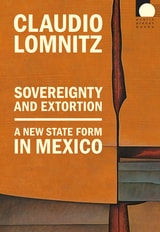
cover of Sovereignty and Extortion: A New State Form in Mexico

Sovereignty and Extortion

A New State Form in Mexico

Claudio Lomnitz

Duke University Press, 2024
Over the past fifteen years in Mexico, more than 450,000 people have been murdered and 110,000 more have been disappeared. In Sovereignty and Extortion, Claudio Lomnitz examines the Mexican state in relation to this extreme violence, uncovering a reality that challenges the familiar narratives of “a war on drugs” or a “failed state.” Tracing how neoliberal reforms, free trade agreements, and a burgeoning drug economy have shaped Mexico’s sociopolitical landscape, Lomnitz shows that the current crisis does not represent a tear in the social fabric. Rather, it reveals a fundamental shift in the relationship between the state and the economy in which traditional systems of policing, governance, and the rule of law have eroded. Lomnitz finds that power is now concentrated in the presidency and enforced through militarization, which has left the state estranged from itself and incapable of administering justice or regaining control over violence. Through this critical examination, Lomnitz offers a new theory of the state, its forms of sovereignty, and its shifting relation to capital and militarization.
[more]
cover of The Public Life of History, Volume 20

The Public Life of History, Volume 20

Bain Attwood, Dipesh Chakrabarty, and Claudio Lomnitz, eds.

Duke University Press, 0

This special issue of Public Culture explores the tension and the challenges raised by the interaction of history with the domains of public life, including politics, the law, and the media. It focuses specifically on situations where a social compact has been reshaped based on the revaluation of historical wounds such as those inflicted in South African apartheid and in the Holocaust. The politics of recognition has challenged historical research to serve public ends, invoking the past as the site of the original slight and calling for redress in the present.

Gathering scholars involved in prominent debates regarding the shifting expectations of the rule of history, this special issue is a sustained engagement with historical experience, public discussion, and historical truth in a variety of global sites. One article considers what happens to the ideal of truth telling when truth commissions attempt to authenticate a complex mix of history and memory that is not always historically verifiable. Another article asks if history can continue to play an adjudicatory role in contemporary democracies when matters relating to the past are disputed in public life, as they are in India where the claims of scientific history are pitted against the culture-based history of Hindus. Still another contributor delves into the concept of “stolen generations” to explore the way indigenous people in Australia have laid claims in the present based on a historical wound.

Contributors. Bain Attwood, Neeladri Bhattacharya, Dipesh Chakrabarty, George Chauncey, Miranda Johnson, Claudio Lomnitz, Deborah Posel

[more]