Results by title
3 books match the query 'Long Civil Rights Movement'
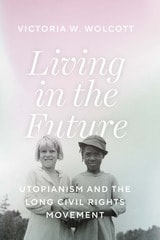
Living in the Future
Utopianism and the Long Civil Rights MovementVictoria W. Wolcott
University of Chicago Press, 2022
Utopian thinking is often dismissed as unrealistic, overly idealized, and flat-out impractical—in short, wholly divorced from the urgent conditions of daily life. This is perhaps especially true when the utopian ideal in question is reforming and repairing the United States’ bitter history of racial injustice. But as Victoria W. Wolcott provocatively argues, utopianism is actually the foundation of a rich and visionary worldview, one that specifically inspired the major figures of the Civil Rights Movement in ways that haven’t yet been fully understood or appreciated.
Wolcott makes clear that the idealism and pragmatism of the Civil Rights Movement were grounded in nothing less than an intensely utopian yearning. Key figures of the time, from Martin Luther King Jr. and Pauli Murray to Father Divine and Howard Thurman, all shared a belief in a radical pacificism that was both specifically utopian and deeply engaged in changing the current conditions of the existing world. Living in the Future recasts the various strains of mid-twentieth-century civil rights activism in a utopian light, revealing the power of dreaming in a profound and concrete fashion, one that can be emulated in other times that are desperate for change, like today.
Living in the Future
Utopianism and the Long Civil Rights MovementVictoria W. Wolcott
University of Chicago Press, 2022
This is an auto-narrated audiobook edition of this book.
Living in the Future reveals the unexplored impact of utopian thought on the major figures of the Civil Rights Movement.
Utopian thinking is often dismissed as unrealistic, overly idealized, and flat-out impractical—in short, wholly divorced from the urgent conditions of daily life. This is perhaps especially true when the utopian ideal in question is reforming and repairing the United States’ bitter history of racial injustice. But as Victoria W. Wolcott provocatively argues, utopianism is actually the foundation of a rich and visionary worldview, one that specifically inspired the major figures of the Civil Rights Movement in ways that haven’t yet been fully understood or appreciated.
Wolcott makes clear that the idealism and pragmatism of the Civil Rights Movement were grounded in nothing less than an intensely utopian yearning. Key figures of the time, from Martin Luther King Jr. and Pauli Murray to Father Divine and Howard Thurman, all shared a belief in a radical pacificism that was both specifically utopian and deeply engaged in changing the current conditions of the existing world. Living in the Future recasts the various strains of mid-twentieth-century civil rights activism in a utopian light, revealing the power of dreaming in a profound and concrete fashion, one that can be emulated in other times that are desperate for change, like today.
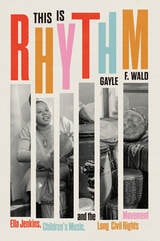
This Is Rhythm
Ella Jenkins, Children’s Music, and the Long Civil Rights MovementGayle F. Wald
University of Chicago Press, 2025
Ella Jenkins was one of the most influential musicians of the twentieth century. Her songs “You’ll Sing a Song and I’ll Sing a Song” and “Who Fed the Chickens?” are classics in the world of children’s music. In a career spanning more than sixty years, she recorded forty albums, won a lifetime-achievement Grammy, and became the best-selling individual artist in the history of Smithsonian Folkways Records, the independent label that played a significant role in the 1960s folk revival movement and introduced listeners to Woody Guthrie and Pete Seeger. During her remarkable career, Jenkins joined forces with twentieth-century luminaries such as Odetta, Big Bill Broonzy, Armando Peraza, Bayard Rustin, and Fred Rogers. Despite her wide-reaching influence on children’s music, Ella Jenkins’s sonic civil rights activism isn’t widely known today.
Based on dozens of interviews and access to Ella Jenkins’s personal archives, Gayle F. Wald’s This Is Rhythm shares how Jenkins, a “rhythm specialist” with no formal musical training, became the most prolific and significant American children’s musician of the twentieth century, creating a beloved catalog of songs grounded in values of community-building, antiracism, and cultural pluralism. Wald traces how the daughter of southern migrants translated the music of her own Black girlhood on the South Side of Chicago into a form of civil rights activism—a musical education that empowered children by introducing them to Black history, African diasporic rhythms, and a participatory, community-centered approach to music. Wald also discusses how, beginning in 1961, Jenkins built a life with a female partner who supported her materially and emotionally. Although Jenkins did not talk publicly about her sixty-three-year relationship, she opened up to Wald, offering insight into how a “private” Black woman in the public eye negotiated sexuality in an era before gay and lesbian liberation movements. Throughout her career, her innovative music found its way into thousands of community centers, classrooms, and concert venues, and her “call-and-response” method has influenced and empowered generations of children and adults.
A beautifully written tribute to Ella Jenkins’s legacy, this biography illustrates her impact on children’s music and expands our understanding of folk music’s relationship with social justice. Jenkins used music to build a new world in which children—and adults—are encouraged to listen to each other’s distinct rhythms.