Results by title
5 books match the query 'Long March'
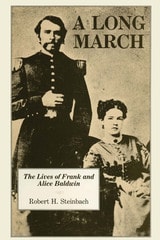
A Long March
The Lives of Frank and Alice BaldwinBy Robert H. Steinbach
University of Texas Press, 1990
During a distinguished military career, in which he rose to the rank of brigadier general and twice won the Medal of Honor, Frank Baldwin saw service in the Civil War, the Indian wars on the Great Plains, and the Spanish-American War. His wife, Alice Blackwood Baldwin, shared the "long march" with him, from his Plains service onward. In this first biography of the Baldwins, Robert Steinbach combines military and personal history to vividly portray a marriage that survived both the harshness of frontier army life and the restrictive Victorian concept of "separate spheres" for husband and wife.
Drawing on a wealth of diaries, letters, and other family papers, Steinbach re-creates the Baldwins' life on the Plains. Moving from post to post in Kansas, New Mexico, Montana, North Dakota, and Texas, they faced danger, excitement, separations, poverty, and many other hardships. Frequently they clashed over Alice's desire to be something more than "an ornament to society"—a wish eventually granted as Frank's long absences and chronic ill health required Allie to take responsibility for herself and their daughter.
With insights into military campaigns on the Great Plains in the years 1865–1890 and a revealing look at the human side of those campaigns, A Long March will appeal to a wide audience.
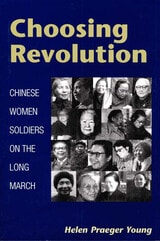
Choosing Revolution
Chinese Women Soldiers on the Long MarchHelen Praeger Young
University of Illinois Press, 2001
Enormously rich in detail, Young's Choosing Revolution reveals the complex interplay between women's experiences and the official, almost mythic version of the Long March. In addition to their riveting stories of the march itself, Young's subjects reveal much about what it meant in China to grow up female and, in many cases, poor during the first decades of the twentieth century. In speaking about the work they did and how they adapted to the demands of being a soldier, these women--both educated individuals who were well-known leaders and illiterate peasants--reveal the Long March as only one of many segments of the revolutionary paths they chose.
Against a background of diverse perspectives on the Long March, Young presents the experiences of four women in detail: one who brought her infant daughter with her on the Long March, one who gave birth during the march, one who was a child participant, and one who attended medical school during the march. Young also includes the stories of three women who did not finish the Long March. Her unique record of ordinary women in revolutionary circumstances reveals the tenacity and resilience that led these individuals far beyond the limits of most Chinese women's lives.

The Long March of Basic Trust
Chronicle of Emotions; Notebook 2Alexander Kluge
Seagull Books, 2025
A kaleidoscopic journey through history and the vast landscape of human emotion, The Long March of Basic Trust presents Alexander Kluge at his most expansive and incisive. Moving seamlessly across time and space, Kluge weaves a tapestry of lived and imagined experience, interrogating the forces that shape our resilience in the face of catastrophe. From the wreckage of World War II to the deep time of geology, his singular prose dissolves boundaries between the real and the speculative.
Blurring the lines between fiction and philosophy, Kluge builds an intricate world enriched by hybrid images and his latest experiment: the “virtual camera,” a cinematic eye that captures the interplay of memory and invention. Now in his tenth decade, Kluge continues his lifelong pursuit of uncovering the patterns that connect us and the basic trust that allows us to go on. Both intellectually provocative and deeply humane, this latest installment in his Chronicle of Emotions is a testament to his unmatched ability to fuse thought and feeling into an electrifying literary form.
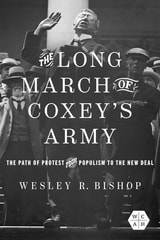
The Long March of Coxey’s Army
The Path of Protest from Populism to the New DealWesley R. Bishop
University of Illinois Press, 2027
Wesley R. Bishop explores how Coxey and his allies organized the first national protest to bring citizens to Washington, D.C. Though the march failed in its immediate goals, for the next forty years its ideas influenced America’s political parties. The demonstration pioneered marching for economic justice while its push for federal public works projects and government responsibility for unemployment helped shaped the New Deal. But in the years after the march, racism and other types of exclusion muddied hopes and tainted demands for democratic and economic fairness.
Eye-opening and insightful, The Long March of Coxey’s Army examines the influence and aftermath of an important historical event.
Thirty Years of Radical History
The Long March, Volume 2001Van Gosse, ed.
Duke University Press, 0
Recognizing the creative power of pluralism, the RHR editors have marshalled a diverse troop of historical scholars in this issue. In “Forum on Radical History,” sixteen historians discuss how the notion of radicalism has affected the way they write, teach, and live, and in "A Conversation about the Radical History Review," past and present members of the editorial board zero in on the journal itself and the political and academic context in which it was born. Offering a more personal perspective, Mike Wallace, Pulitzer Prize winner and radical history founder, shares his thoughts on RHR and the movement. Other articles in this special issue tackle the state of radicalism today, analyzing the academic labor movement, the significance of physical space in Pinochet’s reign of terror, and the enduring symbolism of a particular statue in Prague.
This retrospective issue celebrates the journal’s past, but it also reflects on the present and looks forward to a future in which radicalism will continue to shape the landscape of historical and political discourse.
Contributors. Tani E. Barlow, Dan Bender, Paul Buhle, Gabriela Cano, Anna Clark, Martin Duberman, Ellen Carol DuBois, Ian Christopher Fletcher, Rob Gregg, Harry D. Harootunian, Winston James, Nikki R. Keddie, Dave Kinkela, Staughton Lynd, Teresa Meade, Joanne Pope Melish, Ellen Noonan, Enrique C. Ochoa, Gary Y. Okihiro, Cynthia Paces, Max Page, Vijay Prashad, David Price, David Roediger, Andor Skotnes, Mike Wallace