Results by title
3 books match the query 'Lothe, Jakob'
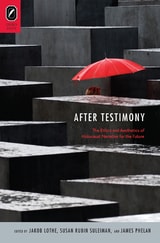
After Testimony
The Ethics and Aesthetics of Holocaust Narrative for the FutureEdited by Jakob Lothe, Susan Rubin Suleiman, and James Phelan
The Ohio State University Press, 2012
After Testimony: The Ethics and Aesthetics of Holocaust Narrative for the Future collects sixteen essays written with the awareness that we are on the verge of a historical shift in our relation to the Third Reich’s programmatic genocide. Soon there will be no living survivors of the Holocaust, and therefore people not directly connected to the event must assume the full responsibility for representing it. The contributors believe that this shift has broad consequences for narratives of the Holocaust. By virtue of being “after” the accounts of survivors, storytellers must find their own ways of coming to terms with the historical reality that those testimonies have tried to communicate. The ethical and aesthetic dimensions of these stories will be especially crucial to their effectiveness. Guided by these principles and employing the tools of contemporary narrative theory, the contributors analyze a wide range of Holocaust narratives—fictional and nonfictional, literary and filmic—for the dual purpose of offering fresh insights and identifying issues and strategies likely to be significant in the future. In addition to the editors, the contributors are Daphna Erdinast-Vulcan, Sidra DeKoven Ezrahi, Anniken Greve, Jeremy Hawthorn, Marianne Hirsch, Irene Kacandes, Phillipe Mesnard, J. Hillis Miller, Michael Rothberg, Beatrice Sandberg, Anette H. Storeide, Anne Thelle, and Janet Walker.
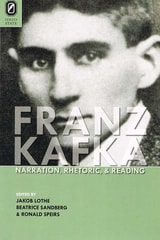
Franz Kafka
Narration, Rhetoric, and ReadingEdited by Jakob Lothe, Beatrice Sandberg, and Ronald Speirs
The Ohio State University Press, 2011
Franz Kafka: Narration, Rhetoric, and Reading presents essays by noted Kafka critics and by leading narratologists who explore Kafka’s original and innovative uses of narrative throughout his career. Collectively, these essays by Stanley Corngold, Anniken Greve, Gerhard Kurz, Jakob Lothe, J. Hillis Miller, Gerhard Neumann, James Phelan, Beatrice Sandberg, Ronald Speirs, and Benno Wagner examine a number of provocative questions that arise in narration and narratives in Kafka’s fiction. The arguments of the essays relate both to the peculiarities of Kafka’s story-telling and to general issues in narrative theory. They reflect, for example, the complexity of the issues surrounding the “somebody” doing the telling, the attitude of the narrator to what is told, the perceived purpose(s) of the telling, the implied or actual reader, the progression of events, and the progression of the telling. As the essays also demonstrate, Kafka’s narratives still present a considerable challenge to, as well as a great resource for, narrative theory and analysis.
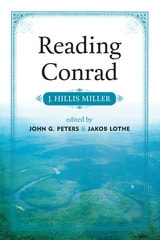
Reading Conrad
Edited by John G. Peters and Jakob Lothe
The Ohio State University Press, 2017
Reading Conrad by J. Hillis Miller demonstrates a surprising cohesiveness across Miller’s career as well as the richness of Conrad’s fiction, which affords varied opportunities for critical approaches as different as phenomenology, new criticism, deconstruction, narrative theory, and narrative ethics. Miller’s analyses emphasize literature’s rhetorical and performative power, ultimately suggesting that while narrative fiction is an effect of a series of complex phenomena in society and in the human psyche, as literary language it can also refer to the external world indirectly and contribute to the formation of history from within.